All species › Tubenoses › Petrels, shearwaters and diving petrels › Murphy's Petrel
Murphy's Petrel | Pterodroma ultima
Murphy-stormvogel | Petrel de Murphy
Murphy's Petrel is an entirely dark tubenose that was only recognised as a regular spring visitor off the California coast in the 1980s — decades after it was first described. It breeds on some of the most remote islands in the Pacific and, on its travels, covers some of the longest foraging ranges of any seabird on Earth.
Voice
At the breeding islands in the South Pacific, far outside the guide area, a short, hoarse bark and a long, moaning groan carry from the burrow at night. Off the American west coast, far out at sea, Murphy's Petrel is, like most of its relatives, entirely silent; anyone who encounters it here sees it gliding wordlessly over the swells.
Recording: Dr Jennifer Lavers — CC BY-NC-SA 4.0 · Henderson I., Pitcairn Group, UK, United Kingdom · xeno-canto
Identification
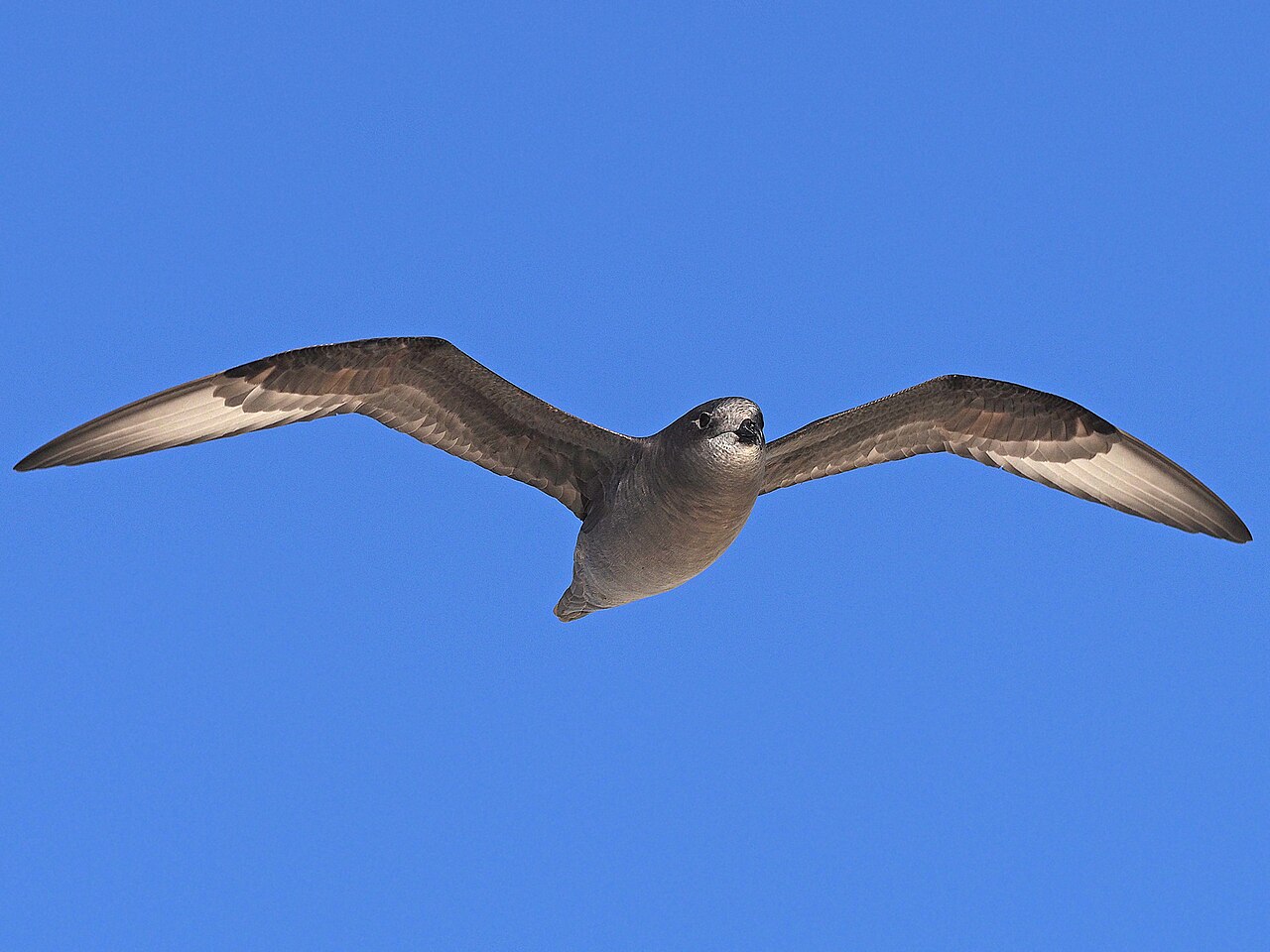
Murphy's Petrel is a medium-sized petrel, entirely sooty grey with no white markings at all, apart from a faint, paler chin. The bill is black and relatively heavy, the legs pinkish. Male, female and juvenile look alike. In flight it shows the high, tumbling banks typical of the genus Pterodroma, with long glides on wings held slightly back, faster and higher above the waves than most of the shearwaters it mixes with.
Confusion species
Of the other entirely dark seabirds off the California coast, Sooty Shearwater (Ardenna grisea) is by far the most numerous, but it flies on stiff wings low over the water, while Murphy's Petrel tumbles high above the swells in the manner typical of the genus Pterodroma. The much smaller Black Storm-Petrel (Hydrobates melania) can be confusing at a distance because of its equally dark colour, but it flutters low over the water with short, irregular wingbeats rather than the fast, high banking of Murphy's Petrel. From the rare dark Kermadec Petrel, which can also reach these waters, Murphy's Petrel is told by its faint pale chin and slightly smaller, slimmer build. At a distance, the uniform dark grey colour and the high, banking flight remain the best clue.
Habitat
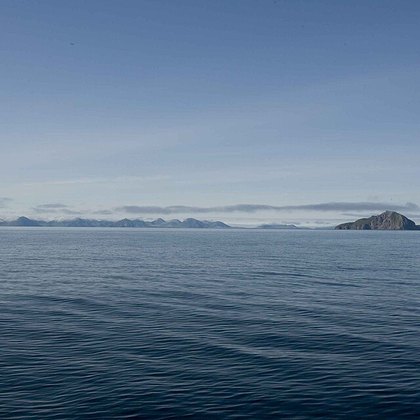
Within this area Murphy's Petrel is entirely a bird of open, far offshore water, usually well out of sight of land at the boundary between warm and cooler currents. It breeds on rocky islets and cliffs on the most remote island groups of the Pacific, far outside the guide area, where it uses a burrow or a crevice among the rocks. It never uses land within North America.
Where the bird is most often found, arranged by the USNVC — the vegetation classification of the United States and Canada — and CMECS for sea and coast.
Range and movements
Murphy's Petrel breeds only on islands in the eastern Polynesian island groups of the Tuamotus, Gambier, Australs, Pitcairn, Easter Island and Salas y Gómez. Only in the 1980s did it become clear that far off the California coast the species was not a rarity but a regular spring visitor: on one occasion in April 1989 nearly a hundred birds were counted, after which the species was removed from the state's rare bird review list. The best spots lie well offshore at Cordell Bank, off Point Conception and Point Arguello, and off Cape Mendocino, with a peak from mid-April to early June. Smaller numbers also reach the waters around Hawaii and the southern Gulf of Alaska.
Where and when to look
Join a pelagic boat trip well off the coast of central or northern California between mid-April and early June, for instance to Cordell Bank; look there, at the boundary of warm and cool water, for a uniformly dark grey petrel tumbling high above the swells, with only a faint pale chin as a colour contrast.
Conservation
Murphy's Petrel is listed as Least Concern (LC), though little is known of its world population, since most colonies lie on uninhabited islands rarely visited by people. Introduced rats and cats pose a risk to the colonies on some of those islands. The sharp rise in sightings off California since the 1980s is thought to reflect better recognition at sea rather than a real increase in the species.
Scientific name
Pterodroma ultima | Murphy, 1949
American ornithologist Robert Cushman Murphy described the species himself in 1949 as Pterodroma ultima; it was placed in its current genus from the start, so author and year do not stand in parentheses. The English name honours Murphy himself, who as 'the dean of American ornithology' did pioneering work on the seabirds of the Pacific. ultima is Latin for 'last' or 'furthest', probably referring to Oeno, the remote atoll in the Pitcairn group that supplied the type material — one of the most isolated islands in the entire Pacific. No type locality more precise than 'Oeno Island, south Pacific' has been recorded.