All species › Tubenoses › Petrels, shearwaters and diving petrels › Mottled Petrel
Mottled Petrel | Pterodroma inexpectata
Regenstormvogel | Petrel moteado
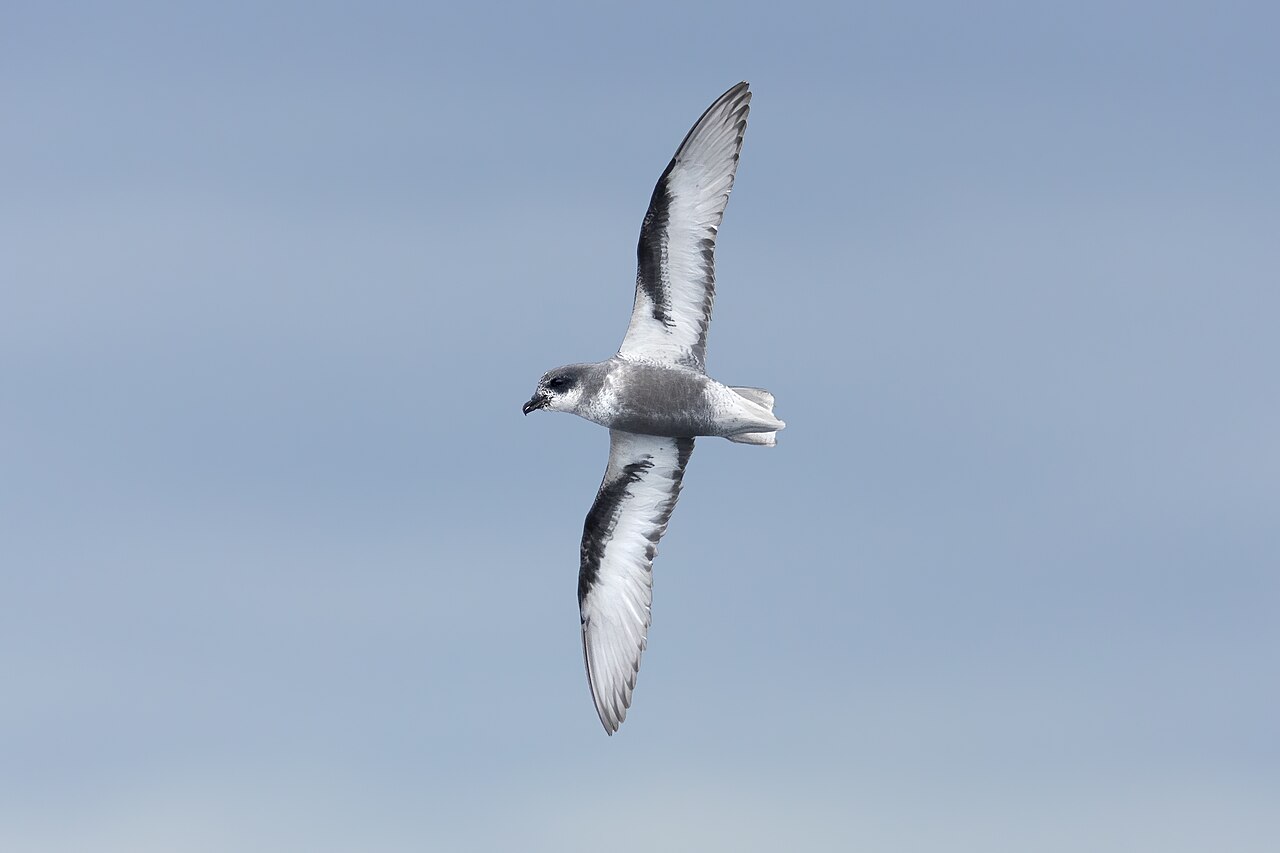
Mottled Petrel is one of the few members of its genus that does not keep to the tropics: it breeds on cool, subantarctic islands off New Zealand and, once breeding is over, crosses the equator to the cold waters of the Bering Sea and the Gulf of Alaska. Its blue-grey back, white underparts and the dark patch on its belly make it recognisable, despite the great distance from its breeding grounds, among the many shearwaters of those same waters.
Voice
At the breeding islands off New Zealand, far outside the guide area, a shrill, repeated kek-kek-kek rings out over the colony at night, along with a lower, growling sound at the burrow. Off the Alaskan coast and in the Bering Sea, where the species visits this area, Mottled Petrel is, like most of its relatives, entirely silent: it forages there alone, without joining other seabirds.
Recording: Johannes Fischer — CC BY-NC-SA 4.0 · Stewart Island, Southland District, Southland, New Zealand · xeno-canto
Identification
Mottled Petrel is blue-grey above, with a dark 'M' pattern running from wingtip to wingtip across the back and wings, and has a white forehead with a dark eye patch. The underparts are white, but a broad, dark patch crosses the belly — a mark no other small petrel in these waters shows. The underwing is mostly dark with a pale triangle at the base, the tail is grey, and the legs are pink with black webs. Male, female and juvenile look alike. In flight it alternates, like other petrels of the genus Pterodroma, quick bursts of wingbeats with high, tumbling banks, often much higher above the swells than the shearwaters it mixes with.
Confusion species
In the Bering Sea and the Gulf of Alaska, Mottled Petrel often flies among large numbers of Sooty Shearwater (Ardenna grisea), which is entirely dark and flies on stiff, straight wings — the white underparts with dark belly patch and the tumbling flight of Mottled Petrel set it apart at once. From Murphy's Petrel, also found in the North Pacific, entirely dark brown without any white, it is likewise distinguished by its white underparts. Confusion is more conceivable with the dark form of Kermadec Petrel, bulkier and lacking a sharp boundary between dark and light on the underparts, but that species is almost never seen in this area. The combination of blue-grey back, white underparts with a dark belly patch, and the small, slight build remains the best mark.
Habitat
Within this area Mottled Petrel is entirely a bird of open, cold water: it seeks the boundary between colder subarctic and warmer temperate currents, in the Bering Sea, the Gulf of Alaska and around the Aleutians, avoiding the warm tropical and subtropical water that most of its relatives favour. For breeding it uses an entirely different landscape: a self-dug burrow among tree roots or in dense tussock grass on cool islands, far outside the guide area. It never uses land within North America.
Where the bird is most often found, arranged by the USNVC — the vegetation classification of the United States and Canada — and CMECS for sea and coast.
Range and movements
Mottled Petrel breeds only on islands off New Zealand: small islets off the coast of Fiordland and even islets in the inland lake Hauroko, in Foveaux Strait and around Stewart Island, and on the Snares Islands. After breeding, which ends around June, almost the entire population crosses the equator to the North Pacific, where the birds reach the Bering Sea, the Gulf of Alaska and the waters around the Aleutians and remain there until late summer before heading south again. Smaller numbers also reach the waters off Japan and the Russian Far East. On mainland New Zealand and the islands reached by rats and stoats, the species has been sharply reduced by predation; it now breeds mainly on islands that are predator-free or have been made so.
- Breeding (summer)
- Winter
- Passage
- dark = core range, pale = thinly spread
Where and when to look
The only practical chance within this area is a boat trip well out into the Gulf of Alaska or the Bering Sea, in the summer months when the species forages there; look for a small, tumbling petrel with white underparts and a dark belly patch, among the far more numerous, entirely dark shearwaters.
Conservation
Mottled Petrel is listed as Near Threatened (NT): the world population has declined sharply over the past century as introduced rats, cats and stoats have hit the colonies on mainland New Zealand and the larger islands hard. On the last predator-free islands, such as the Snares, numbers remain more stable, and chicks have been moved to additional predator-free islands to found new colonies.
Scientific name
Pterodroma inexpectata | (Forster, 1844)
Johann Reinhold Forster, naturalist on Cook's second voyage, described the species as Procellaria inexpectata; the name did not appear until 1844, decades after his death, when his notes on the birds of that voyage were finally published, and because the species has since been placed in another genus, author and year stand in parentheses. The genus Pterodroma was introduced in 1856 by Bonaparte, from the Greek for 'wing' and 'runner'. inexpectata is Latin for 'unexpected', probably because the species was a surprising find among the rest of the voyage's bird material. The type locality is vague: 'in the Southern Ocean, together with the preceding [species]', with no further indication of place.