All species › Tubenoses › Petrels, shearwaters and diving petrels › White-necked Petrel
White-necked Petrel | Pterodroma cervicalis
Kermadec-witnekstormvogel | Petrel cuello blanco
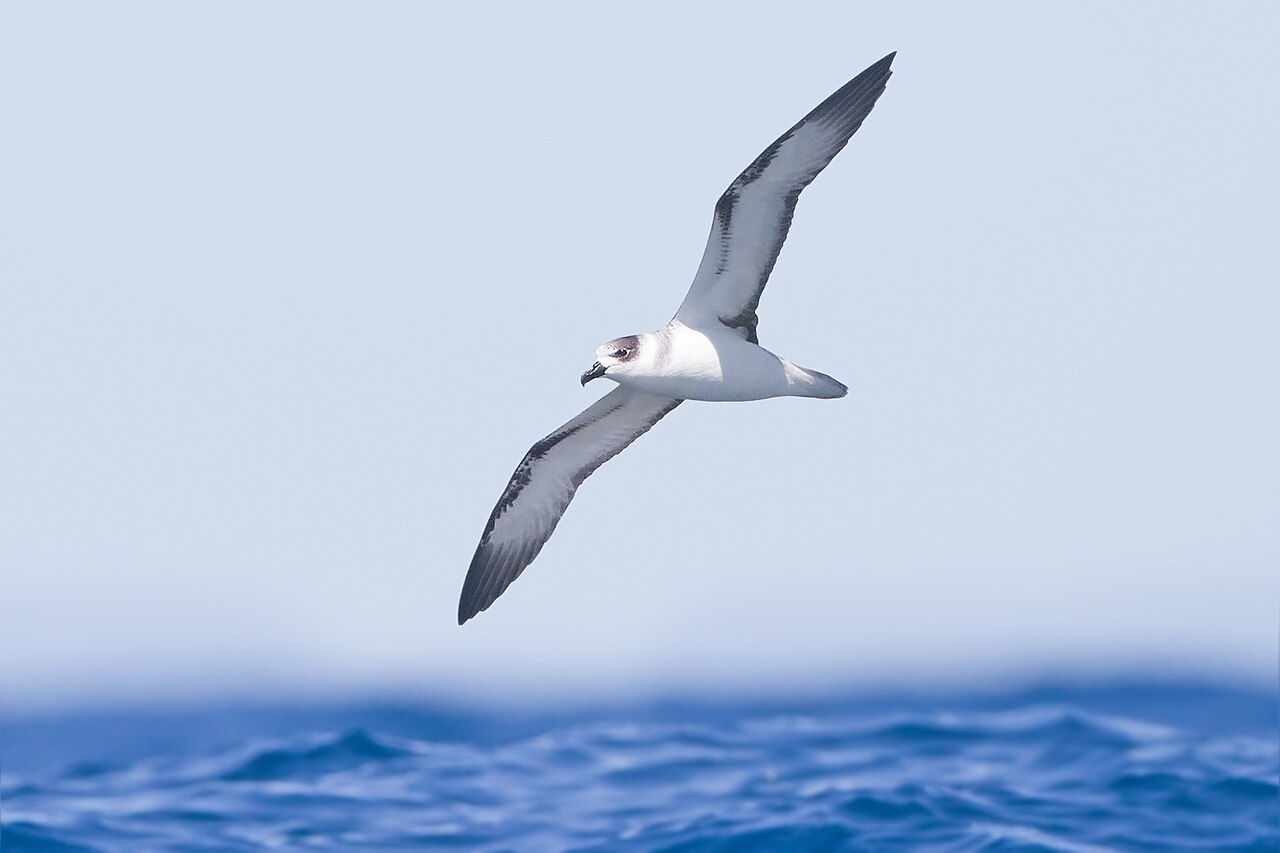
White-necked Petrel is recognisable by the broad white band that separates its black cap from the grey back — the feature that explains its name. Nearly the entire world population breeds on a single island, Macauley in the Kermadec group near New Zealand, and it appears in the waters around Hawaii only as a scarce but annual non-breeding visitor.
Voice
Above the colony on Macauley Island a loud flight call sounds, rendered as ooo kek-kek-kek-kek-kek, with a repeated eh-eh-eh as a ground call. At sea, far from the colony — and so everywhere within the guide area — the species is completely silent.
No recording with a suitable Creative Commons licence has been found for this species yet; what to listen for is described below.
Identification
White-necked Petrel has a black cap sharply bordered by a broad white band across the forehead, hindneck and neck; the back, wings and tail are grey with a darker rump. The underparts are white, with a narrow dark band along the leading edge of the underwing formed by dark bases to the primaries. The bill is long and black, the legs pink. Worn plumage looks noticeably darker than fresh plumage, which can cause confusion at sea. Male, female and juvenile cannot be told apart.
Confusion species
Confusion is greatest with Juan Fernandez Petrel (Pterodroma externa), seen in the same waters: that species entirely lacks the broad white hindneck band and instead has a solid black cap extending below the eye. Do not confuse the name with Kermadec Petrel (P. neglecta) either, a different species also named for the Kermadec Islands: it lacks the sharply defined cap and white underparts, showing instead a more uniform, brownish plumage with a light and a dark colour morph and a yellow-and-black bill. At sea, the broad white band on the neck is the key mark for White-necked Petrel.
Habitat
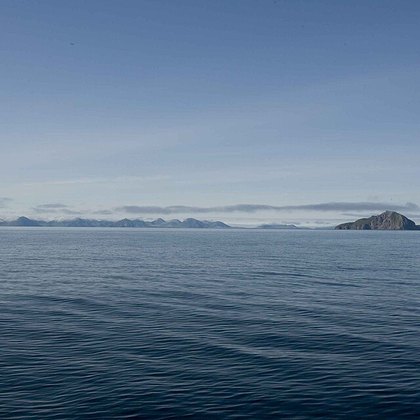
For breeding the species uses damp, seasonally wet grassland on the slopes of a subtropical island, where it digs a burrow. Outside the breeding season it is entirely a bird of open, warm ocean water, far from shore. It therefore never comes ashore anywhere within the guide area.
Where the bird is most often found, arranged by the USNVC — the vegetation classification of the United States and Canada — and CMECS for sea and coast.
Range and movements
Almost the entire world population — an estimated fifty thousand pairs — breeds on Macauley Island in the Kermadec group; a small, recently established colony of a few dozen pairs is on Phillip Island near Norfolk Island. The species formerly also bred on Raoul Island, until introduced rats and cats wiped it out there. After breeding, most of the population moves northwest to waters southeast of Japan; a small part reaches the Hawaiian Islands, where the species is seen mainly in November and December, concentrated off the west coast of Hawaii Island and around some of the northwestern atolls.
Where and when to look
Look for White-necked Petrel on a pelagic boat trip off the west coast of Hawaii Island in November or December; it is scarce there, so do not count on a guarantee, and watch above all for the broad white hindneck band that separates it from the closely similar Juan Fernandez Petrel.
Conservation
The species is listed as Vulnerable (VU) because almost the entire population breeds on a single island. Since Macauley Island was cleared of goats and cats early this century, the colony there has grown; the recent establishment on Phillip Island is likewise the result of successful habitat recovery after introduced animals were removed. New introductions of predators to the remaining breeding islands nonetheless remain the greatest risk.
Scientific name
Pterodroma cervicalis | (Salvin, 1891)
British ornithologist Osbert Salvin described the species in 1891 as Oestrelata cervicalis; because it has since been placed in another genus, author and year stand in parentheses. The genus Pterodroma was introduced in 1856 by Bonaparte, from the Greek for 'wing' and 'runner'. cervicalis is Latin for 'of the neck', after the broad white band separating the cap from the back. The type locality is the Kermadec Islands — the same island group where, on Macauley Island, the species still holds its main colony today.