All species › Swifts › Swifts › Alpine swift
Alpine swift | Tachymarptis melba
Alpengierzwaluw | Vencejo real
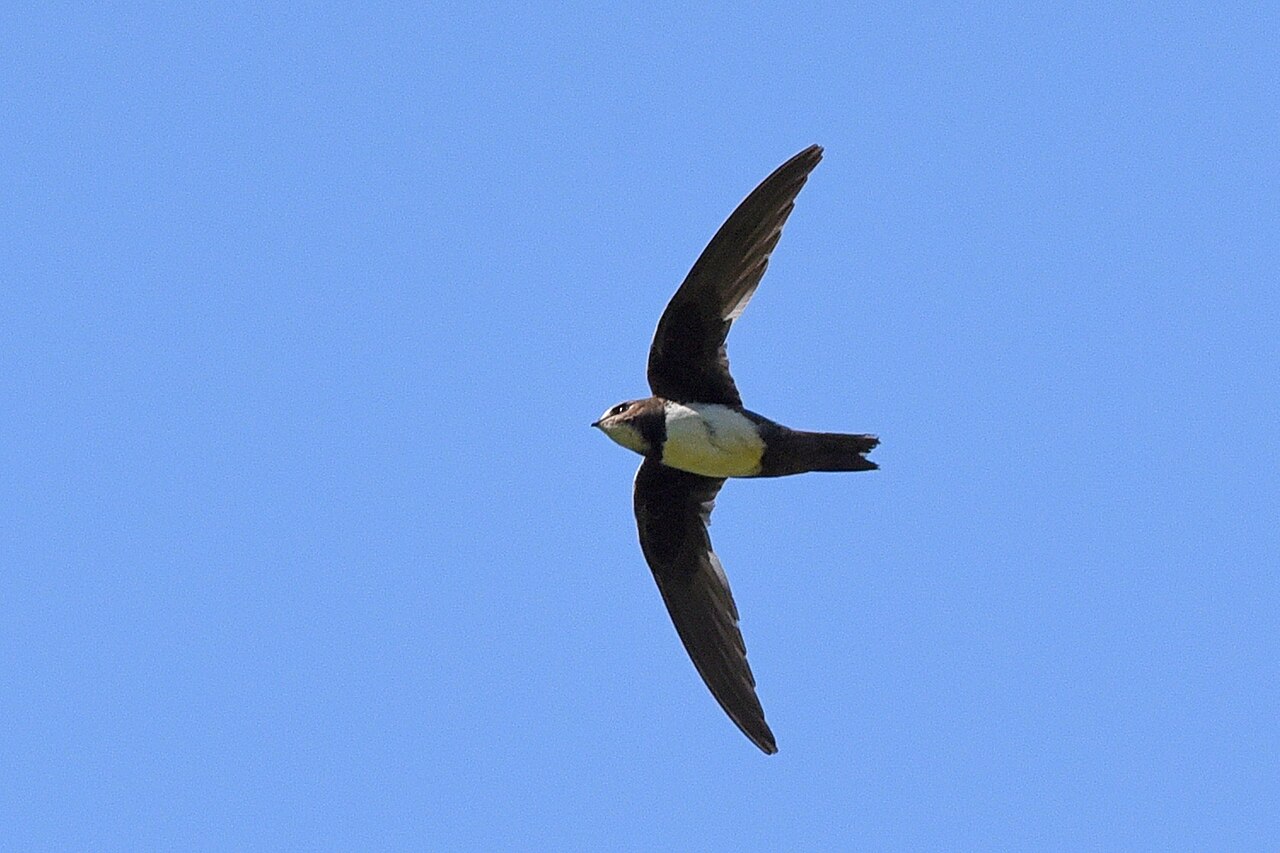
The Alpine swift is the largest swift of the Mediterranean: nearly twice the weight of a common swift and with a wingspan that suggests a small falcon. Over a cliff face or a cathedral it gives itself away by the white belly flashing from below.
Voice
A long metallic trill that continually changes pitch: ti-ti-ti-tirrrrrrr-ti-ti, first accelerating and rising, then slowing and falling, sometimes for half a minute on end. That alone separates it from the flat, even scream of a common swift. Around colonies it is heard all day, loudest in the late afternoon.
Recording: tsilianidis saky — CC BY-SA 4.0 · Wikimedia Commons
Identification
Heavily built, with long scythe-shaped wings and a short, shallowly forked tail. The upperparts are uniform grey-brown; below there is a white throat and a large oval white belly patch, separated by a brown breast band that stays visible as a line even at range. Flanks and undertail coverts are dark, so the white sits as a detached oval in the middle of the underside. The wingbeats are slower and heavier than a common swift's, with long glides in which the bird hardly seems to move.
Confusion species
Common swift is clearly smaller and uniform sooty brown, with at most a faint pale throat patch; the white belly and the brown breast band are absent altogether. Pallid swift is likewise far smaller and browner, with a stronger head and throat pattern and broader-based wings, and again no white on the belly. At long range a Hobby can mislead, but it has streaked underparts, rusty thighs and a driving flight with only short glides.
Habitat
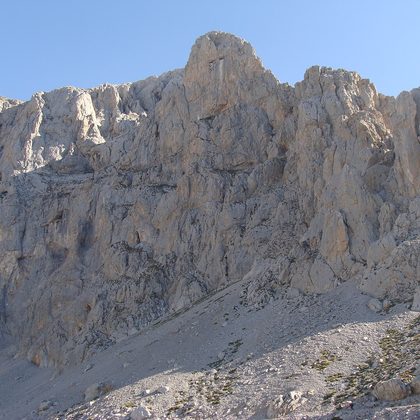
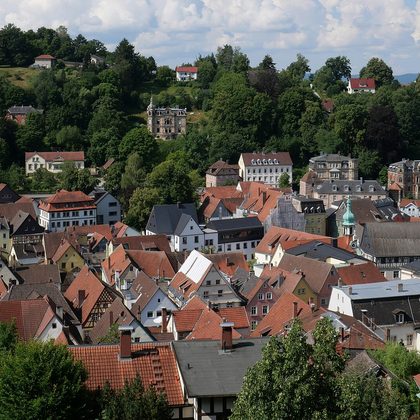
Rock faces, gorges and steep mountain flanks, and along the coast high sea cliffs. Also tall old buildings — cathedrals, castle towers, town walls — that serve as artificial rock. Hunts high in the open air over mountain ranges, alpine pasture and cities, often tens of kilometres from the colony; in cold, wet weather it drops to low levels over lakes and reservoirs.
Where the bird is most at home, classified with EUNIS — the European standard for habitats.


Range and movements
Breeds in southern Europe north to the Alps, north-west Africa, Turkey and the Middle East, east to the Himalayas; resident populations in Africa, Madagascar and India. In Iberia it breeds across much of the peninsula, from the limestone cliffs and gorges of the interior to the cities of Andalusia and the Mediterranean coast. In north-west Europe a scarce vagrant, mostly birds overshooting from the south: nearly half between late March and late June, most of the rest between mid-August and early November. European breeders winter in tropical and southern Africa.
- Resident
- Breeding (summer)
- Passage
- dark = core range, pale = thinly spread
How and when to look
In May go to a limestone massif or an urban cliff in the Mediterranean region — the cathedral rock of Cuenca, the Tajo at Ronda, the Hoces del Duratón — and watch between midday and late afternoon, when the birds circle highest above the rim and call most; in cool weather they hunt low over nearby reservoirs. In north-west Europe a spell of persistent south-easterly wind in April or May is the moment to scan the coast and the large waters among the first common swifts.
Conservation status
Not globally threatened (IUCN: Least Concern), with a wide range and a stable world population. In parts of Europe it is increasing, as building colonies spread into new towns. Local pressures are renovations that seal nest cavities in towers and churches, and disturbance of cliff colonies by climbing routes.
Scientific name
Tachymarptis melba | (Linnaeus, 1758)
Linnaeus described the species in 1758 as Hirundo melba; because it was later moved to another genus, the author and year stand in brackets. The genus Tachymarptis was introduced in 1922 by Roberts. Tachymarptis is Greek, from takhus 'fast' and marptis 'seizer', after the bird that takes its prey from the air in swift flight. melba is of uncertain origin; possibly a short form of melanoalba, from Greek melas 'black' and Latin albus 'white', after the brown-and-white plumage. The specimen the first description was based on came from Gibraltar.