All species › Waterfowl › Ducks, geese and swans › American Wigeon
American Wigeon | Mareca americana
Amerikaanse smient | Silbón americano | Kanadapfeifente | ברווז אמריקני | Canard d'Amérique
A North American Wigeon that turns up almost annually among Eurasian Wigeon flocks in north-west Europe. The drake announces itself with a cream crown and green eye mask, but the females demand patient, head-by-head searching.
Click a thumbnail to switch the photo above.
Voice
The drake whistles differently from Wigeon: a dry, three-part whi-whiu-whiu with a nasal, quacking quality, where Wigeon gives a shrill, clean wheeoo. The female answers with a low growling krr-krr. Heard mostly from displaying winter parties between January and March, when drakes chase one another.
Recording: Valerie Heemstra — CC BY-NC-SA 4.0 · Wikimedia Commons
Identification
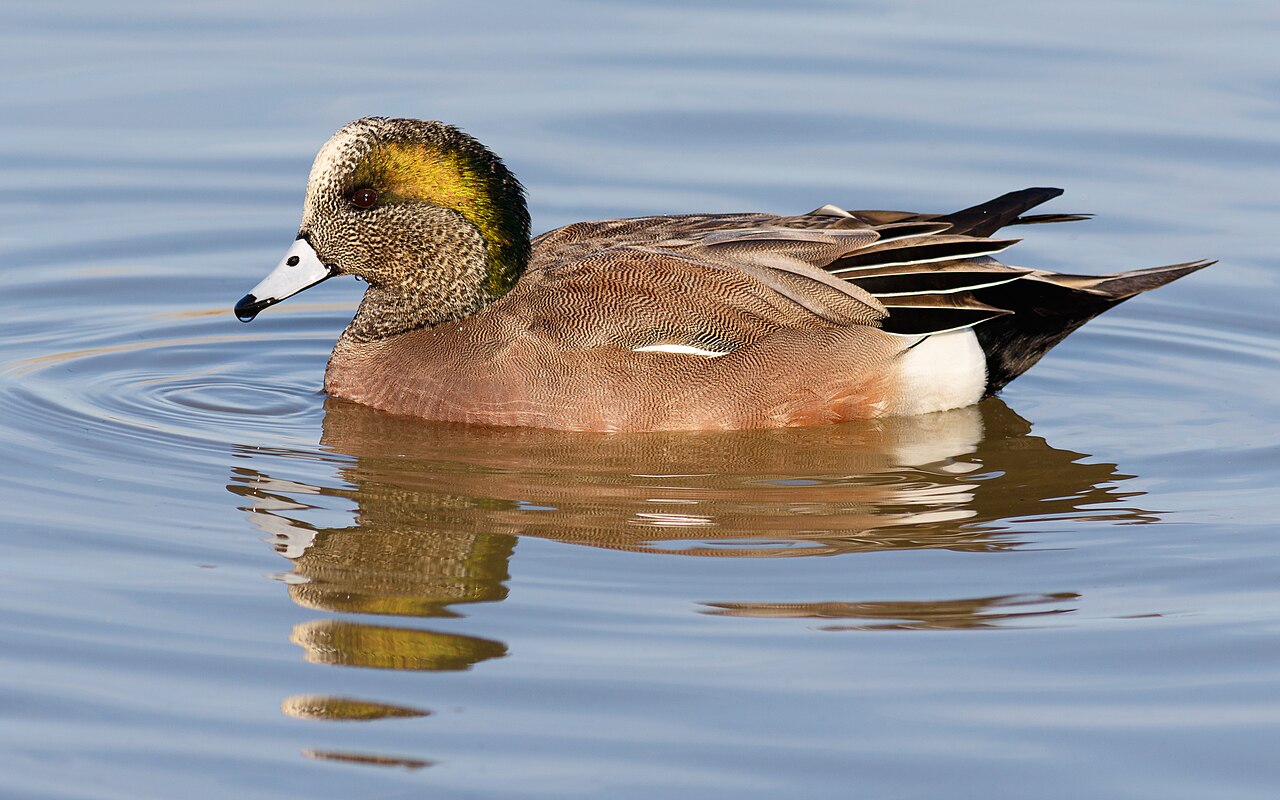
The drake has a grey, finely speckled head with a cream-white crown stripe and a broad green mask running from the eye into the nape; breast and flanks are pinkish wine and a white flank patch sits before the black stern. Female and eclipse drake are warm rufous on the flanks against a sharply contrasting grey head, and show white axillaries in flight.
Confusion species
Everything hinges on Eurasian Wigeon. On the drake, a cream crown and green eye mask replace the chestnut head with buff blaze, and the flanks are pinkish rather than grey. On females the sharp break between grey head and rufous flanks decides it, backed by the white axillaries where Wigeon shows grey.
Habitat
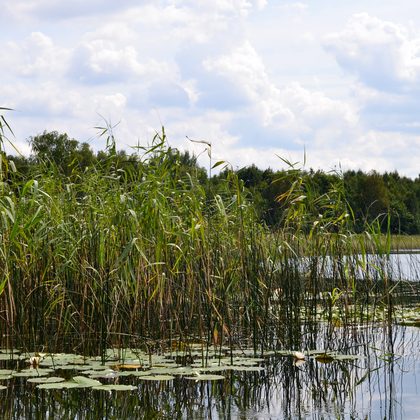
Shallow water with short-grazed shores: flooded grassland, brackish creeks, freshwater lakes and tidal flats. In north-west Europe, where most records come from, almost always among large grazing Eurasian Wigeon flocks on wet grassland or beside freshwater lakes. Grazes on land or picks from the surface while swimming, and hardly ever dives.
Where the bird is most at home, classified with EUNIS — the European standard for habitats.



Range and movements
Breeds in northern North America, Alaska included, and winters across North America; inside the map area a rare but near-annual vagrant, chiefly to north-west Europe: a few birds each winter on the southern North Sea coast, in deltas and on the large inland waters, and also in Iceland. In Iberia much rarer, with scattered records in Galicia and the Ebro delta.
How and when to look
Work the big Wigeon flocks on wet grassland from December to March, preferably in the morning when the birds graze tightly together. Go through them head by head with a scope; the drake's cream crown leaps out the moment he lifts his head. When a flock flushes, check the underwing for white axillaries.
Conservation status
Numerous and stable across its wide North American breeding range. European records concern genuine vagrants and say little about the population. Drainage of prairie wetlands and hunting pressure in the wintering areas are the familiar concerns, but the species absorbs them well for now.
Scientific name
Mareca americana | (Gmelin, 1789)
Gmelin described the species in 1789 as Anas americana; because it was later moved to another genus, the author and year stand in brackets. The genus Mareca was introduced in 1824 by Stephens. Mareca comes from the Portuguese marreco, a word for a small duck. americana is Latin for 'American', after the North American breeding range. The specimen the first description was based on came from Louisiana and New York.