All species › Waders, gulls and terns › Sandpipers and snipes › Baird's sandpiper
Baird's sandpiper | Calidris bairdii
Bairds strandloper | Correlimos de Baird
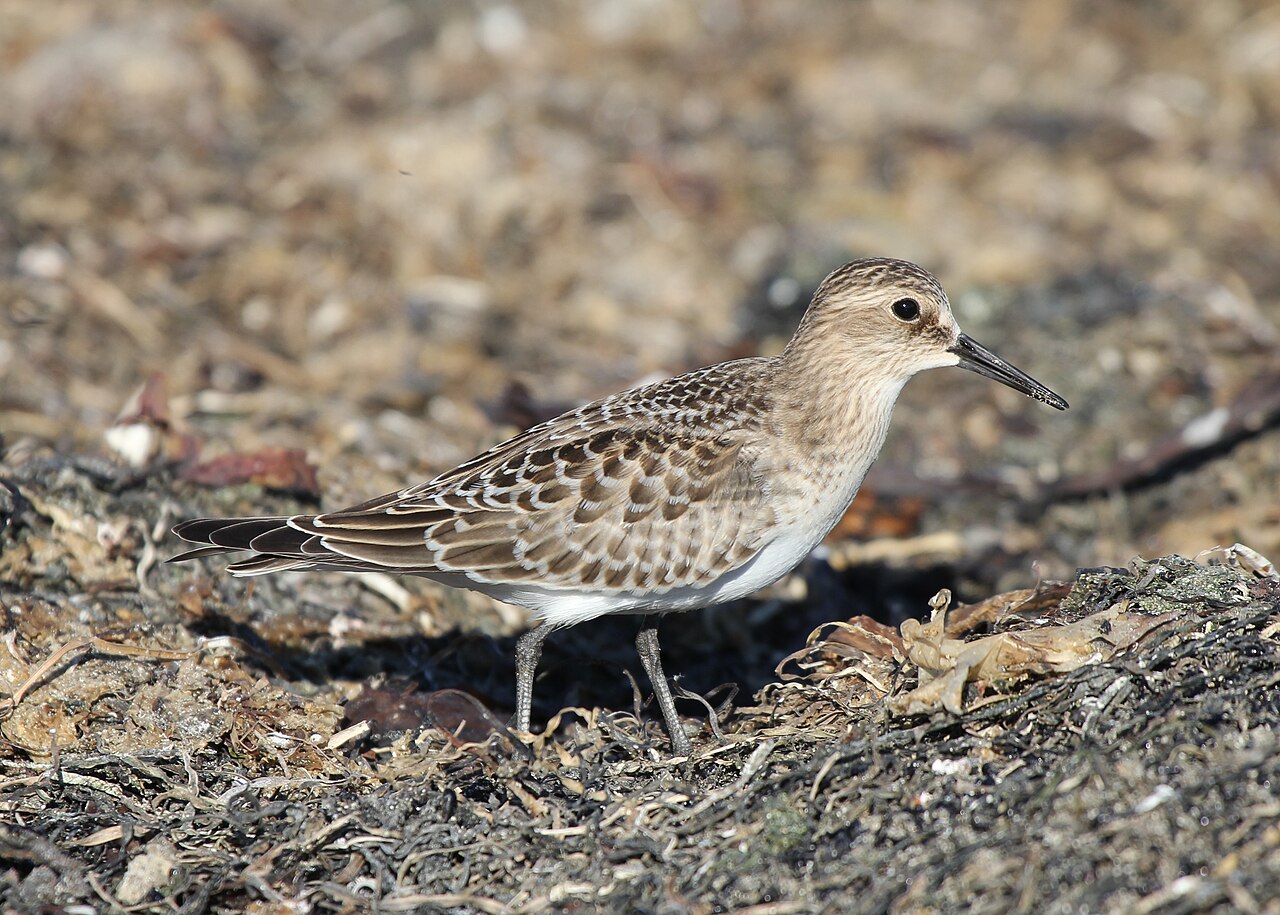
A flat, drawn-out sandpiper whose wing tips reach well past the tail, giving it the look of a bird flying on borrowed wings. Britain had recorded some one hundred and eighty accepted records by the end of 2004 and Ireland about ninety; the Netherlands has sixteen and Spain just over twenty, mostly from Galicia and the Canary Islands. Almost everywhere the overwhelming majority are July–September juveniles.
Voice
On flushing, a low, dry, rolling trill: prrreep or krrrit, short and level, earthy and coarse. It is the exact opposite of the thin, mouse-like tzeet of white-rumped sandpiper, and on a flock lifting off the mud it is worth more than any plumage character. Generally silent while feeding.
Recording: Doug Hynes — CC BY-SA 4.0 · Wikimedia Commons
Identification
Marginally larger than little stint but looking far longer because of the wings: at rest the primaries cross and project clearly beyond the tail tip. The stance is horizontal, the neck short, the back flat. The bill is short, straight, fine and wholly black, the legs black. A plain buff wash crosses the breast, finely dark-streaked, ending cleanly against the white underparts and not running down the flanks. Juveniles, which is what nearly every European bird is, have broad pale fringes to the upperpart feathers that produce a neatly scaled back. In flight a narrow white wing bar and a dark rump with only thin white sides.
Confusion species
Start with the wing tips. Baird's and white-rumped sandpiper both show primaries projecting well beyond the tail; Dunlin and curlew sandpiper reach the tail tip at best. The rump then separates the two: watch as the bird flushes or stretches, because White-rumped carries a square white block across the uppertail coverts while Baird's has an unbroken dark rump with only a narrow white margin. At close range the bill decides it. Baird's is short, straight and entirely black; White-rumped is a shade longer, with a slightly decurved culmen and a dull orange patch at the base of the lower mandible. The breast of Baird's is a plain buff wash with faint streaking cut sharply against white; White-rumped shows coarser black streaks continuing as arrowheads onto the flanks. Both have black legs, and that alone rules out Pectoral and sharp-tailed sandpiper, which have yellow to olive legs, a pale bill base and a far shorter wing projection. Against Dunlin, Baird's is smaller, buffer, shorter-billed and much longer-winged, while Dunlin stands taller and has a longer bill drooping at the tip. Curlew sandpiper is bigger and longer-legged, with an evenly curved bill and, in flight, a broad white rump patch noticeably larger than that of White-rumped.
Habitat
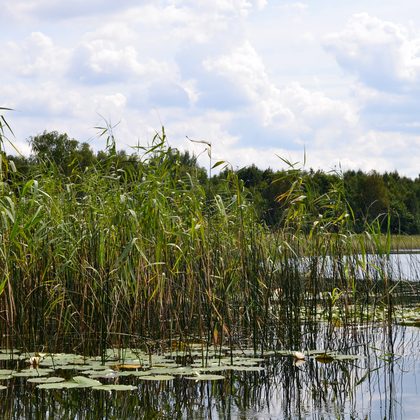
In Britain and Ireland it favours drier ground than the other Nearctic waders: the high, drying edges of coastal pools and reservoirs, short turf on airfields and links, cattle-poached field corners and the strandline of sandy beaches, especially in the west of Ireland and in Cornwall and Scilly. Birds work higher up the shore than Dunlin and pick rather than probe. It breeds on dry, stony high arctic tundra from north-east Siberia across arctic Canada to Greenland and winters on Andean bogs and Patagonian steppe.
Where the bird is most at home, classified with EUNIS — the European standard for habitats.



Range and movements
The species migrates south through the interior of North America, which is why far fewer birds end up over the Atlantic than white-rumped sandpiper. Within the map area it is an annual but scarce vagrant, chiefly in south-west Britain and the south and west of Ireland, and along the north-west coast of Spain and in the Canaries, with a clear peak from late August to late September.
How and when to look
Work the dry margins in September, after a run of westerlies: the grassy back edge of a coastal scrape, a drawn-down reservoir shoreline or a short-grazed coastal meadow, not the open mudflat. A juvenile Baird's stands out as a stint-sized wader that looks too long and too flat and that keeps to ground the Dunlin have left. Check the wing projection first, then wait for the bird to fly and settle the rump, since that single view removes White-rumped from the equation.
Conservation status
The world population is large and the species is assessed as Least Concern. Even so, almost the entire population funnels through a narrow band of high arctic tundra and winters in a limited set of Andean wetlands and Patagonian grasslands. Drainage of high Andean bogs, overgrazing and the loss of prairie stopover wetlands are the concerns; in Europe the bird carries no conservation weight of its own.
Scientific name
Calidris bairdii | (Coues, 1861)
Coues described the species in 1861 as Actodromas (actodromas) bairdii; because it was later moved to another genus, the author and year stand in brackets. The genus Calidris was introduced in 1804 by Merrem. Calidris goes back to Ancient Greek kalidris or skalidris, a name Aristotle used for an unidentified grey waterside bird. bairdii honours the American naturalist Spencer Fullerton Baird (1823–1887), assistant secretary of the Smithsonian Institution. The specimen the first description was based on came from Fort Resolution, Great Slave Lake.