All species › Falcons › Falcons › Common kestrel
Common kestrel | Falco tinnunculus
Torenvalk | Cernícalo vulgar
The only European raptor that routinely hangs hovering over a verge, head motionless in the wind. An everyday species; male and female differ clearly in colour.

Click a thumbnail to switch the photo above.
Voice
At the nest and in disputes a shrill, rapidly repeated kee-kee-kee-kee, sharper and higher than most falcons. Heard mainly from March to June around nestboxes, church towers and cliffs; begging young call hoarsely into August.
Recording: Pascal Christe — CC BY-SA 4.0 · Wikimedia Commons
Identification
Slim, long-tailed falcon with pointed but not very sharp wings and a long tail rounded at the tip. Male: blue-grey head and tail with a broad black terminal band, rufous back with small black spots. Female and juvenile brown, barred on back and tail. Hovers with legs dangling and tail fanned.
Confusion species
Lesser kestrel: shorter-tailed and more compact, the male with an unspotted back, a blue-grey wing panel and white claws, and almost always in colonial groups over Spanish towns. Hobby: shorter-tailed, sickle-winged, dark and heavily streaked, and never hovers. Sparrowhawk: rounded wings and flap-and-glide flight, with no hovering.
Habitat
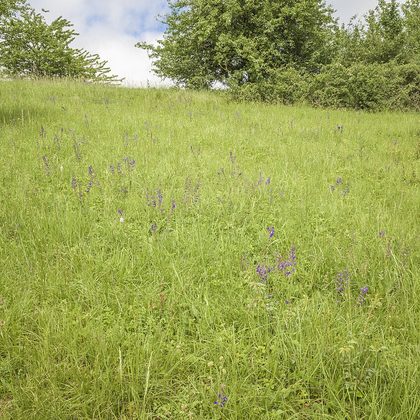
Open and semi-open country: verges, dikes, rough set-aside, young polders and field margins with voles. Nests in old crow nests, church towers, building niches and nestboxes, and often hunts from posts, fences and motorway lamp-posts.
Where the bird is most at home, classified with EUNIS — the European standard for habitats.


Range and movements
Breeds across almost all of Europe. In the Netherlands it is spread nationwide but commonest in open arable land and young polders; northern birds move out while Dutch birds largely stay. In Spain numerous year-round, from cereal plains to city centres, with an influx of central European birds in winter.
- Resident
- Breeding (summer)
- Winter
- Passage
- dark = core range, pale = thinly spread
How and when to look
All year, but easiest in October and November when young birds hover along motorway verges. Watch in early morning and the last hour of daylight over rough strips; vole abundance decides where the birds are.
Conservation status
Declining over much of north-west Europe through agricultural intensification and the loss of rough, vole-rich margins. Rodenticides accumulate in the prey, and road casualties along motorways and the loss of nest sites in renovated barns and towers add to the pressure.
Scientific name
Falco tinnunculus | Linnaeus, 1758
Linnaeus described the species in 1758 and placed it straight away in the genus where it still stands. He introduced the genus Falco in that same work. Falco is Late Latin for 'falcon', from falx, falcis 'sickle', after the sickle-shaped claws of the bird. tinnunculus is the Latin name of the kestrel, from tinnulus 'shrill', after the call. The specimen the first description was based on came from Sweden.