All species › Falcons › Falcons › Lesser kestrel
Lesser kestrel | Falco naumanni
Kleine torenvalk | Cernícalo primilla
A small, noisy falcon that prefers to circle over a town by the dozen and lives almost entirely on insects. In southern Europe it belongs to the church tower and the old city wall much as the Swift does, and its chattering calls fill the air there in May and June — in Trujillo, Alcalá de Henares or the Seville countryside as much as anywhere else around the Mediterranean.
Click a thumbnail to switch the photo above.
Voice
Much noisier than a Kestrel and audible at the colony all summer: a hoarse, rattling chay-chay-chay, lower and rougher than the shrill kee-kee-kee of a Kestrel, usually from dozens of birds at once above the roofs. The din over a town centre peaks around fledging in June, and the birds still call in the evening at the communal roost.
Recording: Bubulcus — CC BY 3.0 · Wikimedia Commons
Identification
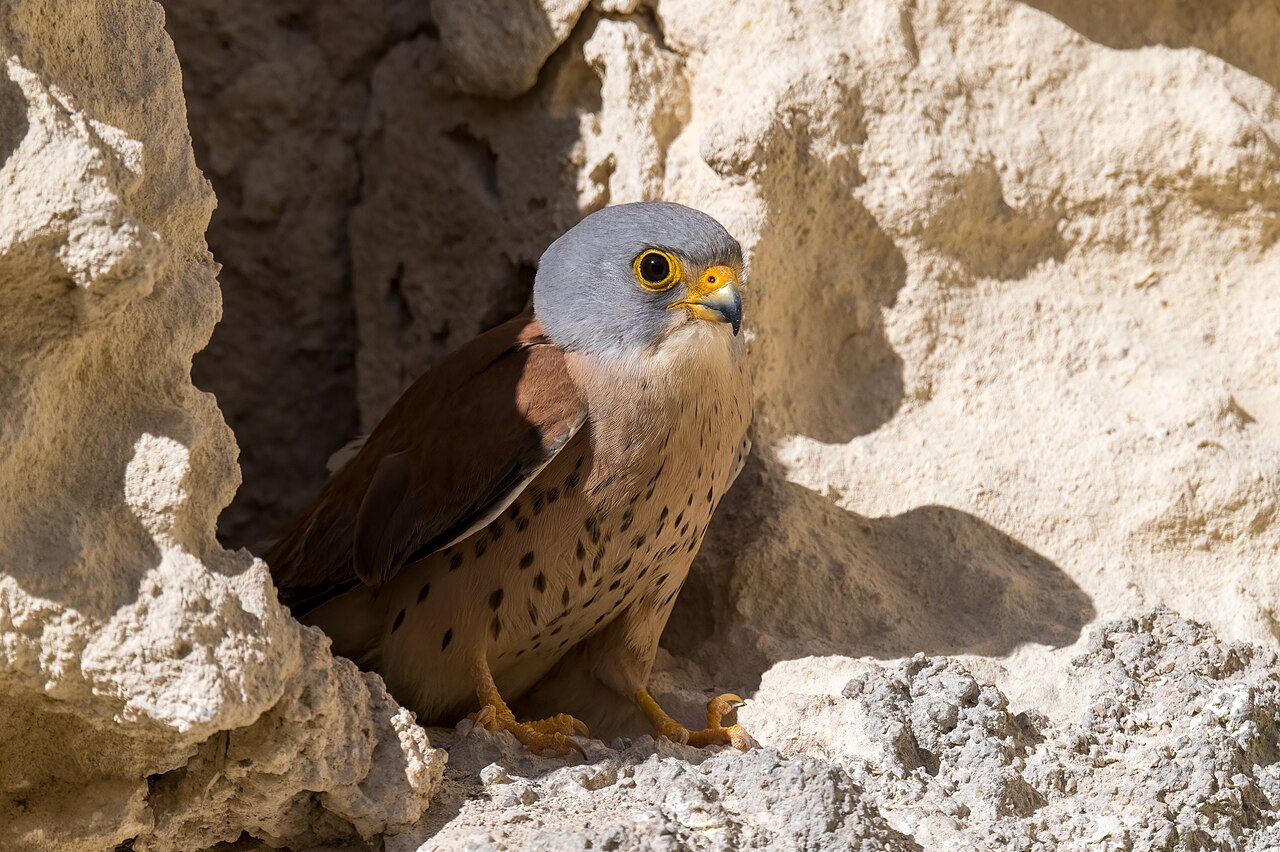
Slightly smaller and more compact than a Kestrel, with shorter, more pointed wings and a shorter tail that ends not rounded but wedge-shaped, the central feathers projecting. The male is the recognisable bird: the back is plain rufous and lacks the black spotting of a Kestrel, a blue-grey panel runs across the greater coverts, the head is pale blue-grey and virtually without a moustache, and the underparts are pale ochre with sparse spotting. At very close range the claws are white rather than black. Female and juvenile are brown and barred and closely resemble a Kestrel; on those you must work from structure, the wedge-shaped tail, the paler head and the voice. It hovers more briefly and less steadily than a Kestrel and hunts a great deal on gliding wings, in parties and close to the colony.
Confusion species
In practice Kestrel is the only confusion species. It is larger and longer-tailed, with a tail rounded at the tip, a clear dark moustache and black claws; the male's rufous back is covered in black spots and it has no blue-grey wing panel. Kestrel hovers steadily over one spot for long periods and is usually alone or in a pair, whereas lesser kestrel is almost always in company and roosts over the roofs of a town. Females are barely separable on plumage: go to the shorter wedge-shaped tail, the paler head, the faster wingbeat and the hoarse call. Hobby is darker, far more sharply streaked and longer-winged, and never hovers.
Habitat
Steppe, dry grassland, lucerne, stubble and extensively farmed arable land, and in Iberia the open oak pasture of the dehesa as well. There it hunts low on gliding wings for grasshoppers, beetles and mole crickets, often in loose parties and preferably in the warmest hours. For nesting it depends on cavities in old buildings — church towers, castles, roof tiles, ruins — and on cliff faces, breeding without nest material in colonies of ten to several hundred pairs.
Where the bird is most at home, classified with EUNIS — the European standard for habitats.


Range and movements
Breeds from Portugal and Spain through the Mediterranean, North Africa, the Balkans and the Levant east to Central Asia, China and Mongolia. With some twenty thousand pairs in Spain, Iberia holds by far the largest share of the European population, concentrated in Extremadura, Andalusia and the two Castiles. In north-west Europe it is a vagrant with only a few records. Western birds winter in the Sahel, eastern birds in southern Africa.
- Resident
- Breeding (summer)
- Winter
- Passage
- dark = core range, pale = thinly spread
How and when to look
April to June in Extremadura, Andalusia, La Mancha or southern Italy. Go at first light to the square of a town with an old church, a castle or a city wall and look up: the birds shuttle to and from the roof cavities and call incessantly. Then find a hunting bird over the surrounding cereal land and check the male's unspotted back and blue-grey wing panel; on a female the short wedge-shaped tail settles it.
Conservation status
Not threatened (IUCN: Least Concern). The species was listed as Vulnerable for many years after a collapse in the second half of the twentieth century, when the conversion of steppe to irrigated cropland, the loss of large insects to insecticides and the renovation of towers and roofs struck at the same time. Since numbers in Spain and Italy recovered — helped by nest boxes, nest tiles and restoration work that spares the cavities — the lower category applies, but the species remains tied to insect-rich, extensively farmed land close to its colonies.
Scientific name
Falco naumanni | Fleischer, 1818
Fleischer described the species in 1818 and placed it straight away in the genus where it still stands. The genus Falco was introduced in 1758 by Linnaeus. Falco is Late Latin for 'falcon', from falx, falcis 'sickle', after the sickle-shaped claws of the bird. naumanni honours the German naturalist Johann Friedrich Naumann. The specimen the first description was based on came from southern Germany.