All species › Waders, gulls and terns › Sandpipers and snipes › Eurasian woodcock
Eurasian woodcock | Scolopax rusticola
Houtsnip | Chocha perdiz
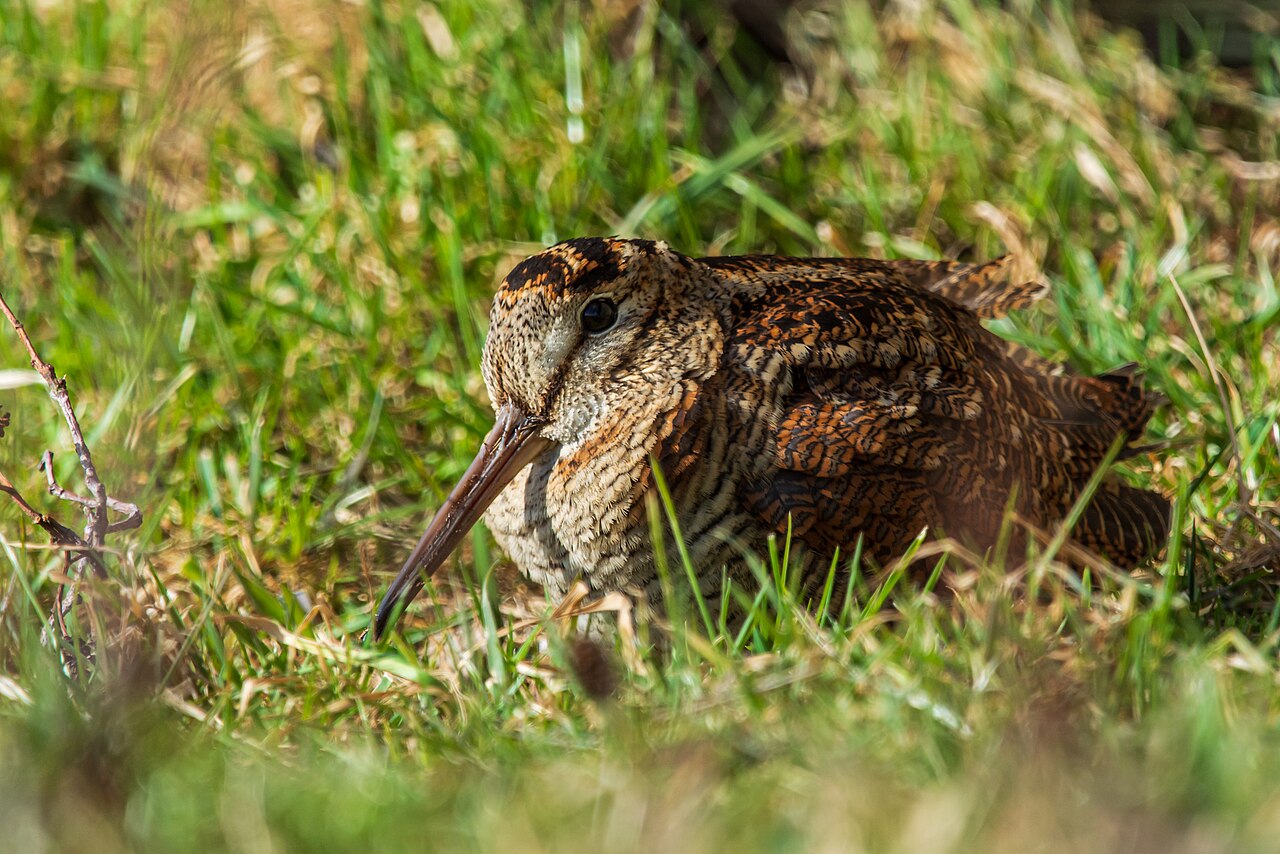
The Woodcock is a snipe that lives in the forest: a big, rufous-marbled bird that spends the day motionless among dead leaves. Usually you only see it when it clatters up at your feet and swerves away between the trunks.
Click a thumbnail to switch the photo above.
Voice
In the roding display over the wood the male gives a series of three or four low grunting orrt orrt orrt notes followed by a sharp high tsiwick. Heard from March to July, in the last twenty minutes before dark and again at first light; otherwise the species is silent.
Recording: ChristianSW — CC0 · Wikimedia Commons
Identification
Heavy and thickset, with short legs, broad rounded wings and a long straight bill. The plumage is dead-leaf marbled in rufous, black and grey, and the crown is barred crosswise rather than striped lengthways; the large eye sits high and far back. In flight it moves slowly and owl-like with the bill angled down; summer and winter plumages are alike.
Confusion species
Snipe only causes trouble in a poor flight view: it is far smaller and slimmer, with lengthwise crown stripes, pointed wings and a fast zigzag escape with a rasping call. Woodcock is bigger, rustier and much broader-winged, and flies off silently and slowly, weaving low between the trunks.
Habitat
Damp broadleaved and mixed woodland with deep leaf litter, open understorey and wet patches: alder carr, ditches and small streams. It rests on the woodland floor by day and flies out at dusk to open damp grassland to probe for earthworms. In hard weather it shifts to wood edges and hedgerows.
Where the bird is most at home, classified with EUNIS — the European standard for habitats.


Range and movements
Breeds across northern, central and eastern Europe and in mountains further south; in the Netherlands a scarce breeder of wooded sandy soils. In the winter half of the year large numbers arrive from Scandinavia and Russia. Iberia is one of Europe's key wintering areas, with many birds in Galicia, the Cantabrian woods and the dehesas.
- Resident
- Breeding (summer)
- Winter
- Passage
- dark = core range, pale = thinly spread
How and when to look
From mid-March to May, stand at a clearing or a junction of wide rides twenty minutes before sunset and watch against the bright sky, when roding males pass on slow deliberate wingbeats. In autumn you find day birds by walking slowly through damp, leaf-deep woodland.
Conservation status
Still numerous globally but declining in western Europe through the drying and fragmentation of woodland, disturbance and very heavy hunting pressure in the wintering range. The Netherlands holds only a small breeding population, sensitive to recreation during the breeding season. Severe frosts can also cause heavy local mortality.
Scientific name
Scolopax rusticola | Linnaeus, 1758
Linnaeus described the species in 1758 and placed it straight away in the genus where it still stands. He introduced the genus Scolopax in that same work. Scolopax is the Latin word for a snipe or woodcock, taken over by Linnaeus as a genus name. rusticola is the Latin name of a gamebird mentioned by Pliny the Elder and Martial. The specimen the first description was based on came from Sweden.