All species › Birds of prey › Hawks, eagles and kites › Golden eagle
Golden eagle | Aquila chrysaetos
Steenarend | Águila real
A very large eagle of Europe's mountains, which sails along cliff faces on raised wings and marks its territory with undulating dives. Spain holds the largest population in western Europe and is one of the best places to watch this large raptor; in the Netherlands it is a major rarity.
Voice
Silent and rarely heard. At the eyrie and during February and March display a weak, high yelping kyek-kyek or a mewing hee-yah carries, thin for a bird of this size. Begging young are noisier and audible at some distance in July.
Recording: British Library — CC BY-SA 4.0 · Wikimedia Commons
Identification
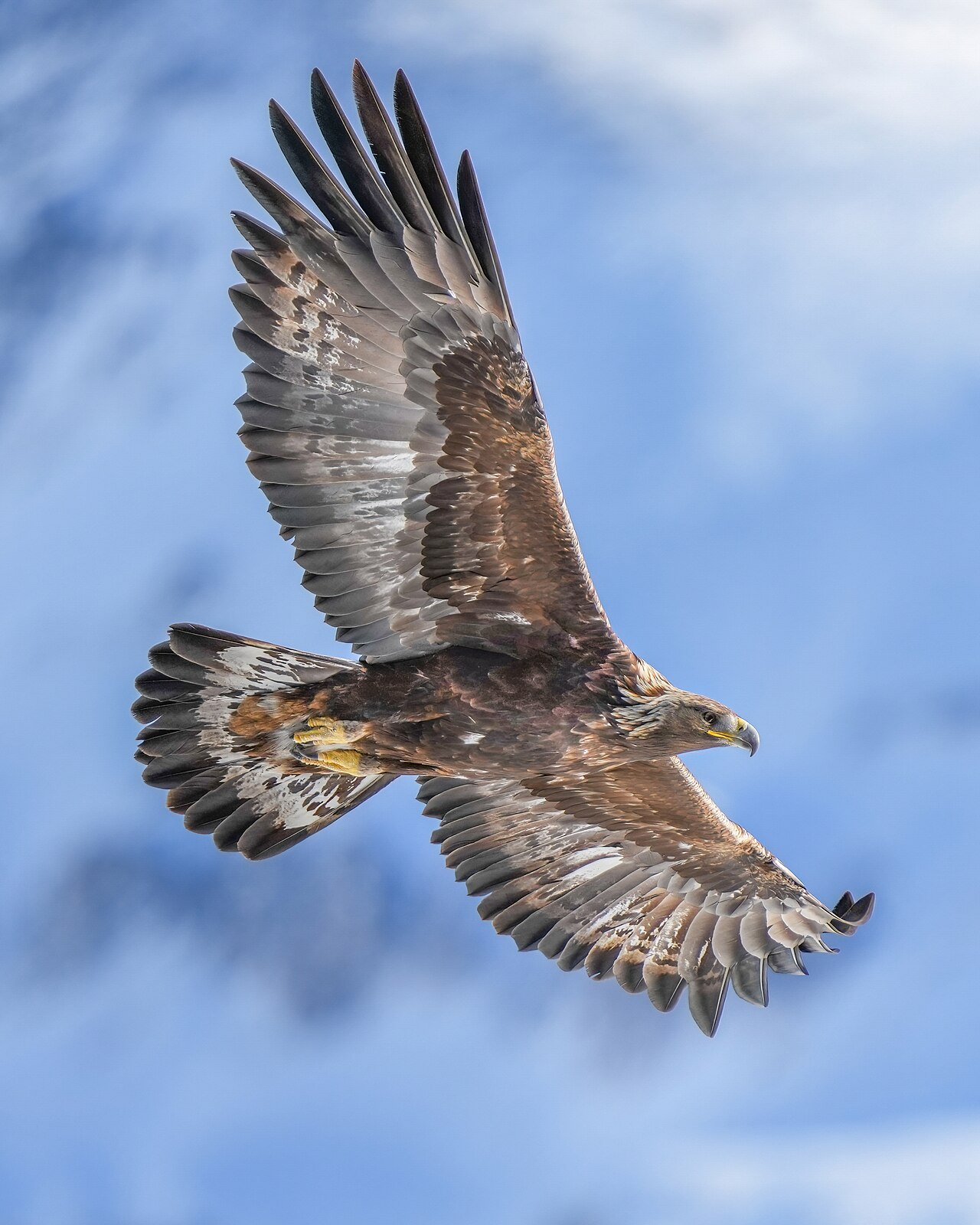
Very large, with long wings pinched at the base, soaring in a distinct shallow V; the head projects noticeably and the tail is long and slightly rounded at the tip. Adults dark brown with a golden nape. Juveniles show sharply defined white patches at the base of the primaries and a white tail base with a broad black terminal band.
Confusion species
Bonelli's eagle: smaller, white below with a pale mantle patch, and soaring on flat wings. Buzzard: far smaller and more compact with a short tail, yet deceptive at range — judge tail length, which in golden eagle exceeds the width of the wing. Young white-tailed eagle: shorter wedge-shaped tail and broader, plank-like wings.
Habitat
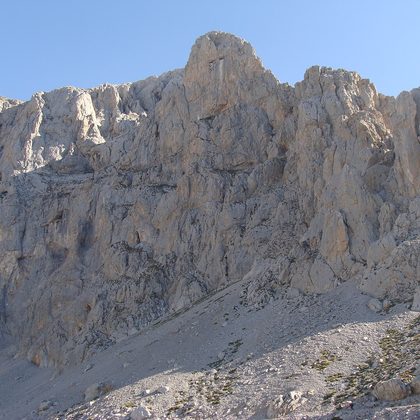
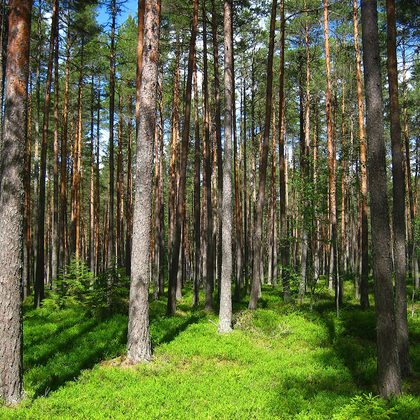
Mountain country with cliffs for the eyrie and wide open slopes, alpine pasture and holm oak or pine woodland for hunting. In Spain also low sierras, crags above dehesa and dry steppe; takes rabbits, hares, marmots and partridges, and feeds heavily on carrion in winter.
Where the bird is most at home, classified with EUNIS — the European standard for habitats.



Range and movements
In Europe chiefly the Alps, Carpathians, Scandinavia, Scotland, the Balkans and the whole Iberian interior — from the Sistema Ibérico and the Baetic ranges to the Pyrenees and the Picos de Europa — with Spain holding the largest population in western Europe. Resident, with young birds wandering widely. In the Netherlands an exceptional vagrant, usually a northern or German wanderer.
- Resident
- Breeding (summer)
- Winter
- Passage
- dark = core range, pale = thinly spread
How and when to look
March to May, mid-morning as the first thermals build: take a viewpoint facing a large cliff — the Pyrenees, Sierra de Guadarrama, Monfragüe — and scan the ridge patiently. Undulating display flights with deep dives are most obvious in February and March.
Conservation status
Stable to slowly increasing in Europe after centuries of persecution, but recovery is slow because the species breeds late and rears few young. Illegal poisoning and killing linked to game interests, lead poisoning from carcasses, collisions with turbines and power lines, and disturbance of eyries by climbers and drones remain the main threats.
Scientific name
Aquila chrysaetos | (Linnaeus, 1758)
Linnaeus described the species in 1758 as Falco chrysaëtos; because it was later moved to another genus, the author and year stand in brackets. The genus Aquila was introduced in 1760 by Brisson. Aquila is Latin for 'eagle', possibly from aquilus 'dark in colour'. chrysaetos is Greek for the golden eagle, from khrusos 'gold' and aetos 'eagle'. The specimen the first description was based on came from Sweden.