All species › Waders, gulls and terns › Sandpipers and snipes › Sanderling
Sanderling | Calidris alba
Drieteenstrandloper | Correlimos tridáctilo | Sanderling | חופית לבנה | Bécasseau sanderling
The whitest little wader of the beach, running ahead of the retreating wave and following the foam back in again. On a broad North Sea beach it is the default bird of the tideline.

Click a thumbnail to switch the photo above.
Voice
A short, hard, liquid twick or plit, often repeated two or three times on take-off and much sharper than the rasping note of Dunlin. It is heard over the beach all year, most of all in August and September when small parties shift back and forth along the tideline.
Recording: Sonothèque ADVL — CC0 · xeno-canto
Identification
Small, stocky sandpiper with a straight black bill, black legs and no hind toe. The winter plumage is the palest of any wader: pale grey above, snow-white below, with a black shoulder patch. In breeding dress head, breast and upperparts are rusty red spotted black, cut off sharply against the white belly. In flight it shows the broadest, brightest wingbar of all small sandpipers.
Confusion species
In winter no other sandpiper is this pale: Dunlin is greyer and darker, longer and more decurved in the bill, with a grey wash across the breast. The black shoulder patch and the missing hind toe settle it. In breeding plumage a rufous Sanderling can suggest Curlew Sandpiper, but that species is longer-legged, more curve-billed and red right down onto the belly.
Compare sandpipers, snipes and allies: bill, legs, wing bar and rump
Habitat
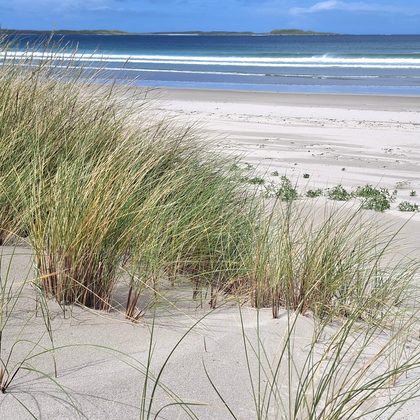
Pre-eminently a bird of the wide sandy beach, always on the wet sand where the waves run out. It also uses sandbanks, groynes and, in smaller numbers, the edges of mudflats and shell banks. At high water it rests in tight parties on dry sand or behind the tideline, often pressed up against a groyne.
Where the bird is most at home, classified with EUNIS — the European standard for habitats.


Range and movements
Breeds on the high Arctic tundra of Greenland, Svalbard, Siberia and Arctic North America; within Europe only on Svalbard. Along the southern North Sea coast it is a numerous passage migrant and winter visitor, with the largest numbers on the Wadden islands and the Zeeland beaches. Iberian sandy beaches from Galicia to Andalusia also hold substantial winter flocks.
- Resident
- Breeding (summer)
- Winter
- Passage
- dark = core range, pale = thinly spread
How and when to look
Walk a wide North Sea beach on a falling tide in September or October and follow the tideline; the birds often let you within ten metres if you keep moving steadily. At high water check fenced beach heads, where they roost. Watch for Dunlin and Curlew Sandpipers running with them, which make the size difference obvious at once.
Conservation status
Still numerous worldwide, but the trend along the East Atlantic flyway is downward. Disturbance of sandy beaches by recreation and off-lead dogs costs precious winter energy, while beach nourishment and coastal defence alter the food supply. On the high Arctic breeding grounds snowmelt and lemming cycles govern breeding success, and both are becoming less predictable.
Scientific name
Calidris alba | (Pallas, 1764)
Pallas described the species in 1764 as Trynga alba; because it was later moved to another genus, the author and year stand in brackets. The genus Calidris was introduced in 1804 by Merrem. Calidris goes back to Ancient Greek kalidris or skalidris, a name Aristotle used for an unidentified grey waterside bird. alba is Latin for 'white', after the pale winter plumage. The specimen the first description was based on came from the North Sea coast.