All species › Waders, gulls and terns › Gulls and terns › Sooty Tern
Sooty Tern | Onychoprion fuscatus
Bonte stern | Charrán sombrío | Rußseeschwalbe | שחפית כהה | Sterne fuligineuse
One of the most numerous seabirds on earth and among the most oceanic of terns: outside the breeding season it stays over open water for months and rarely settles on the sea. In Europe it is a vagrant that arrives with the remnants of tropical storms.
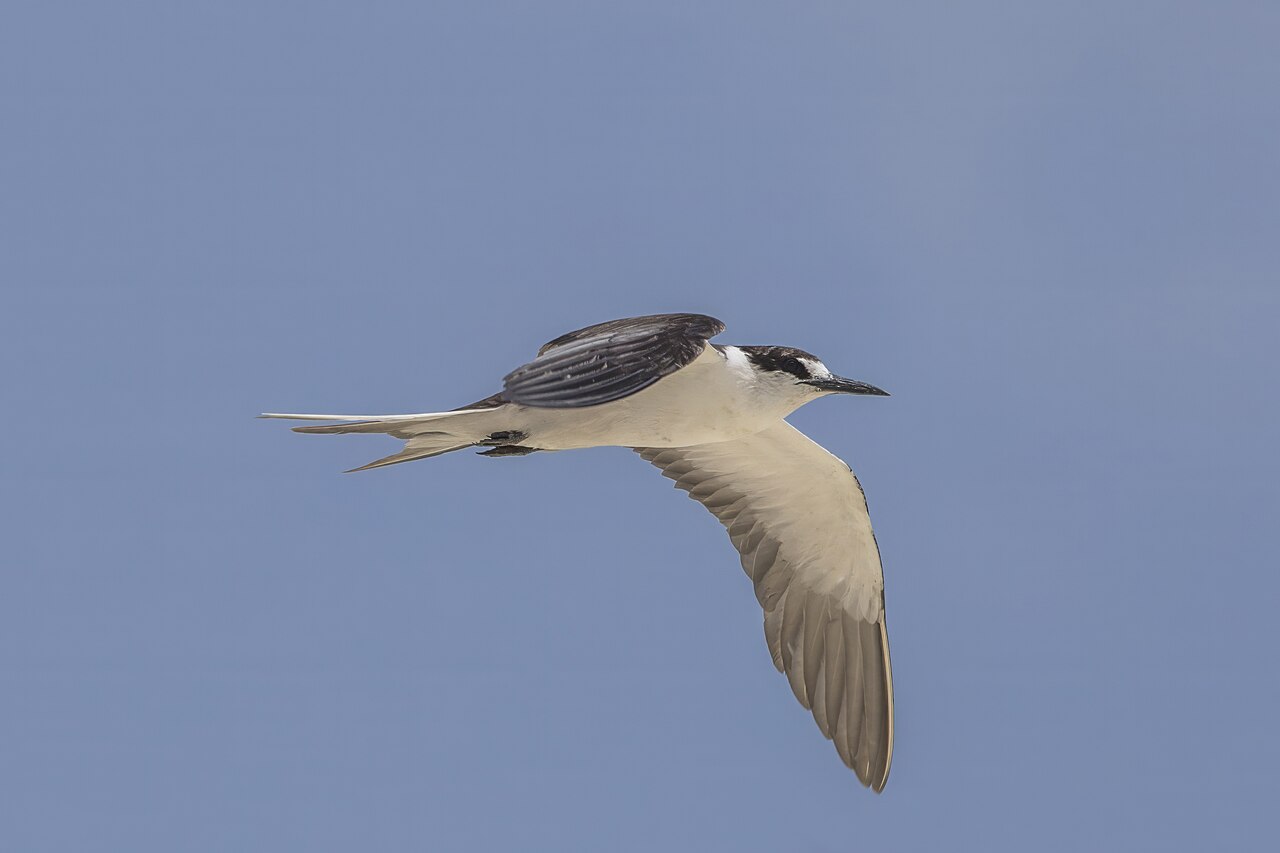
Click a thumbnail to switch the photo above.
Voice
Calls a lot at the colony, with a nasal, far-carrying ker-wack-wack written in English as wide-awake, which gave the bird its old name of Wideawake Tern. Vagrants are usually silent, though one lifting from a tern roost may call once.
Recording: Craig Robertson — CC BY-NC-SA 4.0 · Wikimedia Commons
Identification
A large, long-winged tern with black upperparts cut sharply against white underparts. The white forehead patch is broad but stops at the eye, and a black line runs from the cap to the bill. The tail is deeply forked with white outer feathers, the bill and legs are black, and the underwing is white with a dark trailing edge. Juveniles are sooty brown throughout with pale scaling on mantle and coverts and look nothing like the adult.
Confusion species
Bridled Tern is the only real problem. The back settles it: black on Sooty Tern, grey-brown and clearly paler than the cap on Bridled. The white forehead is broader on Sooty but ends at the eye, whereas on Bridled it carries on behind the eye as a narrow white brow. Bridled also shows a white collar between cap and mantle, which Sooty lacks, and more white in the outer tail feathers. Against Arctic Tern at sea the gap is wide: Arctic is smaller and pale grey above, with a translucent hand and a blood-red bill, while both tropical terns are black above and white below and fly on slower, more elastic beats.
Compare terns: bill, legs, head and tail side by side
Habitat
Open ocean, often over schools of tuna that drive small fish and squid to the surface; the birds snatch prey in flight and hardly ever dive. Colonies are on flat sand and coral islands and sometimes on bare lava. In Europe the few records are on beaches, groynes and sandbanks among Sandwich Terns after onshore gales.
Where the bird is most at home, classified with EUNIS — the European standard for habitats.



Range and movements
Breeds in all tropical oceans, the nearest colonies to Europe being on Ascension, in Cape Verde and in the Red Sea. Records in the map area are thinly scattered along the Atlantic coasts — the British Isles, the coasts of the Channel and the Bay of Biscay, Iberia and the Strait of Gibraltar — and rarely reach the southern North Sea coast, with almost all falling between June and September. Some birds ride north with the remains of tropical cyclones.
- Breeding (summer)
- Passage
- dark = core range, pale = thinly spread
How and when to look
July and August after a spell of south-westerly weather give the best chance. Work resting Sandwich Tern flocks on sandbanks and groynes and judge the bird on size and on the hard line between black upperparts and white underparts rather than on general darkness, because a dark tern in a European roost is far more often a Black Tern.
Conservation status
Not globally threatened, with a population in the tens of millions, but individual colonies are fragile. Introduced rats and cats, egg harvesting and shifts in the fish and squid the birds depend on have caused steep declines on several islands, Ascension among them.
Scientific name
Onychoprion fuscatus | (Linnaeus, 1766)
Linnaeus described the species in 1766 as Sterna fuscata; because it was later moved to another genus, the author and year stand in brackets. The genus Onychoprion was introduced in 1832 by Wagler. Onychoprion comes from Greek onux 'nail, claw' and prion 'saw'. fuscatus is Latin for 'darkened', from fuscus 'dark', after the sooty upperparts. The specimen the first description was based on came from Santo Domingo.