All species › Gamebirds › Pheasants and partridges › Western capercaillie
Western capercaillie | Tetrao urogallus
Auerhoen | Urogallo común
Europe's largest grouse, and a bird you rarely meet by chance. Outside the display season capercaillie lives hidden in old conifer forest; the cock only gives itself away in early spring, with a song that carries barely two hundred metres. At the edges of the range the species is under heavy pressure: Scotland lost its native capercaillie in 1785, and every bird there now goes back to stock brought over from Sweden, with that second population once again close to disappearing; the Cantabrian subspecies in Spain lives in beech forest rather than conifer and is counted today by droppings and genetics rather than song posts at dawn.
Click a thumbnail to switch the photo above.
Voice
The cock's song runs five to eight seconds and falls into four phases. It opens with separate clicks that accelerate, tock … tock … tock-tock-tock, like a tap beginning to run. The clicks then run together into a trill, which ends in one dry pop, exactly the sound of a cork leaving a bottle. Last and longest comes two to three seconds of whetting, tshee-kree-tshee-kree, as though a scythe were being sharpened. It is during that whetting phase that the muscles of the middle ear contract, damping the bird's own very low-frequency notes and leaving him effectively deaf for a few seconds; hunters exploited that window for centuries to close the last distance unheard. The whole performance is quiet and rarely carries beyond two hundred metres. Lek sites are used year after year and are fragile: repeated disturbance by walkers, dogs and photographers at dawn empties a lek within a few seasons. Stay on paths, keep well back, and do not walk into the wood in spring to look for the source of the sound.
Recording: Jugrü — CC BY-SA 3.0 · Wikimedia Commons
Identification
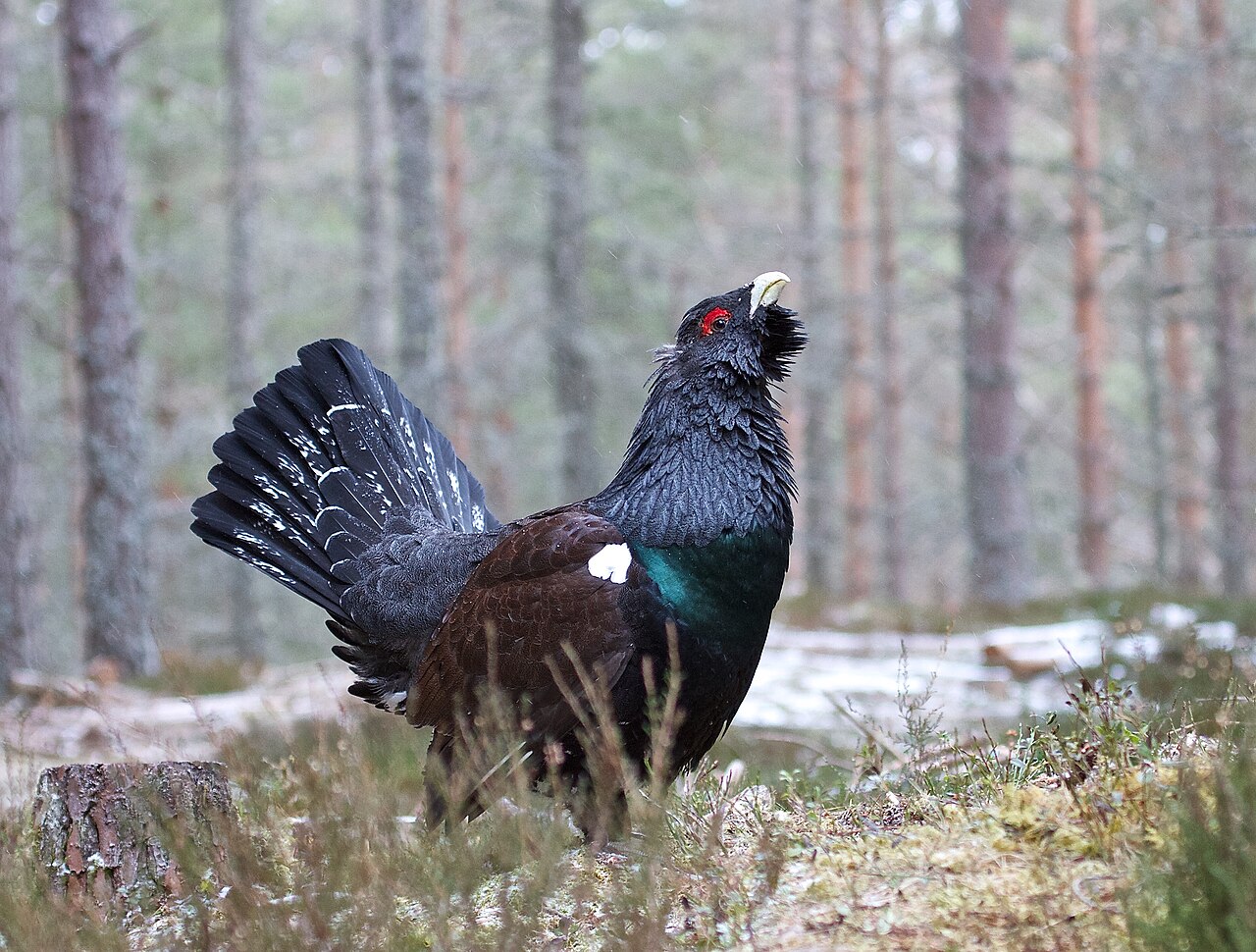
The cock is slate grey with a dark green glossed breast shield, red-brown wings, a white spot at the bend of the wing and a heavy ivory bill, with a red wattle above the eye. Displaying, he fans the tail into a broad white-flecked disc and thrusts out the pointed beard feathers below the chin. The hen is rust-brown, barred black, with an unmarked orange-buff patch in the centre of the breast and a rounded tail. The size gap is extreme: cocks weigh four to five kilos, hens rarely more than two.
Confusion species
Hens are confused with black grouse greyhens. The Capercaillie hen is much bigger, warmer rufous, shows that plain orange breast patch and a rounded tail; a greyhen is colder grey-brown, more finely barred, with a forked tail and a white wing bar. Where the two species meet, the hybrid known as the Rackelhahn also occurs, usually a male black grouse on a female Capercaillie. It is intermediate at 65–78 cm, glossy black with a copper to violet sheen on the breast, a broad but only shallowly forked tail — neither the deep lyre of black grouse nor the fan of Capercaillie — a narrow white wing bar, and a bill paler than a blackcock's but lacking the heavy ivory of a capercaillie. Hybrid males usually turn up at black grouse leks, where they bully the smaller cocks off the ground, and their calls are a hoarse mixture without the four clean phases of a real capercaillie song. They are sterile.
Habitat
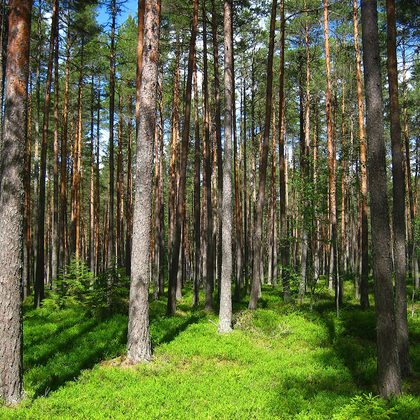
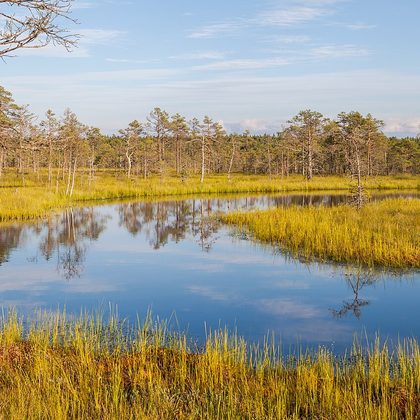
Old, open coniferous forest with light reaching the floor and a thick carpet of blaeberry, which supplies winter buds, summer fruit and the insects the chicks need. Add ant nests, an open patch for the lek, mature pines for roosting, and grit taken from track edges and burn sides. In Scandinavia and Russia bog margins and wet pinewood belong to the picture; in the Alps and Carpathians it is mixed montane and larch forest, and in the Cantabrian Mountains the birds live in old beechwood.
Where the bird is most at home, classified with EUNIS — the European standard for habitats.


Range and movements
From Scotland and the Pyrenees east through the Alps, Carpathians and Balkans, and continuously across Fennoscandia and northern Russia into Siberia, where the bulk of the population lives. The western edge is fragmented: in Scotland almost entirely inside the Cairngorms, with a scatter of birds in Easter Ross and Aberdeenshire, and gone from the rest of the British Isles; in Iberia two cores, the Cantabrian mountains and the Pyrenees with the race aquitanicus; in central Europe the Black Forest, the Alps, the Bavarian Forest and small relict populations in the uplands. From the Low Countries and the Ardennes the capercaillie has long been gone.
- Resident
- Breeding (summer)
- Winter
- Passage
- dark = core range, pale = thinly spread
How and when to look
The easiest chance is central Sweden or southern Finland, where lek watching from fixed hides in April is long established; you go in at night and stay until the birds themselves leave. In Scotland, the Cantabrian mountains and the Pyrenees do not go looking for a lek: the small populations cannot absorb the disturbance, and in Scotland you watch from the Loch Garten hide during the short capercaillie-watch season, booked in advance. In central Europe the Bavarian Forest or Šumava are the places, from the road or a viewpoint. Outside the lek season look for signs: needle debris under roost trees, cigar-shaped droppings three centimetres thick, and feathers at dust baths on sandy tracks.
Conservation status
Least Concern globally, but the Scottish story runs the other way. Numbers there peaked in the 1970s and the most recent estimate is 532 birds, roughly half the total of five years earlier, which makes a second extinction in Britain a real prospect. The Cairngorms Capercaillie Emergency Plan 2025–2030 puts some twelve million pounds behind woodland expansion and restructuring, bog restoration, grazing with cattle, diversionary feeding to take pressure off nests, and the removal or marking of deer fences, which one radio-tracking study blamed for around a third of annual adult mortality. A feasibility study into bringing in birds from mainland Europe to widen the gene pool has been completed. Wet, cold Junes that kill chicks remain the factor no plan can manage.
Scientific name
Tetrao urogallus | Linnaeus, 1758
Linnaeus described the species in 1758 and placed it straight away in the genus where it still stands. He introduced the genus Tetrao in that same work. Tetrao is the Latin word for a game bird, probably the black grouse. urogallus is a Neo-Latin form echoing the German name Auerhuhn, with Latin gallus 'cock' inside it. The specimen the first description was based on came from Sweden.