All species › Storks › Storks › White stork
White stork | Ciconia ciconia
Ooievaar | Cigüeña blanca
The white stork is a big white bird that travels on thermals and crosses the sea straits in vast flocks. In the Netherlands it has returned as a breeding bird.

Voice
Essentially voiceless. At the nest the pair greet each other by bill-clattering, a dry rattling kle-kle-kle-klepper with the head thrown back over the shoulders, mainly from March to July. Young hiss and wheeze hoarsely; otherwise this bird is silent.
Recording: felix.blume — CC BY-SA 3.0 · Wikimedia Commons
Identification
Large and white with black flight feathers, a long straight red bill and long red legs. In flight the neck is held outstretched and the feet project well beyond the tail; it soars on flat wings with spread fingers, circling in thermals. Juveniles have a duller, dark-tipped bill and brownish-black flight feathers.
Confusion species
Black stork is dark with a white belly, shyer and tied to forest streams. Great White Egret is smaller, wholly white, and flies with the neck retracted. Common crane is grey, with a black-and-white head and a bustle, migrating in V-formation while bugling. Outstretched neck plus red bill settles it instantly.
Habitat
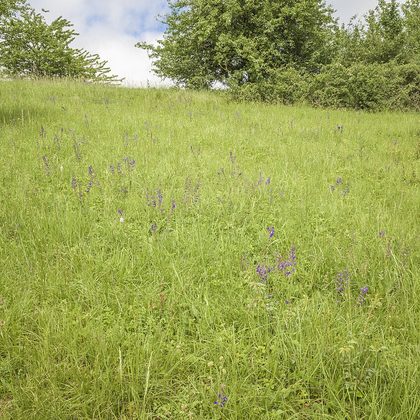
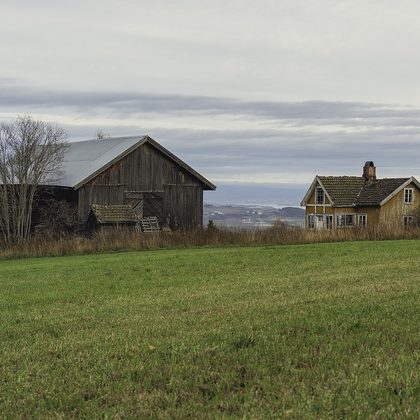
Damp grassland, stream valleys, floodplains and extensively farmed land with frogs, voles and large insects. Nests high and open: on poles, chimneys, church towers and pylons, in Iberia often in colonies on a single church roof or eucalyptus.
Where the bird is most at home, classified with EUNIS — the European standard for habitats.


Range and movements
Strong in Iberia, Poland and eastern Germany. The Dutch population, once almost extinct, has recovered through reintroduction and again breeds in stream valleys and polders. A migratory divide runs diagonally across Europe, from the German-Dutch border by way of a point east of Munich to Croatia. Birds breeding west of it cross at the Strait of Gibraltar to north-west Africa and the Niger delta; those breeding east of it — Denmark, northern Germany, Poland, the Baltic states and further east — cross at the Bosphorus and travel through the Middle East to eastern and southern Africa. Departure begins in August. A growing share no longer migrates at all and stays the winter in Iberia and France.
- Resident
- Breeding (summer)
- Winter
- Passage
- dark = core range, pale = thinly spread
How and when to look
Late March at a nest pole, when pairs clatter and build in full view. For the migration go to Tarifa in August, around midday when thermals build and hundreds of storks screw up over the strait together.
Conservation status
Strongly recovered after the twentieth-century collapse, helped by protection, reintroduction and the end of the worst persecution. Loss of damp grassland and pesticide use still bite, and collision and electrocution on power lines kill many birds each year.
Scientific name
Ciconia ciconia | (Linnaeus, 1758)
Linnaeus described the species in 1758 as Ardea ciconia; because it was later moved to another genus, the author and year stand in brackets. The genus Ciconia was introduced in 1760 by Brisson. Ciconia is the Latin word for 'stork'. The specific name repeats the genus name. The specimen the first description was based on came from Sweden.