All species › Waders, gulls and terns › Gulls and terns › Yellow-legged gull
Yellow-legged gull | Larus michahellis
Geelpootmeeuw | Gaviota patiamarilla
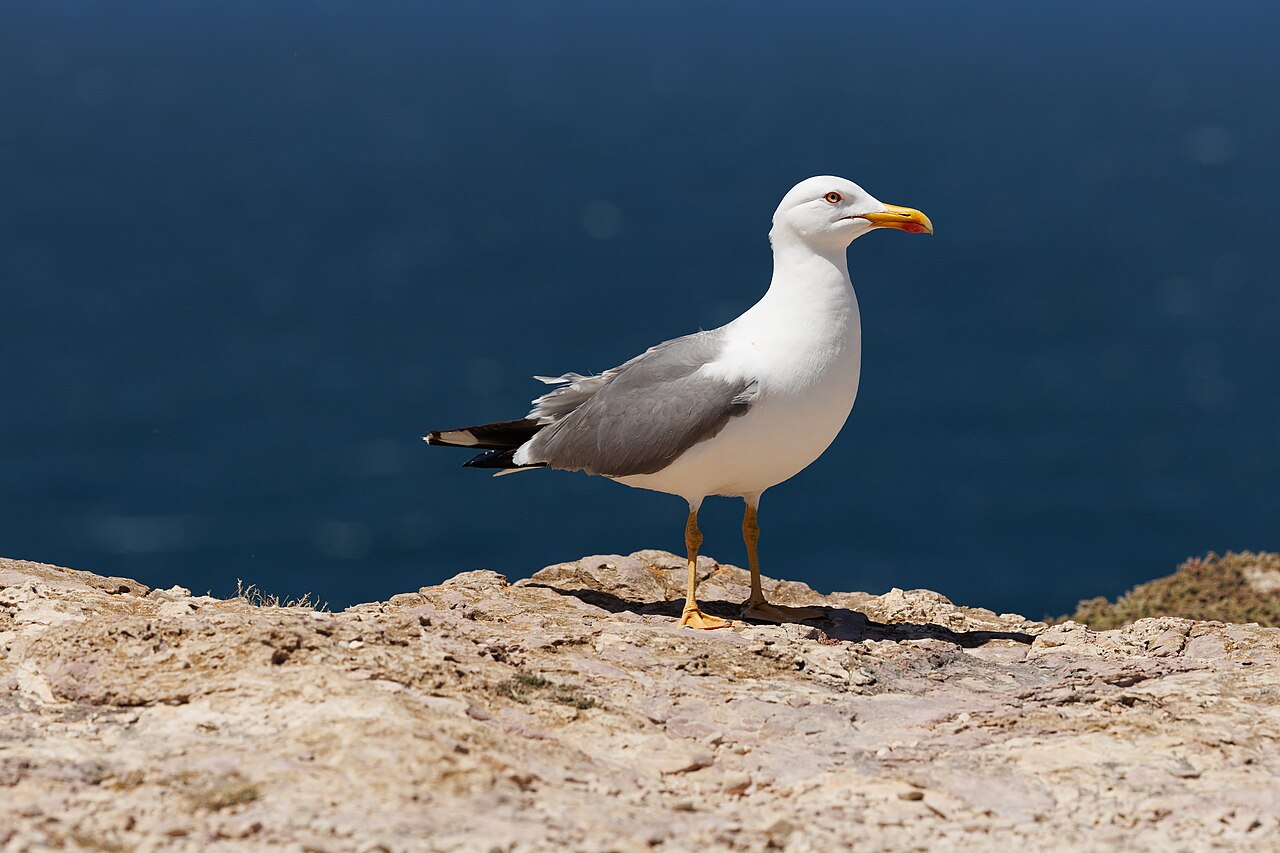
The yellow-legged gull is the big gull of the Mediterranean and the Iberian coast, and for some decades now a fixture on Dutch river sandbanks as well. Learn it in Spain and you will pick it out of a Dutch gull flock on stance and voice alone.
Click a thumbnail to switch the photo above.
Voice
Deeper and more nasal than Herring Gull, with a full, falling laughing call, gow-gow-gow, delivered head thrown back, and a short ga-ga when uneasy. In Spanish and Italian port towns it sounds year round from roofs and jetties; in the Netherlands it usually comes from a single bird among Herring Gulls. Tone is the best clue when the bird is heard and not seen: heavier and audibly hoarse against the clear wail of a Herring Gull.
Recording: Cedric Mroczko — CC BY-SA 4.0 · Wikimedia Commons
Identification
A powerful, long-legged gull with a mantle clearly darker grey than Herring Gull and clearly paler than Lesser Black-backed. The legs are bright chrome yellow, the eye pale yellow inside a thick, vivid red orbital ring, and the heavy bill has a strong gonydeal angle with a large red spot that often bleeds onto the upper mandible. The moult schedule matters: the head is snow white already in August and September, without the smudgy winter streaking a Herring Gull acquires at exactly that time. The wingtip carries a lot of black, with one clear mirror on p10 and at most a small one on p9, giving a heavy black wedge in flight. First-years are strikingly contrasty: a dark mask around the eye, an early white head and underparts, chequered greater coverts, plain dark tertials with a narrow pale tip, and a white rump cutting sharply against a crisp black tail band.
Confusion species
Herring Gull is the first test: paler grey mantle, flesh-pink legs, a smaller red bill spot, and in autumn and winter a streaked, dirty head while the Yellow-legged is already white. Caspian gull is the harder case: a long, parallel-sided bill without a marked gonydeal angle, a small and often dark eye in a sloping forehead, longer dull pink to yellowish legs, more white in the outer primary and a whiter-looking underwing; it looks long and pear-shaped where the Yellow-legged looks angular and burly. Lesser black-backed gull also has yellow legs, but a far darker slate mantle that at distance reads almost black against the white body. In first-years the cards fall differently: Caspian shows plain grey scapulars and a pale head, Yellow-legged coarser chequered coverts and a dark eye mask.
Habitat
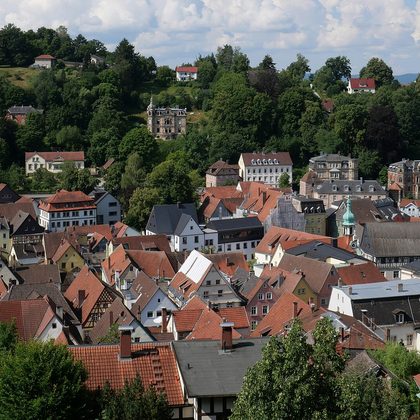
Rocky coasts, cliffs, beaches, salt pans, harbours, reservoirs, river sandbanks, landfills and flat city roofs. It breeds colonially on rocky islets and cliffs and increasingly on buildings, from Barcelona to Rome. In the Netherlands it favours sand and mud flats along the big rivers, the Delta and industrial sites, almost always among Herring and lesser black-backed gulls.
Where the bird is most at home, classified with EUNIS — the European standard for habitats.





Range and movements
The core range is the Mediterranean, the Atlantic coasts of Iberia and Morocco and the offshore islands; in Iberia it is the default large gull along virtually the whole coast and on the big inland reservoirs. From there it pushes north through France and Switzerland into Germany and the Low Countries, where it is a scarce but rapidly increasing visitor to the large rivers and estuaries, peaking from July to October, with a handful of pure breeding records since 2011.
- Resident
- Breeding (summer)
- Winter
- Passage
- dark = core range, pale = thinly spread
How and when to look
In August or September walk a sandbank on a large river or in an estuary in north-west Europe — the Rhine branches and the Delta are the classic ground — and look for the bird with the snow-white head among the streak-headed Herring Gulls. Then work downwards: mantle tone against the neighbouring bird, then legs, then orbital ring and bill spot. Around the Mediterranean the species is best nailed at a fishing harbour at sunrise, where birds rest at short range and every plumage stage is lined up beside the next.
Conservation status
Not threatened; the species has profited for decades from fishery discards, landfill and rooftop nesting, and is expanding across most of western Europe. That growth has a downside: in the Mediterranean yellow-legged gulls crowd out smaller colonial seabirds such as audouin's gull and storm-petrels, and on some islands numbers are actively managed. In the Netherlands the species increases year on year and a breeding record in a mixed colony is now a realistic prospect.
Scientific name
Larus michahellis | Naumann, 1840
Naumann described the species in 1840 and placed it straight away in the genus where it still stands. The genus Larus was introduced in 1758 by Linnaeus. Larus is Latin, from Ancient Greek laros, and appears to have referred to a gull or another large seabird. michahellis honours the German zoologist Karl Michahelles (1807–1834). The specimen the first description was based on came from the coast of Dalmatia.