All species › Waders, gulls and terns › Gulls and terns › European herring gull
European herring gull | Larus argentatus
Zilvermeeuw | Gaviota argéntea
The Herring Gull is the yardstick against which every other large gull is measured, and precisely for that reason it has become a difficult bird. Since Yellow-legged and Caspian gull were split off, every individual deserves a second look.
Click a thumbnail to switch the photo above.
Voice
Loud and nasal. The long call, kyow-kyow-kyow, is delivered with the head thrown back and is heard all year, though most intensely at colonies from March to July. Alarm is a short barking ga-ga-ga, and juveniles give a plaintive mewing begging note.
Recording: Sonothèque ADVL — CC0 · Wikimedia Commons
Identification
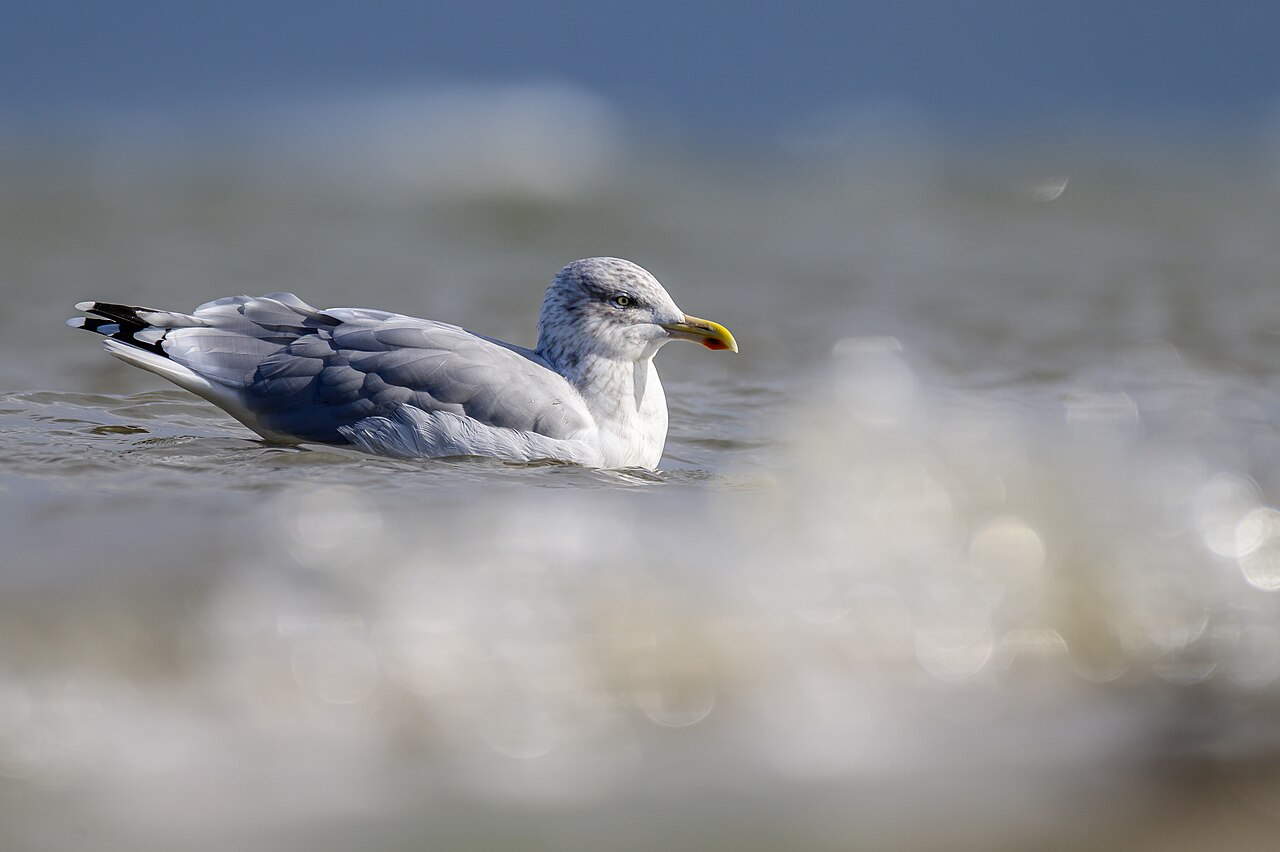
Adult: pale grey mantle, black primaries with white mirrors, pink legs, yellow bill with a red gonys spot, and a pale yellow eye set in an orange-yellow ring. Immatures take four calendar years, from mottled brown with a dark tail band to steadily greyer mantles. Males are bigger, flatter-headed and thicker-billed than females.
Confusion species
Yellow-legged gull: darker grey mantle, bright yellow legs, more black in the wingtip, and a fierce expression on a smallish head. Caspian gull: long-bodied with a pear-shaped head, long slim dark bill, long pale legs and a small dark eye; often droops its wings. Lesser Black-backed is slate-grey with yellow legs.
Habitat
Coasts, harbours, piers and high-tide roosts, but equally warehouse roofs and housing estates, landfills and freshly ploughed fields inland. Breeds in dunes, on shell banks and on flat roofs, often in loose colonies alongside other gulls.
Where the bird is most at home, classified with EUNIS — the European standard for habitats.




Range and movements
A coastal bird of north-west Europe. In the Netherlands a common breeder in dunes, on the Wadden islands and in port cities, present all year. In Spain it is scarce: essentially a winter visitor to the Cantabrian coast and Galicia, where yellow-legged gull is the default large gull.
- Resident
- Breeding (summer)
- Winter
- Passage
- dark = core range, pale = thinly spread
How and when to look
Winter is gull season. In December or January pick a fishing harbour or a high-tide roost and work through the flock in morning light: mantle shade first, then leg colour, then head shape and expression. Take your time, since many birds stand around for hours.
Conservation status
Despite the numbers, breeding populations in the Netherlands and north-west Europe have declined for decades. Reduced fishery discards and the closure of landfills removed easy food, and ground colonies suffer heavily from fox predation. Roof-nesting in towns, by contrast, keeps increasing.
Scientific name
Larus argentatus | Pontoppidan, 1763
Pontoppidan described the species in 1763 and placed it straight away in the genus where it still stands. The genus Larus was introduced in 1758 by Linnaeus. Larus is Latin, from Ancient Greek laros, and appears to have referred to a gull or another large seabird. argentatus is Latin for 'decorated with silver', after the silvery grey plumage. The specimen the first description was based on came from Christiansø, Denmark.