All species › Waders, gulls and terns › Gulls and terns › Caspian gull
Caspian gull | Larus cachinnans
Pontische meeuw | Gaviota del Caspio
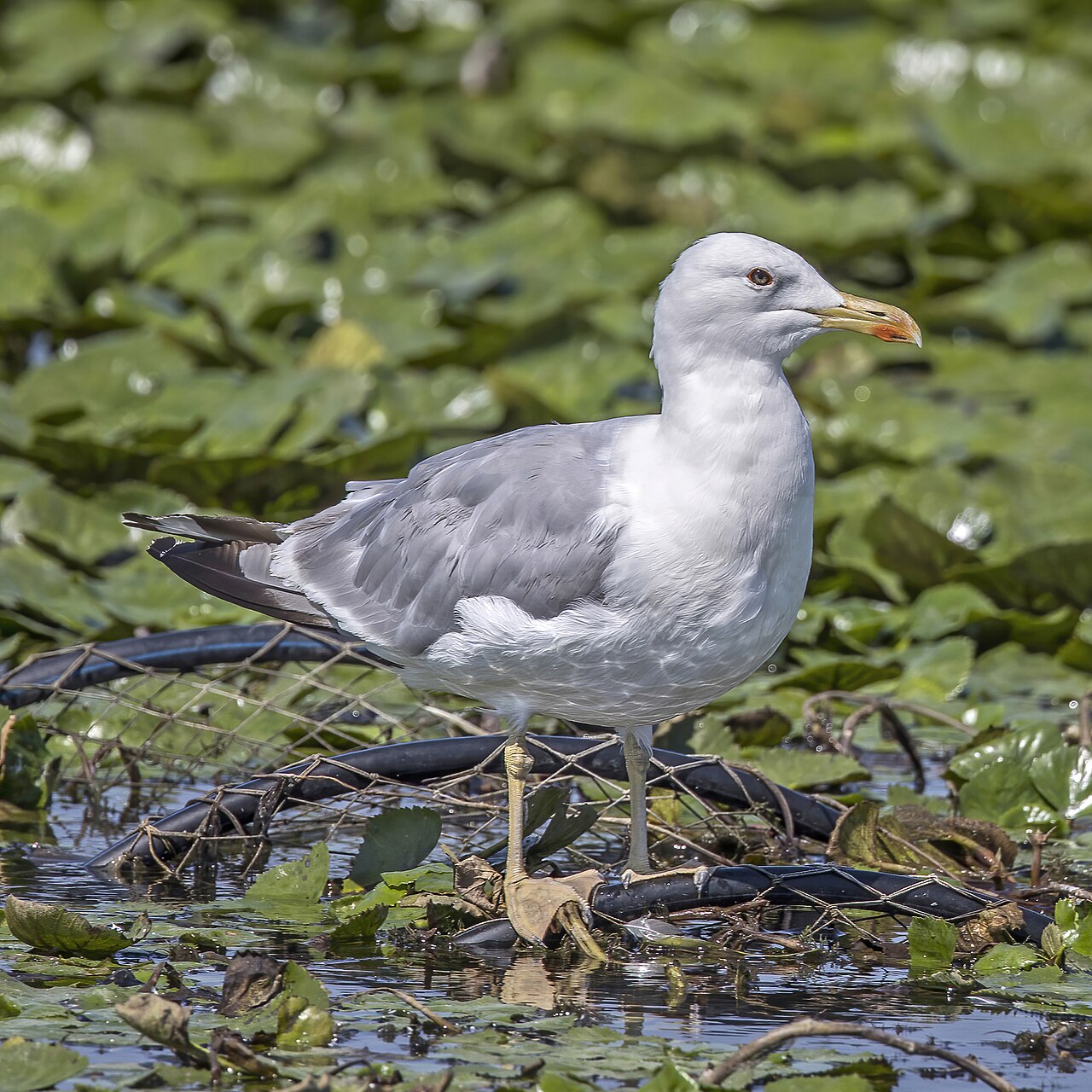
The Caspian gull is a long-bodied, long-legged large gull with a pear-shaped head and a small dark eye. Since the 1980s it has increased fast in the Netherlands along rivers and landfills.
Voice
Deeper and more nasal than Herring Gull. The long call is a hoarse, wailing aaauw-a-a-a, delivered with the body bowed low and the wings raised in the so-called albatross posture. Heard mainly during territorial behaviour in spring, but also in winter at landfills and roosts, where displaying birds give themselves away.
Recording: Sonothèque ADVL — CC0 · xeno-canto
Identification
Winter adults have an almost pure white, unstreaked head, a small dark eye, a long slim bill with weak gonys and red spot, long pale pinkish legs and a mid-grey mantle between Herring and yellow-legged gull. The wingtip shows much black, a large mirror and a long grey tongue on the outer primary. First-winters are white-headed, with black bill, notched greater coverts, narrowly fringed tertials and a narrow tail band.
Confusion species
Yellow-legged gull is stockier and blunter-headed, with bright yellow legs, a thick bill with a heavy gonydeal angle, a darker slate-grey mantle and more black in the tip; its juvenile plumage is warmer brown with broadly fringed tertials. Herring Gull is paler grey, heavily streaked about the head in winter, with pink legs and a pale yellow eye. When in doubt, judge structure, bill shape and the tertial pattern.
Habitat
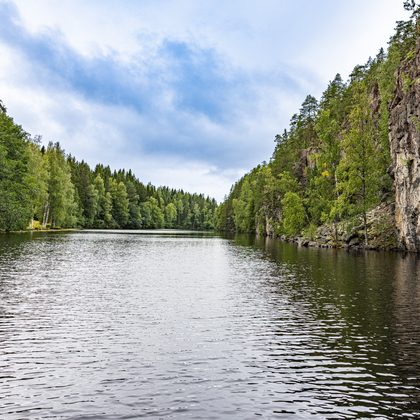
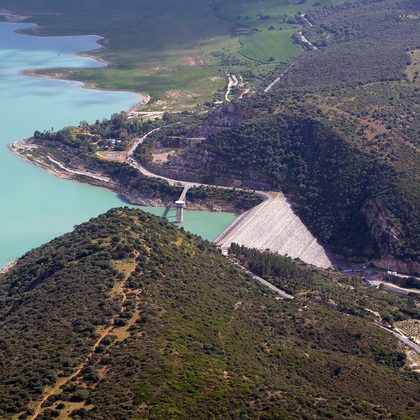
Originally a bird of steppe lakes, river islands and inland salt lakes. In western Europe mainly on large rivers, reservoirs, sand-extraction lakes, landfills and harbours, and less maritime than Herring or yellow-legged gull. Roosts in large mixed gull flocks on open water, sandbanks and reclaimed ground.
Where the bird is most at home, classified with EUNIS — the European standard for habitats.


Range and movements
Breeds from Poland and Ukraine to Central Asia, expanding west along the Vistula, Oder and Rhine; the Netherlands now has small breeding numbers and substantial passage and wintering numbers along the large rivers and in the Delta. In Spain it is a rare but near-annual vagrant, usually picked out among large gulls on the coast.
- Resident
- Breeding (summer)
- Winter
- Passage
- dark = core range, pale = thinly spread
How and when to look
November to February is the best window. Settle at a landfill or a river pumping station in late afternoon as gulls arrive to roost, and scan systematically for a long, white-headed bird with a slim bill. Photograph any candidate: leg colour, tertial pattern and the primary pattern are often easier to judge at home.
Conservation status
It has increased strongly in Europe and expanded its range, partly on food from landfills and rivers. Landfill closure and the removal of fishery discards may slow that growth. Hybridisation with Herring and yellow-legged gull in the contact zones is increasing and complicates both identification and the monitoring of numbers.
Scientific name
Larus cachinnans | Pallas, 1811
Pallas described the species in 1811 and placed it straight away in the genus where it still stands. The genus Larus was introduced in 1758 by Linnaeus. Larus is Latin, from Ancient Greek laros, and appears to have referred to a gull or another large seabird. cachinnans is Latin for 'laughing', from cachinnare 'to laugh out loud', after the call. The specimen the first description was based on came from the Caspian Sea.