All species › Passerines › Wrens › Northern House Wren
Northern House Wren | Troglodytes aedon
Huiswinterkoning | Chivirín saltapared | Corruíra-do-norte
The Northern House Wren in the strict sense is the northern member of the House Wren complex: it breeds in North America and winters south to Mexico. In the guide area it is replaced by Southern House Wren, which occurs everywhere there. Older reports of Troglodytes aedon from South America almost always refer to that species.
Voice
A rapid, bubbling song of trills and descending series of notes; the call is a grating chrr and a dry tick.
Recording: JAYRSON ARAUJO DE OLIVEIRA — CC BY-NC-SA 4.0 · xeno-canto
Identification
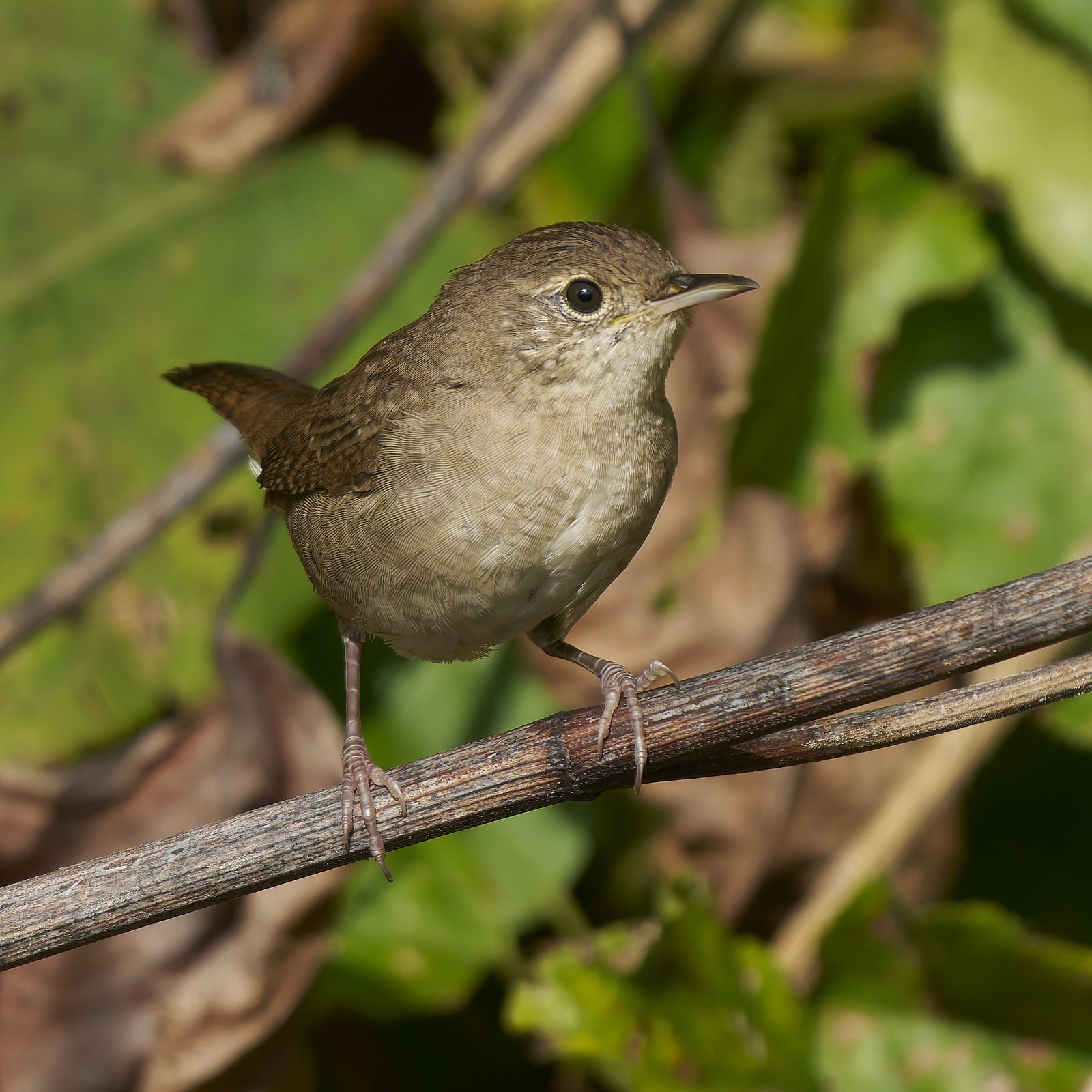
11–12 cm, with a thin, slightly decurved bill and a fairly short tail. The upperparts are grey-brown, with fine dark barring on the wings and tail. A narrow, pale supercilium is inconspicuous. The underparts are pale grey to dull brownish grey, with fine barring on the flanks and undertail coverts. The sexes are alike.
Confusion species
Southern House Wren Troglodytes musculus is warmer brown, with buffier underparts and shorter wings, and is the only house wren in the guide area. Mountain Wren Troglodytes solstitialis is more rufous-brown, with a distinct buff supercilium, and lives in montane forest.
Habitat
On the breeding grounds in open woodland, forest edges, gardens, parks and shrubbery; in winter also in scrub and rough ground. It eats insects and spiders. It nests in cavities, including nest boxes.
Where the bird is most at home, classified by the vegetation units of the Andes and the west coast.


Range and movements
Not reliably recorded in the guide area; reports under this name from Colombia, Ecuador, Peru and Bolivia refer to Southern House Wren. Absent from the Galápagos. Outside the guide area it breeds in southern Canada and the United States and winters in the southern United States and Mexico.
- Resident
- dark = core range, pale = thinly spread
How and when to look
A house wren in the guide area is almost always a Southern House Wren. A bird identified as a Northern House Wren should be well documented, preferably with sound recordings.
Conservation status
Not Evaluated as a separate species; the Red List treats the house wrens as one species, which is listed as Least Concern. The northern form is widespread and common.
Scientific name
Troglodytes aedon | Vieillot, 1809
Vieillot described the species in 1809 and placed it straight away in the genus where it still stands. He introduced the genus Troglodytes in that same work. The genus name comes from Greek trōglodutēs, 'cave-dweller', after the wrens' habit of creeping into and nesting in cavities. The species name comes from Greek aēdōn, 'nightingale' or 'songstress', for the song; in Greek myth Aëdon was turned into a nightingale. The specimen the first description was based on came from New York, United States.