All species › Owls › Barn owls › Ashy-faced Owl
Ashy-faced Owl | Tyto glaucops
Hispaniolakerkuil | Lechuza cara ceniza
The Ashy-faced Owl is a Caribbean barn owl with a grey facial disc. It was long regarded as endemic to Hispaniola, but on genetic grounds the dark barn owls of Dominica and of St Vincent, the Grenadines and Grenada are now usually included in this species. On Hispaniola it lives alongside American Barn Owl Tyto furcata, which became common there only in the twentieth century.

Voice
A hoarse, rasping scream of two to three seconds, shorter and less drawn out than that of American Barn Owl, often preceded by a series of rapid, higher clicking notes. Also hissing, snoring and twittering sounds.
Recording: Jonathan M — CC BY-NC 4.0 · Converted to mp3, mono, full length · iNaturalist
Identification
33–35 cm, a barn owl with a heart-shaped silvery-grey facial disc framed by a narrow rufous rim, and dark eyes. The upperparts are dark grey-brown with fine pale and dark vermiculation and small white dots; the wings are mottled buff. The underparts are warm tawny with dark arrowhead spots and barring. The legs are long and grey-brown. Birds on Dominica and in the southern Lesser Antilles are darker and more rufous below, with a browner disc. Females are clearly heavier than males.
Confusion species
American Barn Owl Tyto furcata has a white facial disc and white to pale buff underparts, and looks much paler in flight. Short-eared Owl Asio flammeus has yellow eyes, short ear tufts and a streaked breast.
Habitat
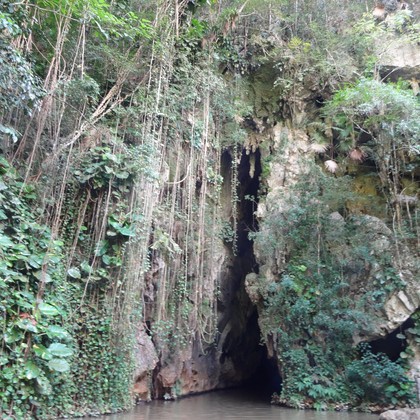
Open woodland, dry and moist broadleaf forest, limestone country with caves, scrub, farmland with trees, plantations and village edges, from sea level to above 2,000 m. It roosts and nests in caves, rock crevices, hollow trees and buildings. It eats mainly small mammals, but takes more birds, frogs and reptiles than American Barn Owl.
Where the bird is most at home, classified by the vegetation types of the Caribbean.






Range and movements
Hispaniola (Haiti and the Dominican Republic) with Île de la Tortue; also Dominica (subspecies nigrescens) and St Vincent, Bequia, Union, Carriacou and Grenada (subspecies insularis). Widespread and locally common on Hispaniola; rare on St Vincent and Grenada. The species does not occur outside the region.
- Resident
- Winter visitor (c. Apr–Sep)
- Passage (Mar–Apr, Oct–Nov)
- dark = core range, pale = thinly spread
How and when to look
On Hispaniola best at night in limestone country with caves and open woodland, for example in the dry south-west of the Dominican Republic. On Dominica it is sometimes heard at dusk along forest edges and village outskirts. A barn owl with a grey face on Hispaniola is this species.
Conservation status
Not threatened; the Hispaniolan population is thought to be stable. Little is known about the Lesser Antillean birds. American Barn Owl competes with it for food on Hispaniola, but the effect has not been established.
Scientific name
Tyto glaucops | (Kaup, 1853)
Kaup described the species in 1853 as Strix glaucops; because it was later moved to another genus, the author and year stand in brackets. The genus Tyto was introduced in 1828 by Billberg. Tyto comes from Ancient Greek tutō 'owl'. glaucops is Greek, from glaukos 'bluish-grey' and ōps 'face', after the grey facial disc. The specimen the first description was based on came from Hispaniola (originally given in error as Jamaica).