All species › Owls › Barn owls › American Barn Owl
American Barn Owl | Tyto furcata
Amerikaanse kerkuil | Lechuza de campanario
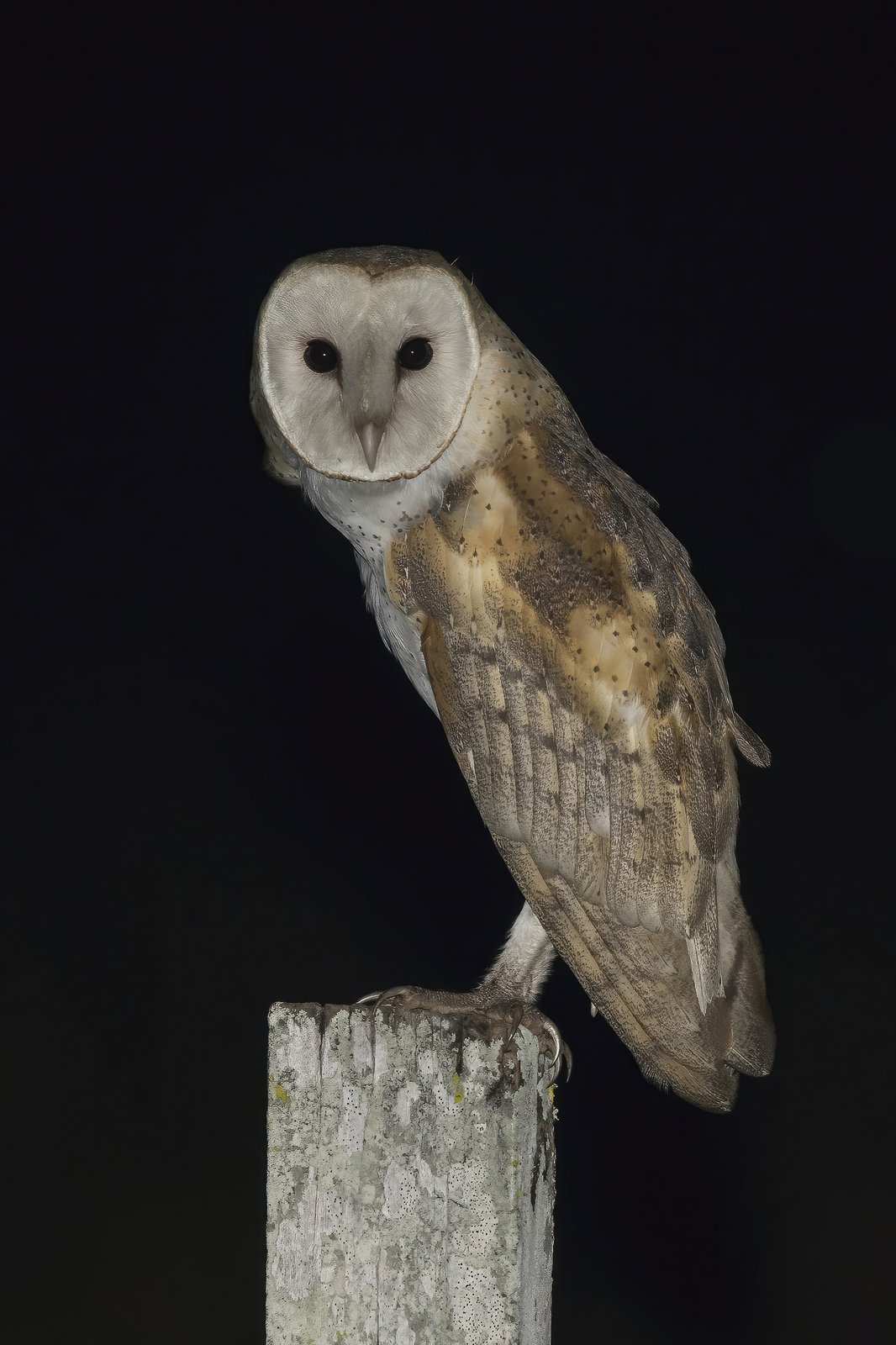
The American Barn Owl is the barn owl of North, Central and South America, now usually treated as a species separate from Western Barn Owl Tyto alba. In the Caribbean it lives in the Greater Antilles, the Bahamas, the Cayman Islands, the ABC Islands and Trinidad and Tobago. It hunts strictly at night, quartering low over open ground and locating prey mainly by ear.
Voice
A drawn-out, hoarse, rasping scream, roughly shrrreeeh, often given in flight. At the nest and when disturbed it hisses; young beg with a persistent snoring sound. Alarmed birds also snap their bills.
Recording: JAYRSON ARAUJO DE OLIVEIRA — CC BY-NC-SA 4.0 · shortened to the first 60 s, mono · xeno-canto
Identification
32–40 cm, with a large heart-shaped white facial disc, dark eyes and long feathered legs. The upperparts are golden buff washed with grey and finely dotted black and white; the underparts range from white to pale buff with small dark spots. In flight the bird looks almost entirely white from below, with long rounded wings and a short tail. Females are on average larger and often warmer-toned and more heavily spotted on the breast than males.
Confusion species
Hispaniola also holds Ashy-faced Owl Tyto glaucops, which has a grey facial disc with a rufous rim and darker buff, more heavily barred underparts. Short-eared Owl Asio flammeus also hunts over open ground, but has yellow eyes set in dark surrounds, short ear tufts and a streaked breast, and flies more often by day.
Habitat
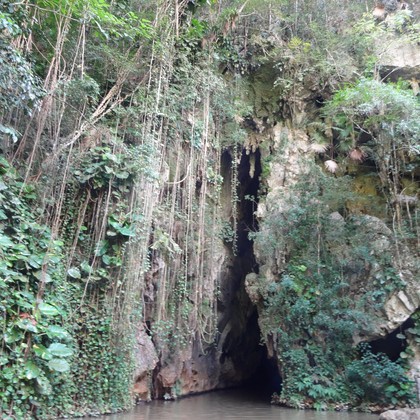
Open and semi-open country: savanna, pasture, sugar cane and other fields, rough ground and dry forest with clearings, also villages and towns. By day it roosts in caves, rock crevices, hollow trees, palms, church towers, barns and derelict buildings, where it also nests. Food is mainly rats and mice, supplemented on islands with bats, birds, lizards and frogs.
Where the bird is most at home, classified by the vegetation types of the Caribbean.





Range and movements
Resident in Cuba (with Isla de la Juventud), Jamaica, the Bahamas, the Cayman Islands (mainly Cayman Brac and Little Cayman, rare on Grand Cayman), Hispaniola, Curaçao and Bonaire, and Trinidad and Tobago. On Hispaniola the species became common only during the twentieth century. The barn owls of the Lesser Antilles are now placed with Ashy-faced Owl. Outside the region from Canada to Tierra del Fuego.
- Resident
- dark = core range, pale = thinly spread
How and when to look
Best at dusk near old buildings, churches, caves and cane fields, or at night along country roads through open land, where the white underside shows up in a torch beam or headlights. Pellets and white droppings below a roost give away an occupied site.
Conservation status
Not threatened. Forest clearance and expanding agriculture tend to create new hunting habitat for this species. Road deaths, rat poison and the loss of nest sites in old buildings are local risks.
Scientific name
Tyto furcata | (Temminck, 1827)
Temminck described the species in 1827 as Strix furcata; because it was later moved to another genus, the author and year stand in brackets. The genus Tyto was introduced in 1828 by Billberg. Tyto comes from Ancient Greek tutō 'owl'. furcata is Latin for 'forked', from furca 'fork'; exactly what Temminck was referring to is unclear. The specimen the first description was based on came from Cuba.