All species › Pelicans, herons and ibises › Hamerkop
Hamerkop | Scopidae
Hamerkop | Avemartillo
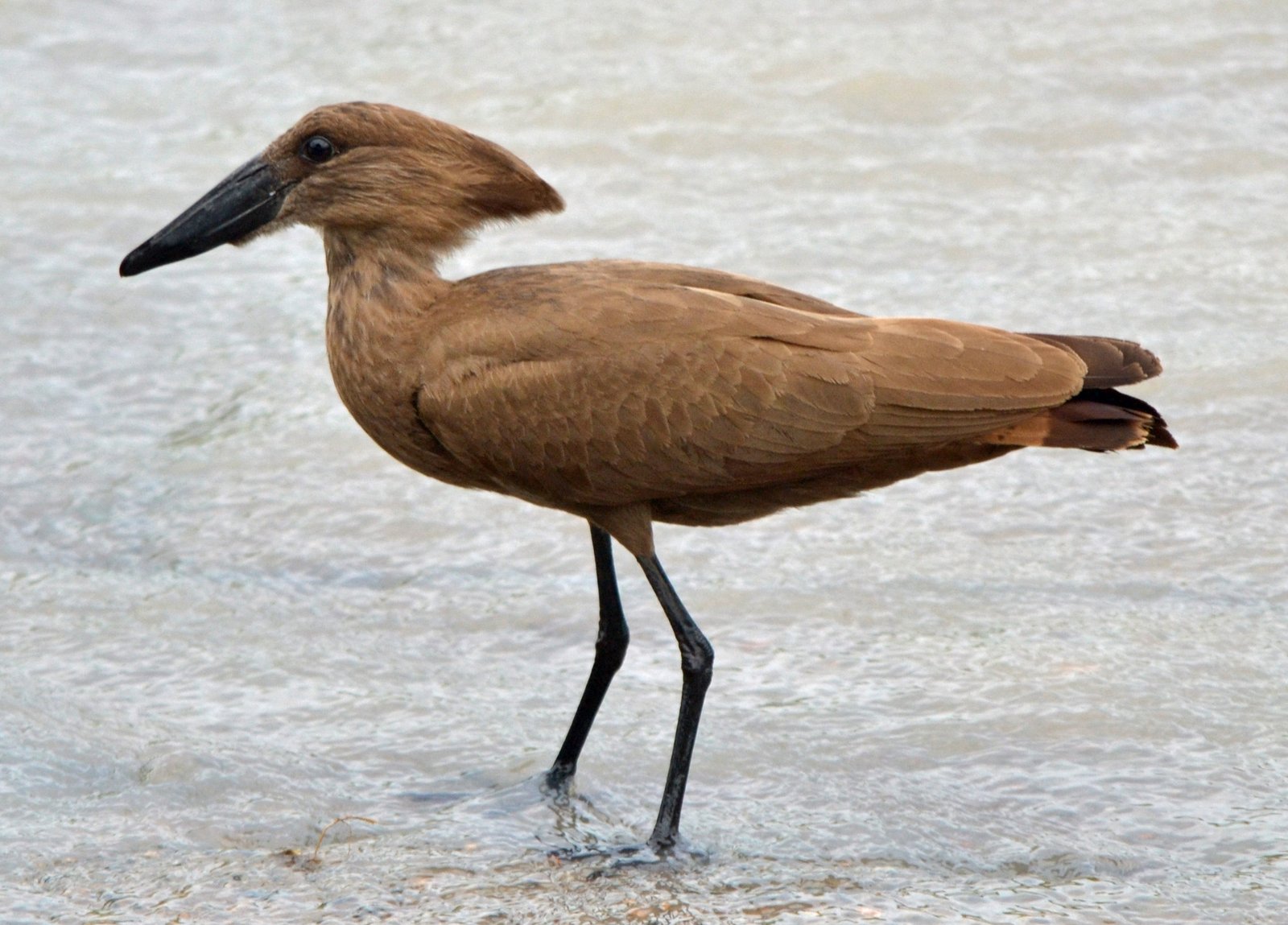
A single medium-sized species, uniformly dull brown with a purple gloss on the back and a faintly barred tail, whose outline is set by the heavy, laterally flattened bill with its slightly hooked tip and the broad crest at the back of the head directly opposite it — together the hammer head from which the bird takes its name. Molecular work places this monotypic family with the pelicans, herons and Shoebill in the Pelecaniformes, no longer with the storks, where appearance long kept it. It forages alone or in twos in the shallows of rivers, vleis, stock ponds and estuaries, searching as it walks with short shuffling paces, stirring the bottom with one foot and at times spreading the wings as a shade canopy; the food consists mainly of frogs and small fish. The nest is out of all proportion to the bird: a domed structure of thousands of sticks, reeds and mud, up to a metre and a half across, in a tree fork or on a rock ledge, with a narrow entrance underneath and an inner chamber holding the three to seven eggs. A pair builds several a year; abandoned nests are taken over by owls, geese, genets and snakes.
Native species 1 species
Species that occur here by nature: breeding birds, winter visitors and passage migrants. They are arranged by genus, in the sequence of the list.
Scopus 1 species