All species › Pelicans, herons and ibises › Hamerkop › Hamerkop
Hamerkop | Scopus umbretta
Hamerkop | Avemartillo
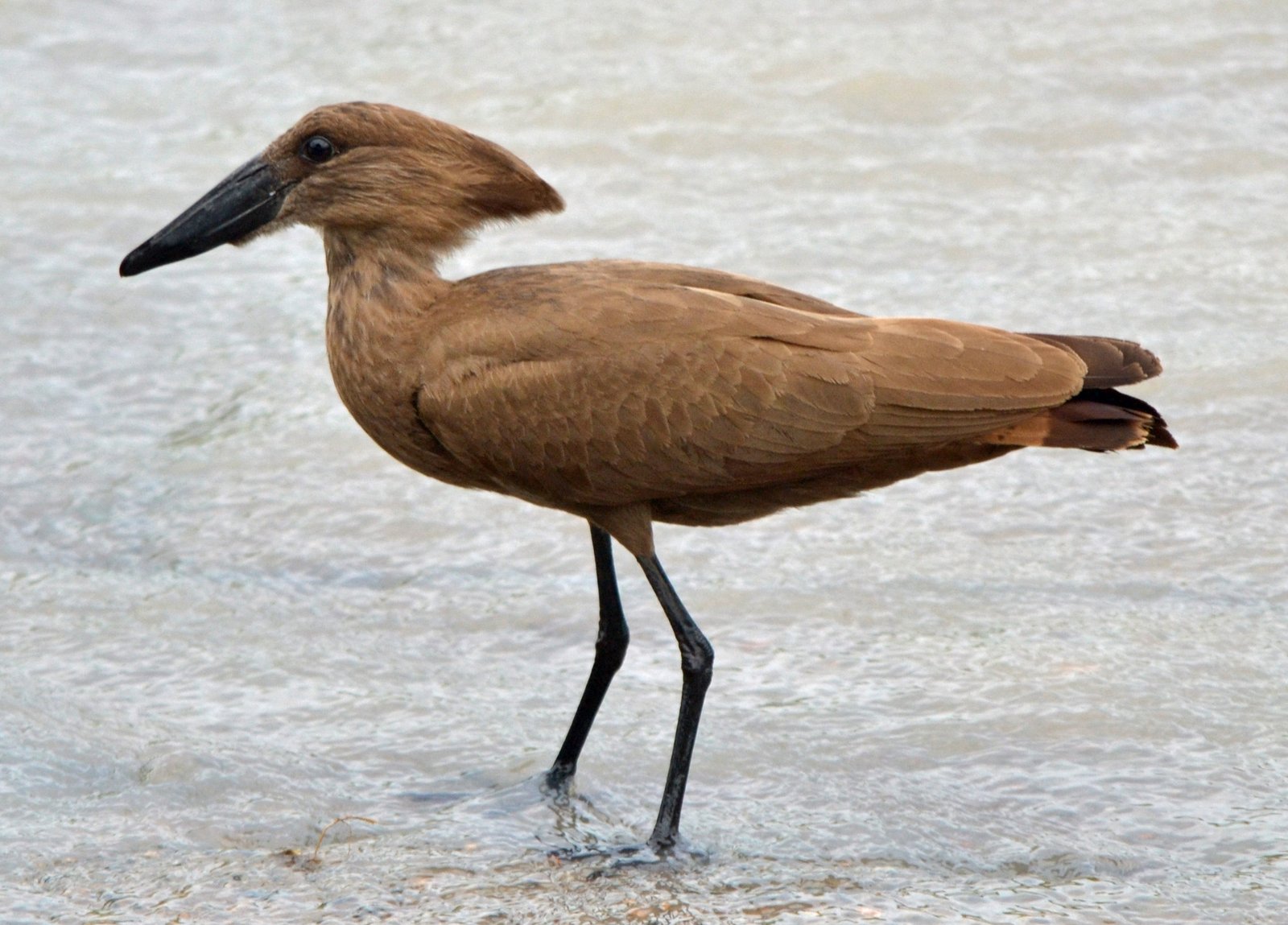
The Hamerkop is a plain brown wading bird with a heavy, laterally flattened bill and a thick backward-pointing crest, so that the head is hammer-shaped in profile. It builds a domed stick nest more than a metre across, the largest nest of any African bird relative to its builder.
Voice
A loud, high nasal yip-purr and a fast rattling cackle, kek-kek-kek-kek, usually in flight or during group gatherings in which five to ten birds circle one another, climb on each other's backs and call continuously.
Recording: GABRIEL LEITE — CC BY-NC-SA 4.0 · converted to mono · xeno-canto
Identification
About 55 cm, wholly dull brown with a faint purple gloss on the back and vague barring on the tail. The bill is black, deep and laterally compressed, with a small hook at the tip. The backward-pointing nape crest together with the bill gives the hammer-headed outline. The legs are short and black, with partial webbing between the middle toes. The sexes are alike and juveniles resemble adults. It flies with the neck partly retracted, on slow deep wingbeats, and at times soars in circles.
Confusion species
No confusion is possible within the region: no other brown wading bird has this hammer-shaped head. At distance or in flight the silhouette can suggest a brown raptor or an ibis, but the heavy bill aligned with the nape crest settles it at once.
Habitat
The margins of rivers, streams, pans, dams, estuaries and temporary pools, down to irrigation ditches and stock troughs. It shuffles its feet in shallow water to flush prey, flutters briefly and stabs. Food is mainly amphibians, especially clawed frogs, with larvae, small fish and aquatic insects. A tree fork or a rock ledge is needed for the nest.
Where the bird is most at home, classified by the vegetation units of southern Africa.

Range and movements
Distributed across virtually the whole region wherever fresh water with shallow margins occurs; scarce in the driest parts of Namibia and the western Karoo. Beyond the region it occupies almost all of sub-Saharan Africa, and also Madagascar and south-western Arabia.
- Resident
- Summer visitor (c. Oct–Mar)
- Winter visitor (c. Apr–Sep)
- Passage (Mar–Apr, Oct–Nov)
- dark = core range, pale = thinly spread
How and when to look
All year along any shallow water edge, best in the early morning and late afternoon when the bird wades slowly through the shallows. The nest is often easier to find than the bird: a massive ball of sticks in a riverside tree or on a ledge, with a narrow entrance underneath. A pair may build several nests in one season; abandoned nests are used by owls, geese and genets.
Conservation status
Not threatened and widespread across its range. Numbers fall locally with the draining of wetlands, declines in amphibians and the use of pesticides. In parts of the region the bird features in local tradition, which gives nest and bird some protection from disturbance.
Scientific name
Scopus umbretta | Gmelin, 1789
Gmelin described the species in 1789 and placed it straight away in the genus where it still stands. The genus Scopus was introduced in 1760 by Brisson. Scopus is derived from the Greek skia, 'shadow'; the specific name umbretta, 'umber, dark brown', likewise points to the Hamerkop's dull brown plumage. umbretta derives from the French 'ombrette', 'little shade/shadow', for the plumage's uniform dark brown colour. The specimen the first description was based on came from Senegal.