All species › Gannets and cormorants › Darters › African Darter
African Darter | Anhinga rufa
Afrikaanse slangenhalsvogel | Anhinga Africana
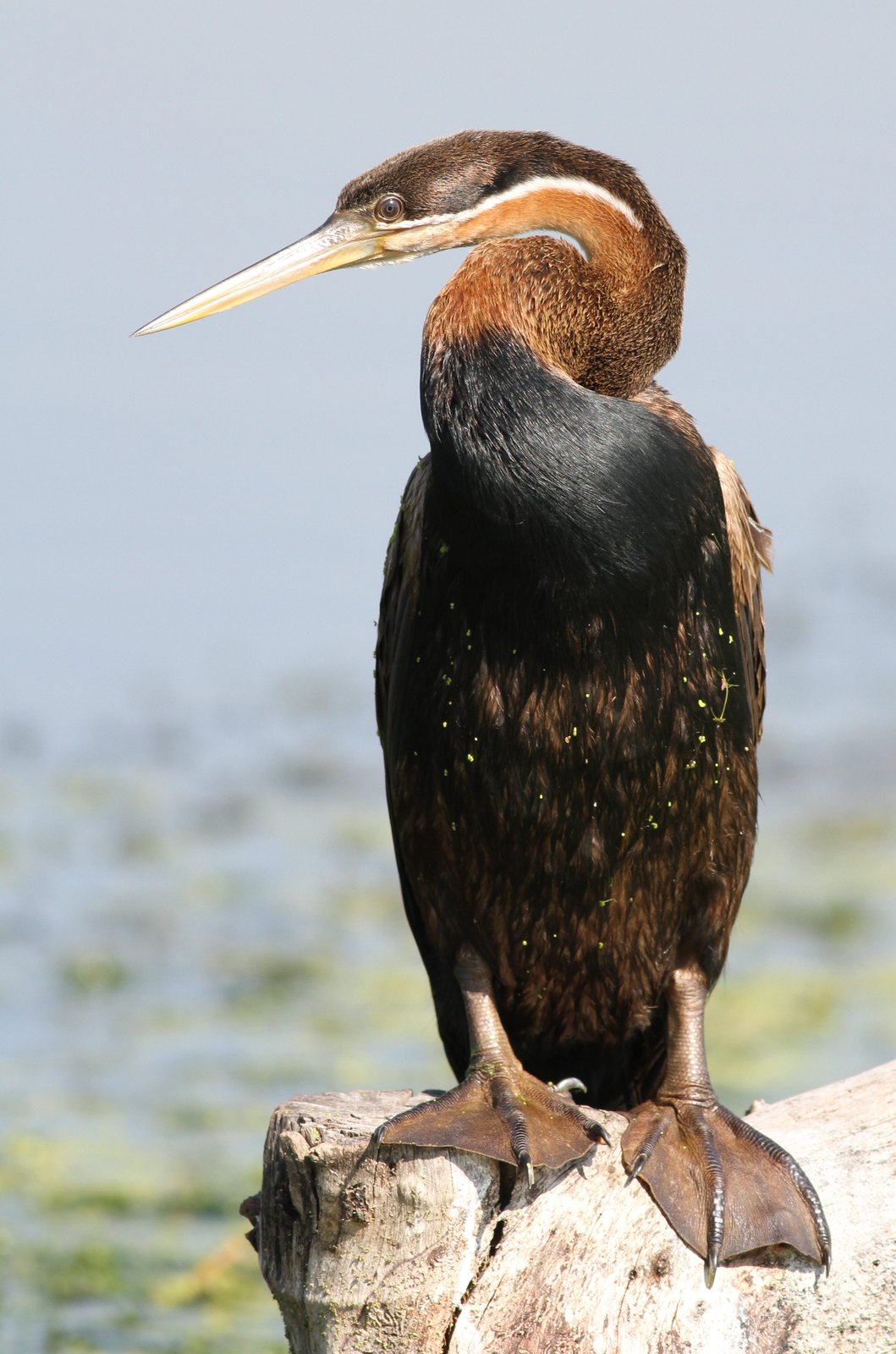
The African Darter is a long, slim waterbird with a thin, S-kinked neck and a dagger-shaped bill with which it spears fish underwater. It often swims so low that only the sinuous neck shows above the surface, which gives it the name snakebird.
Voice
Usually silent away from the colony. At the nest a dry, rattling croak, krrr-krrr-krrr, and a rasping kok-kok-kok; a hiss when disturbed.
Recording: Lynette Rudman — CC BY-NC-SA 4.0 · converted to mono · xeno-canto
Identification
About 80 cm, with a long, fan-shaped tail and a conspicuous kink in the neck at the seventh and eighth vertebrae. The male is glossy black with a rufous foreneck and a white stripe along the side of the neck; the mantle and coverts carry long, white-streaked lanceolate plumes. The female is browner, with a paler, pale buff neck and a less sharply defined white neck stripe. Juveniles are light brown with a buff neck and underparts. The bill is pointed and yellowish-brown, without a hook. It flies with the neck extended and the tail spread, alternating flapping with gliding, and at times soars high on thermals.
Confusion species
The Great Cormorant (Phalacrocorax carbo) and the Reed Cormorant (Microcarbo africanus) have a shorter, straight neck and a bill hooked at the tip, and swim with the body higher in the water. In flight the darter stands out by its long, thin neck, long tail and habit of soaring on thermals, which cormorants rarely do.
Habitat
Still and slow-flowing fresh water with sheltered margins and overhanging trees or dead wood: lakes, dams, rivers, marshes and floodplains, and locally estuaries and mangroves. It hunts medium-sized fish underwater, spearing them with a rapid thrust of the neck, then tossing and swallowing them at the surface. It rests on branches and rocks, often with wings spread to dry, since the plumage absorbs water. It breeds in colonies, often with herons and cormorants, in trees over or beside water.
Where the bird is most at home, classified by the vegetation units of southern Africa.

Range and movements
Distributed over most of the region: common in the Okavango Delta, along the Zambezi and Chobe, in Zimbabwe, Zambia, Malawi, Mozambique and eastern South Africa, and in Angola; local in western South Africa along rivers and dams, and absent from the driest parts of Namibia, the Karoo and the Kalahari. Beyond the region it occurs over almost all of sub-Saharan Africa, on Madagascar and in small, isolated populations in Iraq and southern Turkey.
- Resident
- Summer visitor (c. Oct–Mar)
- Winter visitor (c. Apr–Sep)
- Passage (Mar–Apr, Oct–Nov)
- dark = core range, pale = thinly spread
How and when to look
Along any wooded shore of a dam or river; the bird gives itself away by the neck sticking up out of the water like a periscope. Best watched at a regular perch, wings spread in the morning sun. In the Okavango Delta and along the Chobe the breeding colonies are often in trees beside the channels, visible from a boat.
Conservation status
Not threatened and widespread. Numbers decline locally through the draining of wetlands, pollution, disturbance of breeding colonies and drowning in fishing nets. The building of dams has, by contrast, created new habitat in parts of the region.
Scientific name
Anhinga rufa | (Daudin, 1802)
Daudin described the species in 1802 as Plotus rufus; because it was later moved to another genus, the author and year stand in brackets. The genus Anhinga was introduced in 1760 by Brisson. Anhinga goes back to a Tupi name for the bird from Brazil; the often-quoted meaning 'devil bird' is uncertain. rufa is Latin for 'rufous, reddish' — for the male's rusty-brown neck. The specimen the first description was based on came from Senegal.