All species › Gannets and cormorants › Frigatebirds › Lesser Frigatebird
Lesser Frigatebird | Fregata ariel
Kleine fregatvogel | Rabihorcado Chico
The Lesser Frigatebird is the smallest and slimmest of the frigatebirds, a black pirate of the air with extremely long, angled wings and a deeply forked tail. In the region it is a scarce visitor to the Mozambique Channel that is sometimes carried far inland by cyclones.
Voice
Silent at sea. At the colony birds clatter their bills, and males with inflated pouches give a high, whistling and chattering wi-wi-wi.
No recording with a suitable Creative Commons licence is available for this species yet.
Identification
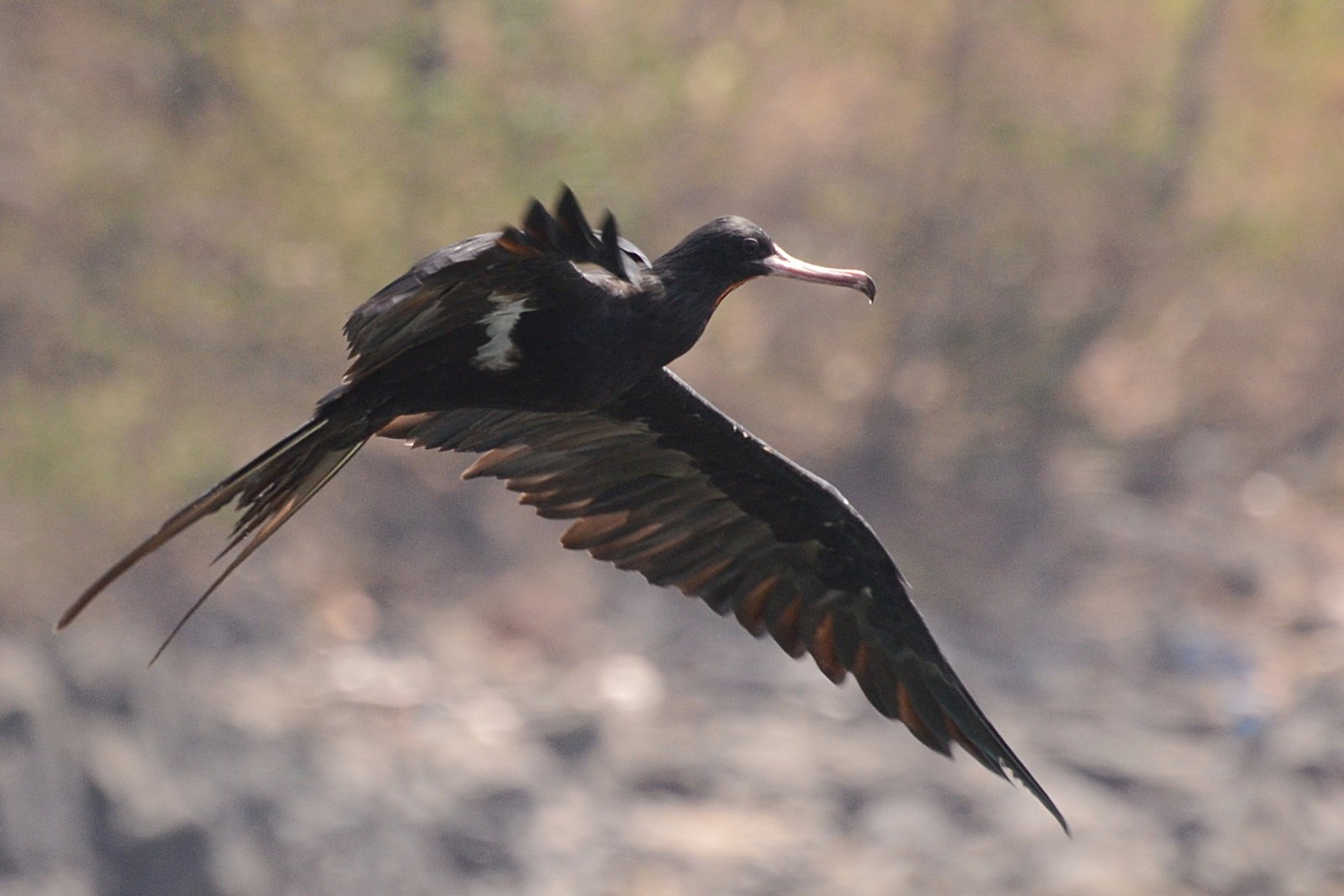
71–81 cm long, wingspan 175–193 cm. Wings narrow and sharply kinked, tail long and deeply forked, usually folded into a single spike; the bill is long, slender and hooked at the tip. The male is black with a red gular pouch and a white patch on each flank that extends as a narrow spur into the armpit; this is the best feature. The female has a black head with a red eye-ring, a white breast that reaches the armpit in a point, and a black belly. Juveniles have a rusty to white head and a white breast and belly. Soars for hours without a wingbeat high over the sea.
Confusion species
Great Frigatebird (Fregata minor) is larger and heavier; the male lacks white flank patches, and the female has a grey-white throat and a white breast that does not extend into the armpit. Juveniles are difficult: in the Lesser the white of the belly runs as a narrow point under the wing. At long range only size is a clue, and without comparison it is unreliable.
Habitat
Warm tropical ocean, both far offshore and along the coast. Takes flying fish and squid just below the surface and robs other seabirds of their catch. Breeds colonially in low bushes on remote coral islands.
Where the bird is most at home, classified by the vegetation units of southern Africa.

Range and movements
Within the region a scarce but regular visitor along the coast of Mozambique, rarer south to KwaZulu-Natal and the Eastern Cape; after tropical cyclones birds are sometimes blown far inland. Beyond the region it breeds on islands in the western Indian Ocean, such as Aldabra and Europa, and elsewhere from the Indian Ocean to the central Pacific; a small population on Trindade in the South Atlantic is close to extinction.
How and when to look
The best chance is from October to April, from the shore or on pelagic trips off Inhambane and Ponta do Ouro. After a cyclone has passed, keep an eye on the coast and large inland waters. With a passing frigatebird, check the armpits first: a white spur under the wing points to this species.
Conservation status
Not globally threatened, but reduced on many islands by introduced rats and cats, disturbance and the taking of birds and eggs. The Atlantic subspecies on Trindade has all but disappeared.
Scientific name
Fregata ariel | (Gray, 1845)
Gray described the species in 1845 as Atagen Ariel; because it was later moved to another genus, the author and year stand in brackets. The genus Fregata was introduced in 1799 by De Lacépède. Fregata derives from the French frégate, 'frigate', a fast warship — for the swift flight and the habit of robbing other seabirds. ariel refers to Ariel, a spirit or sylph of the air in medieval folklore. The specimen the first description was based on came from Raine Island, Queensland, Australia (designated later).