All species › Birds of prey › Hawks, eagles and kites › African Hawk-Eagle
African Hawk-Eagle | Aquila spilogaster
Afrikaanse havikarend | Águila-azor Africana
The African Hawk-Eagle is a powerful, medium-sized eagle of the bushveld, blackish-brown above and white below with narrow black streaks. Pairs often hunt together and strike guineafowl, francolins, hares and hyraxes at great speed; in flight the white ‘windows’ in the primaries identify the species from afar.

Voice
A melodious, fluting kloo-kloo-kloo-klu-klooo, mainly during display flights and around the nest; also a sharp keek from both partners.
Recording: Andrew Spencer — CC BY-NC-SA 4.0 · converted to mono · xeno-canto
Identification
60–65 cm, wingspan 130–160 cm. Adults are dark blackish-brown above, white below with narrow black streaks on the breast and flanks; the thighs are streaked to white. In flight the underwing is white with black spotting on the coverts, a broad black trailing edge and conspicuous white, unmarked primary bases, which also show as pale patches from above. The grey tail has a broad black terminal band. Legs fully feathered, toes yellow. The female is larger and more heavily streaked. Juveniles are rufous below with fine dark streaks, brown above, with a finely barred tail lacking a terminal band.
Confusion species
Ayres's Hawk-Eagle Hieraaetus ayresii is smaller, heavily blotched black below rather than streaked, and has a densely barred underwing without white primary windows. Martial Eagle Polemaetus bellicosus is much larger, with a dark head and breast and a dark underwing. Cassin's Hawk-Eagle Aquila africana, only in the far north of Angola, has a black underwing. Juveniles can resemble the pale morph of Wahlberg's Eagle Hieraaetus wahlbergi, which has a longer, square-ended tail and parallel-edged wings.
Habitat
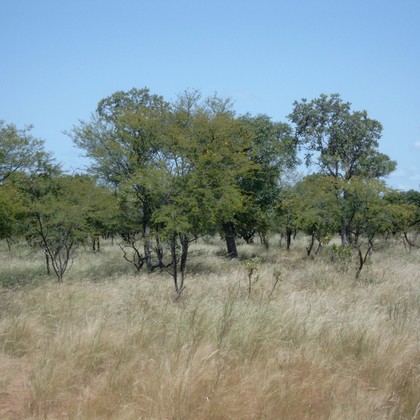
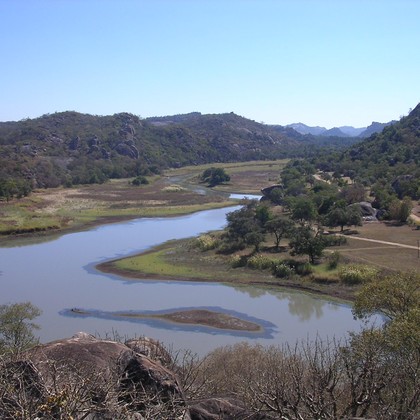
Fairly open to fairly dense woodland, often in hilly country with tall trees along dry riverbeds; mopane, mixed broadleaf woodland and acacia savanna. It hunts from a concealed perch in a tree crown or in a fast glide low over the veld. The nest is a large stick platform high in a tree, often in the fork of a large acacia or a baobab.
Where the bird is most at home, classified by the vegetation units of southern Africa.

Range and movements
Widespread in the north and east of the region: Angola, Zambia, Malawi, Mozambique, Zimbabwe, northern and eastern Botswana, northern and central Namibia and north-eastern South Africa (Limpopo, the Mpumalanga lowveld, North West, northern KwaZulu-Natal), and scarce in Eswatini. Absent from the arid west, the highveld and the Cape. Beyond the region it occurs in savannas across much of sub-Saharan Africa, from Senegal to Ethiopia and Somalia.
- Resident
- Summer visitor (c. Oct–Mar)
- Winter visitor (c. Apr–Sep)
- Passage (Mar–Apr, Oct–Nov)
- dark = core range, pale = thinly spread
How and when to look
The Kruger National Park and the mopane country along the Limpopo are good areas. Watch for two birds hunting together low over the bushveld, or for an eagle circling above the trees showing white primary windows and a black tail band. At waterholes pairs sometimes wait for guineafowl and francolins.
Conservation status
Not threatened, but like many large raptors it has declined outside protected areas through poisoning, persecution by poultry farmers, loss of tall nest trees and collisions with power lines. In South Africa it is now largely confined to game reserves and large farms.
Scientific name
Aquila spilogaster | (Bonaparte, 1850)
Bonaparte described the species in 1850 as Spizaëtus spilogaster; because it was later moved to another genus, the author and year stand in brackets. The genus Aquila was introduced in 1760 by Brisson. Aquila is Latin for 'eagle', possibly from aquilus 'dark in colour'. spilogaster comes from the Greek spilos, 'spot', and gastēr, 'belly' — for the dark-streaked white underparts. The specimen the first description was based on came from Ethiopia.