All species › Birds of prey › Hawks, eagles and kites › Verreaux's Eagle
Verreaux's Eagle | Aquila verreauxii
Zwarte arend | Águila de Verreaux
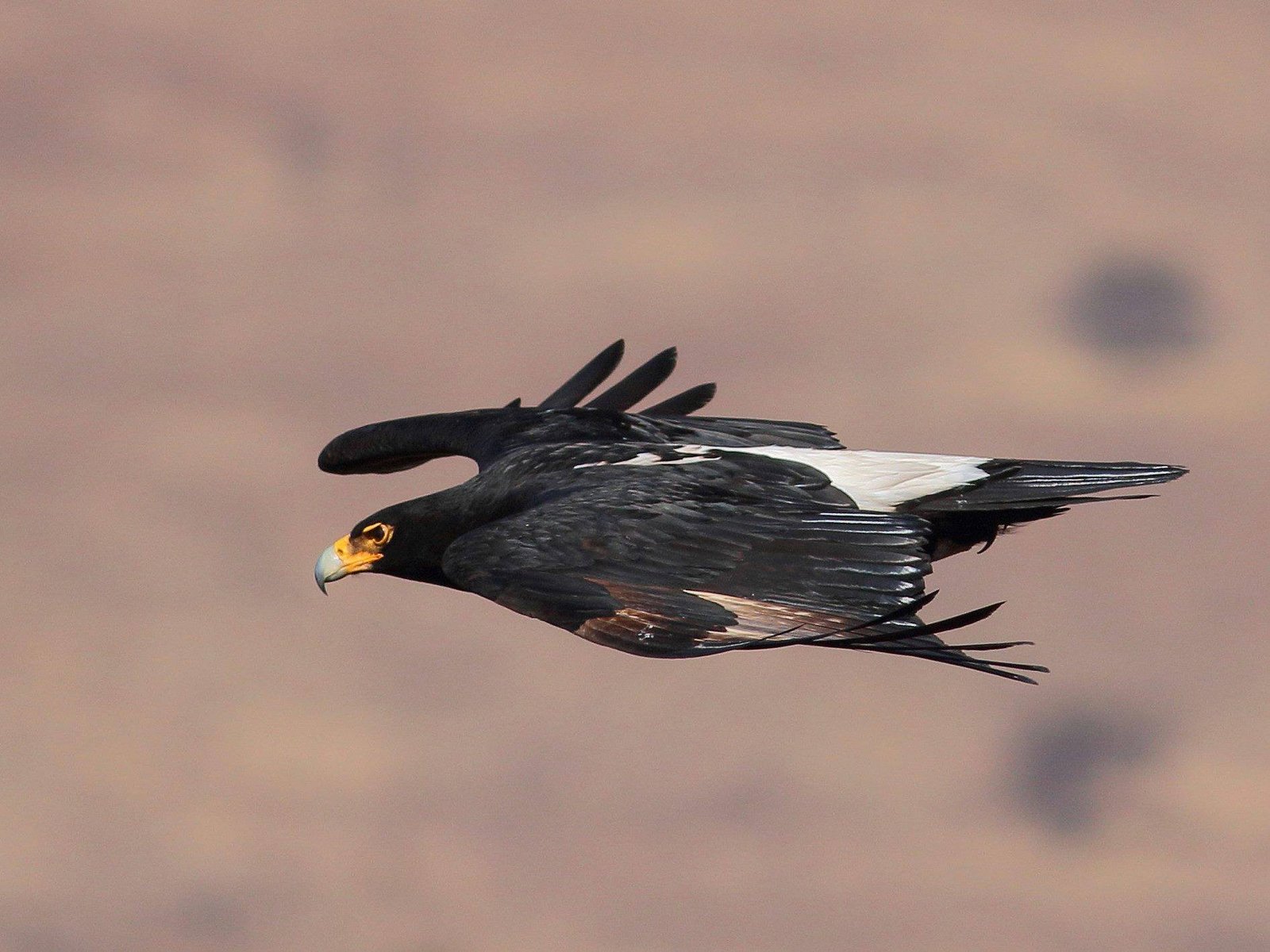
Verreaux's Eagle is the large, jet-black eagle of the cliffs and rocky hills of southern and eastern Africa. It is highly specialised on rock hyraxes, and where these are plentiful, as in the Matobo Hills of Zimbabwe, one of the densest eagle populations in the world is found.
Voice
Mostly silent. At the nest and in display a melodious, drawn-out wee-oo or a short barking keep; the pair sometimes call during undulating roller-coaster dives above the cliffs.
No recording with a suitable Creative Commons licence is available for this species yet.
Identification
75–96 cm, wingspan 181–219 cm. Adults are deep black with a white V on the back that runs into a white rump, only clearly visible in flight or when the wings droop. The bill is heavy, and the cere, eye-ring and feet are yellow. In flight the silhouette is unique: the wings are narrow at the base, broaden markedly in the arm and end in long ‘fingers’, paddle-like, with a whitish window at the base of the primaries. The tail is fairly long and wedge-shaped. Juveniles are mottled brown with a rufous crown and nape, a dark face and paler, scaly trousers, and become black in about four years.
Confusion species
An adult is unmistakable. Bateleur Terathopius ecaudatus is also black but has an almost invisible short tail, a red face and legs and white underwing coverts. The dark morph of Wahlberg's Eagle Hieraaetus wahlbergi is much smaller and brown. Jackal Buzzard Buteo rufofuscus is smaller, with a rufous tail. Juveniles resemble Tawny Eagle Aquila rapax but have a dark mask, a rufous crown and already the typical paddle-shaped wings.
Habitat
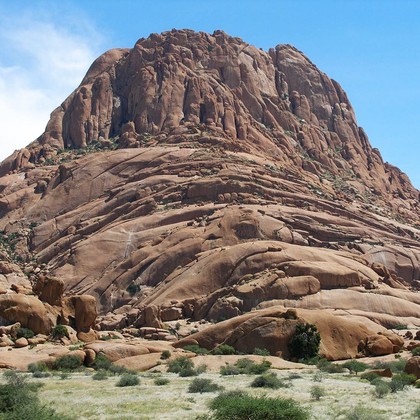
Mountains, cliffs, gorges and rocky hills (koppies) with plenty of rock hyraxes, from fynbos in the south-west to the Drakensberg and the rocky hills of the savanna. Rock hyraxes often form more than 90 per cent of the diet; doves, francolins, young antelope, hares and carrion are also taken. The nest is a large stick platform on a cliff ledge.
Where the bird is most at home, classified by the vegetation units of southern Africa.


Range and movements
In southern Africa widespread wherever there are cliffs and hyraxes: the mountainous parts of South Africa, from the Cape Fold Mountains to the Drakensberg, the Magaliesberg and the Waterberg, Lesotho and Eswatini, the western escarpment and rocky hills of Namibia, eastern Botswana (Tswapong, Tuli), Zimbabwe (especially Matobo), western Mozambique, Malawi, parts of Zambia and western Angola. Further in East Africa to Ethiopia, Sudan and Somalia, and beyond that locally in Arabia and Sinai.
- Resident
- Summer visitor (c. Oct–Mar)
- Winter visitor (c. Apr–Sep)
- Passage (Mar–Apr, Oct–Nov)
- dark = core range, pale = thinly spread
How and when to look
The Matobo Hills in Zimbabwe, the Magaliesberg and the Walter Sisulu Botanical Garden near Johannesburg are famous sites, where a pair has bred on the same cliff for decades. On warm afternoons watch along the edge of a cliff: the eagles glide low over the rocks and surprise the hyraxes. In flight the paddle-shaped wing silhouette is recognisable from a great distance.
Conservation status
Not threatened on the global Red List, but assessed as Vulnerable in South Africa. Outside protected areas the species is declining through the loss of hyraxes, persecution by stock farmers, poisoning, electrocution and collisions with wind turbines, a growing problem in the mountains of the Eastern and Western Cape.
Scientific name
Aquila verreauxii | Lesson, 1831
Lesson described the species in 1831 and placed it straight away in the genus where it still stands. The genus Aquila was introduced in 1760 by Brisson. Aquila is Latin for 'eagle', possibly from aquilus 'dark in colour'. verreauxii honours the French naturalist and natural-history dealer Jules Verreaux (1807–1873), who collected in South Africa for several years. The specimen the first description was based on came from the interior of the Cape, South Africa.