All species › Birds of prey › Hawks, eagles and kites › Cassin's Hawk-Eagle
Cassin's Hawk-Eagle | Aquila africana
Cassins kuifarend | Águila-azor Congoleña
Cassin's Hawk-Eagle is a slender, little-known eagle of the equatorial rainforest, which mainly soars above the canopy and hunts within the forest itself. Within the area of this guide it reaches only the extreme northern edge of Angola, where the Congolian rainforest begins.

Voice
Poorly documented. In display flight over the forest a high kwee-ow or a series of whistled kee-kee-kee calls, usually high in the sky.
Recording: Mike Nelson — CC BY-NC-SA 3.0 · converted to mono · xeno-canto
Identification
50–61 cm, wingspan 103–113 cm. Blackish above, with a small, sometimes barely visible crest. White below, with black blotches and streaks confined to the sides of the breast and the flanks; the feathered legs are white or lightly spotted. In flight the short, broad, black underwing coverts stand out against the white body, while the flight feathers are grey and barred. The tail is fairly long, grey with a few narrow dark bars and a broader terminal band. The iris is light brown to yellow. Juveniles are brown above with pale fringes, and white to cream below with a rufous wash on head and breast and fine dark streaks on the flanks.
Confusion species
Ayres's Hawk-Eagle Hieraaetus ayresii has heavily blotched underparts and a spotted rather than black underwing. African Hawk-Eagle Aquila spilogaster is larger, has finely streaked underparts, white primary bases and a broad black terminal tail band, and lives in open savanna. A juvenile Crowned Eagle Stephanoaetus coronatus is much larger, with a white head and rufous-spotted underwings. Long-Crested Eagle Lophaetus occipitalis is wholly dark with a long crest.
Habitat
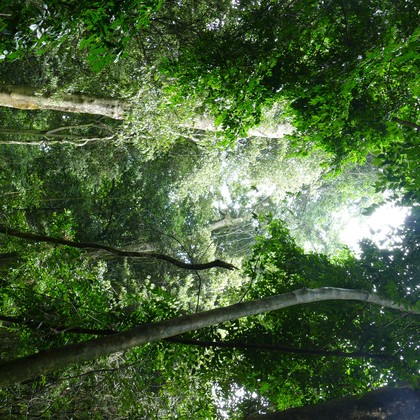
Evergreen lowland and gallery forest and old secondary forest, with clearings and forest edges; it avoids open savanna. It hunts from a concealed perch in the canopy on birds such as pigeons and parrots, and on squirrels and other small arboreal mammals. It soars above the canopy in the morning.
Where the bird is most at home, classified by the vegetation units of southern Africa.

Range and movements
In the region only in the extreme north of Angola, in rainforest and gallery forest of Cabinda, Zaire, Uíge and Lunda Norte provinces; very scarce and poorly known, with few recent records. Not known from the rest of the region. Beyond the region in the rainforest of West and Central Africa, from Sierra Leone and Liberia to the Democratic Republic of the Congo, Uganda and western Kenya.
How and when to look
There is a chance of this species only when visiting forest in northern Angola, for example in Cabinda or the Uíge area. In the late morning scan from a lookout over the canopy for soaring raptors: the combination of white body and black underwing coverts is diagnostic. Every record in Angola is valuable and worth documenting.
Conservation status
Not threatened on the Red List thanks to its large range, but everywhere scarce and hard to see. The species depends on tall, continuous forest, so logging and conversion to farmland in northern Angola threaten its local survival.
Scientific name
Aquila africana | (Cassin, 1865)
Cassin described the species in 1865 as Limnaetus africanus; because it was later moved to another genus, the author and year stand in brackets. The genus Aquila was introduced in 1760 by Brisson. Aquila is Latin for 'eagle', possibly from aquilus 'dark in colour'. africana is Latin for 'African', for the continent where the species occurs. The specimen the first description was based on came from the Ogabi River, Gabon.