All species › Birds of prey › Hawks, eagles and kites › Tawny Eagle
Tawny Eagle | Aquila rapax
Savannearend | Águila Rapaz
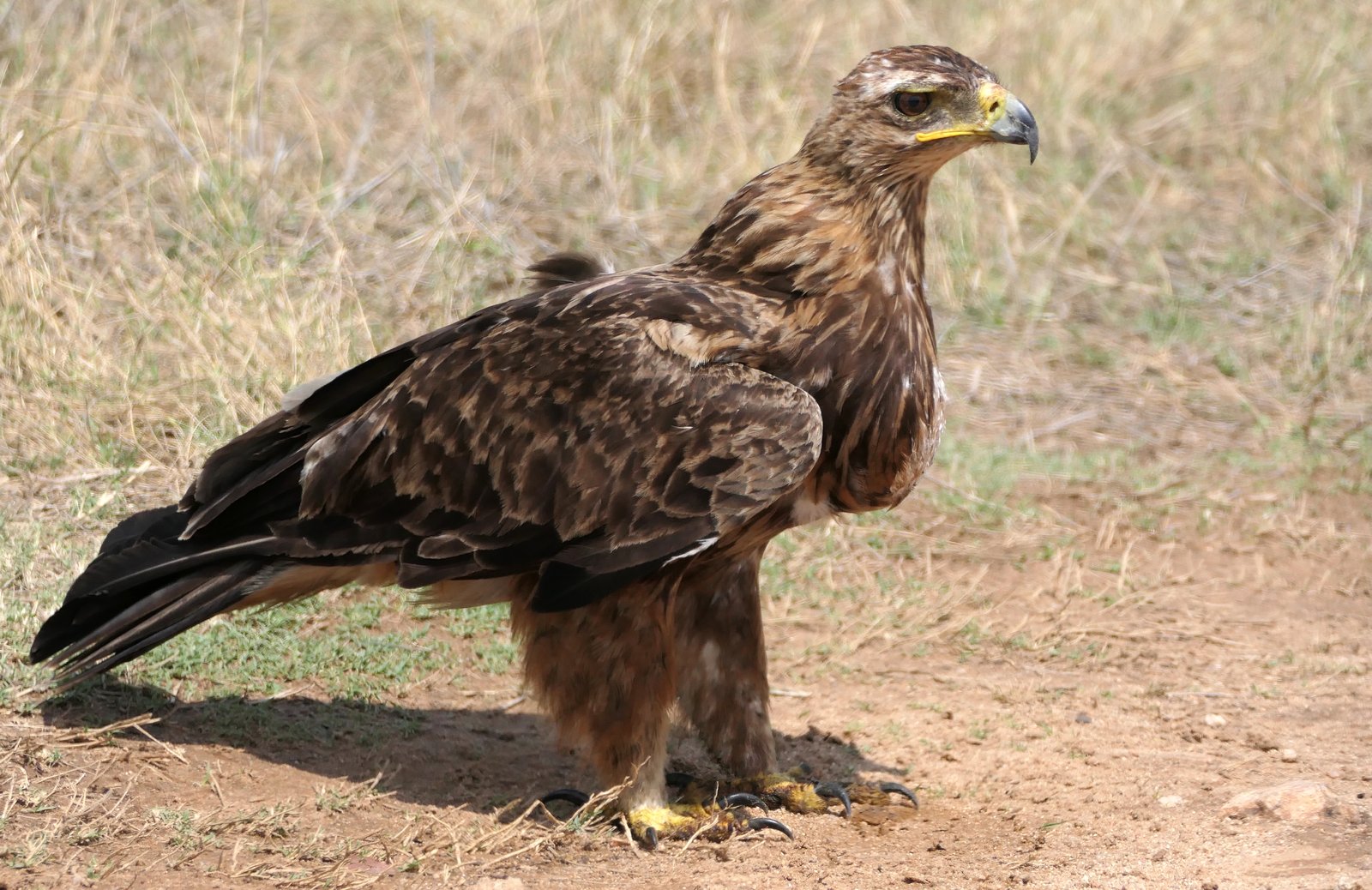
The Tawny Eagle is the characteristic large brown eagle of the African savanna: a versatile hunter, scavenger and pirate that robs other raptors of their prey. Its plumage ranges from almost creamy white to dark rufous brown, making it one of the more difficult eagles of the region.
Voice
Rather quiet. At the nest and in display a barking, repeated kiow-kiow or kow-kow-kow, sometimes in duet.
Recording: Oliver Fowler — CC BY-NC-SA 4.0 · converted to mono · xeno-canto
Identification
65–75 cm, wingspan 159–183 cm. A robust eagle with shaggy feathered ‘trousers’, a yellow cere and a gape line reaching to below the middle of the eye; the nostril is oval. The plumage ranges from pale buff through rufous to dark brown, often blotchy and untidy; the iris is light brown to yellowish in adults. Flight feathers and tail are dark with faint barring. Juveniles are often uniform rufous or rusty and fade to pale sandy, with narrow pale wing bars. In flight the wings are fairly long with a somewhat bulging trailing edge, the tail rounded and medium-long; the inner primaries often form a pale ‘window’ on the upperwing. The sexes are alike; the female is larger.
Confusion species
Steppe Eagle Aquila nipalensis is larger and more uniformly dark, with a gape line reaching behind the eye; juveniles show a broad white wing band. Lesser Spotted Eagle Clanga pomarina is smaller and more uniformly brown, with a round nostril and narrow ‘stockings’. Pale Wahlberg's Eagles Hieraaetus wahlbergi are smaller, with a long straight-ended tail and a small crest. Brown Snake Eagle Circaetus cinereus has bare legs, a large round head and yellow eyes.
Habitat
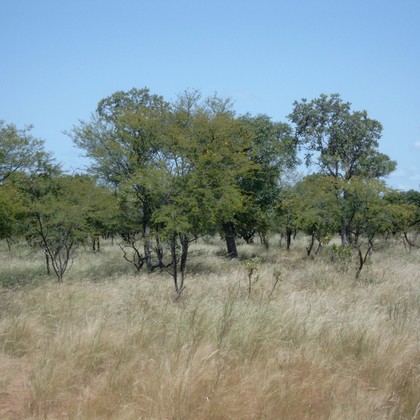
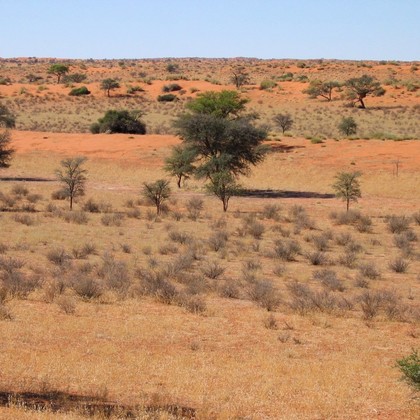
Arid and semi-arid savanna, thornveld, Kalahari thornveld and mopane woodland; it avoids dense forest, fynbos and high mountains. It hunts game such as guineafowl, francolins, hares and rodents, eats much carrion and chases other raptors and storks to steal their prey. The nest is a stick platform at the top of a thorn tree.
Where the bird is most at home, classified by the vegetation units of southern Africa.

Range and movements
Mainly in the north and west of the region: Namibia, Botswana, Zimbabwe, Zambia, southern and eastern Angola, Malawi and Mozambique; in South Africa now largely confined to the large protected areas in the north, such as the Kruger National Park and the Kgalagadi, and scarce elsewhere. Absent from Lesotho; rare in Eswatini. Beyond the region across much of Africa south of the Sahara and in North Africa, and further afield in India and neighbouring countries.
- Resident
- Summer visitor (c. Oct–Mar)
- Winter visitor (c. Apr–Sep)
- Passage (Mar–Apr, Oct–Nov)
- dark = core range, pale = thinly spread
How and when to look
In the Kruger and the Kgalagadi Tawny Eagles often perch on dead trees along the roads and at carcasses among vultures. Look for the shaggy trousers, the gape line to the middle of the eye and the yellow cere; ignore plumage colour, which means nothing. At carcasses the eagles often chase off jackals and vultures or sit waiting patiently.
Conservation status
Vulnerable on the Red List, after steep declines across much of Africa. In southern Africa the species has declined sharply outside protected areas through poisoned carcasses, electrocution and drowning in farm reservoirs. Its reliance on carrion makes the eagle highly vulnerable to the poisoning that also affects vultures.
Scientific name
Aquila rapax | (Temminck, 1828)
Temminck described the species in 1828 as Falco rapax; because it was later moved to another genus, the author and year stand in brackets. The genus Aquila was introduced in 1760 by Brisson. Aquila is Latin for 'eagle', possibly from aquilus 'dark in colour'. rapax is Latin for 'grasping, rapacious' — for its habit of also stealing prey from other raptors. The specimen the first description was based on came from South Africa.