All species › Birds of prey › Hawks, eagles and kites › Steppe Eagle
Steppe Eagle | Aquila nipalensis
Steppearend | Águila Esteparia
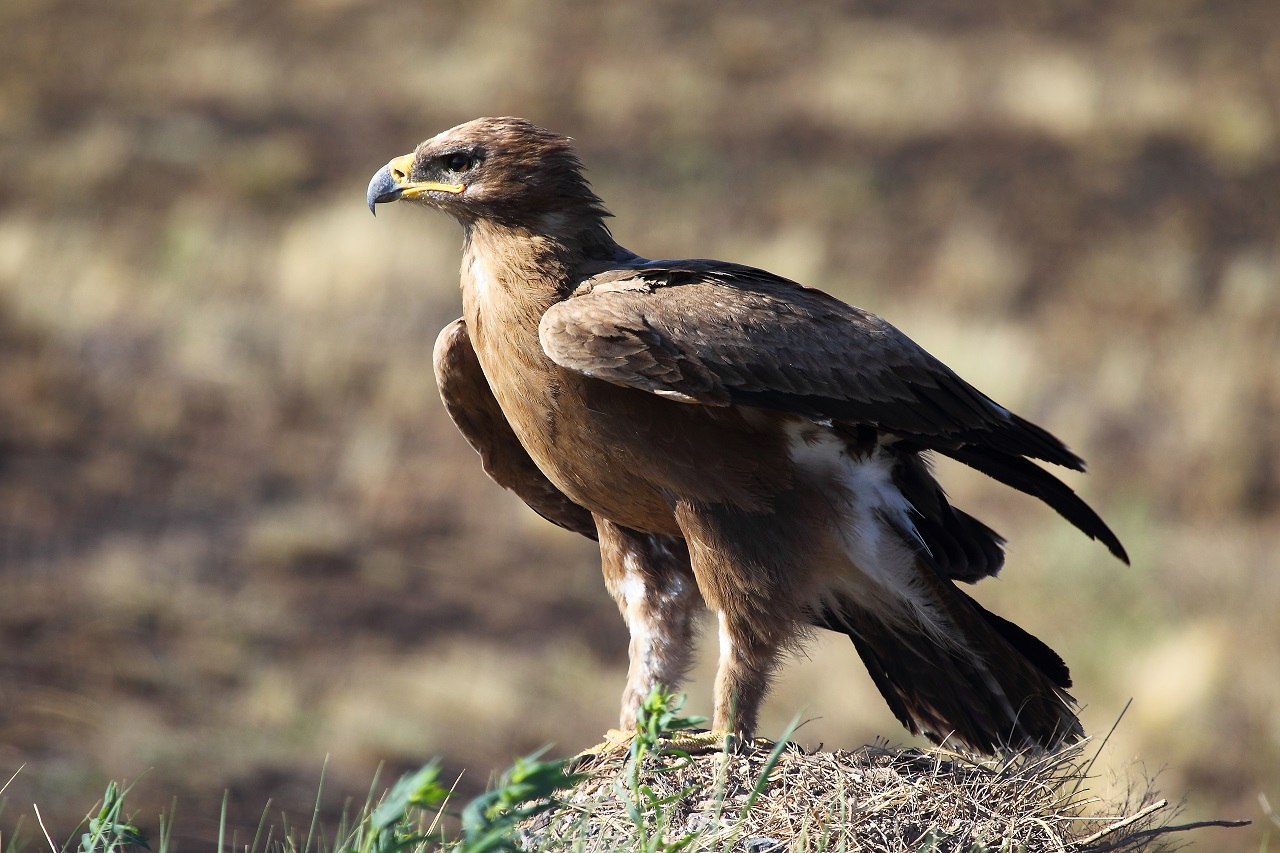
The Steppe Eagle is a large, dark brown eagle of the Eurasian steppes that migrates to eastern and southern Africa for the austral summer. In the region it was once a familiar sight at termite swarms and quelea colonies, but after a collapse of the world population it has become a rarity.
Voice
Silent in the non-breeding range. Occasionally a low, barking kow or a hoarse crow-like sound in squabbles over food.
Recording: Bo Shunqi 薄顺奇 — CC BY-NC-SA 4.0 · shortened to the first 60 s, mono · xeno-canto
Identification
65–81 cm, wingspan 165–214 cm. A heavy eagle with a powerful bill, a long gape line reaching behind the eye and an oval nostril. Adults are uniform dark brown, often with a rusty patch on the nape; below, the flight feathers and tail are densely and finely barred with a dark trailing edge. The wings are long and broad with seven ‘fingered’ primaries. Juveniles are paler, greyish brown to milk-chocolate brown, with a striking broad white band across the underwing, a white trailing edge to wing and tail and a white rump. Immatures retain traces of that white band for several years. In soaring flight the wings are held flat or slightly lowered.
Confusion species
Tawny Eagle Aquila rapax is smaller, has a gape line reaching only to below the middle of the eye, is usually paler and shaggier in tone and, as a juvenile, lacks the white wing band. Lesser Spotted Eagle Clanga pomarina is smaller and slimmer, with a round nostril, a thinner bill and slightly drooping primaries. Verreaux's Eagle Aquila verreauxii is black with a white back and has a quite different flight shape.
Habitat
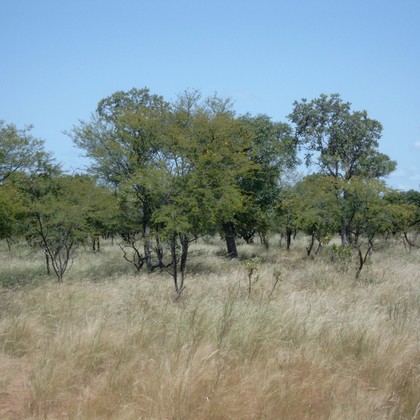
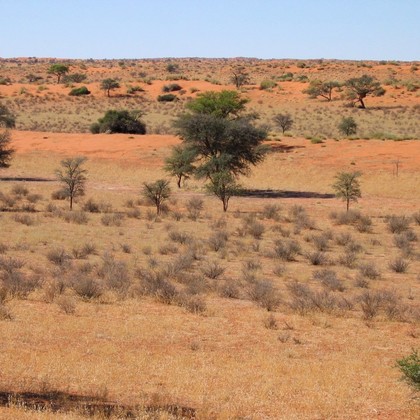
Open and semi-open savanna, thornveld, Kalahari thornveld and mopane woodland, also grassland and farmland. It seeks swarming termites, young queleas and rodents; it readily walks on the ground and also takes carrion. Groups may gather where food is plentiful and follow thunderstorm fronts.
Where the bird is most at home, classified by the vegetation units of southern Africa.

Range and movements
Mainly in the north and centre of the region: Botswana, Zimbabwe, Zambia, northern and eastern Namibia, western Mozambique and northern South Africa (Limpopo, North West, the Northern Cape and the Kgalagadi area); irregular in Malawi and Angola and further south. It breeds in the steppes from southern Russia and Kazakhstan to Mongolia and China; it winters in eastern and southern Africa, the Middle East and southern Asia.
- Summer visitor (c. Oct–Mar)
- Passage (Mar–Apr, Oct–Nov)
- dark = core range, pale = thinly spread
How and when to look
In December–February check every group of eagles at termites or a quelea colony: a Steppe Eagle may be among the Lesser Spotted and Tawny Eagles. On perched birds note the gape line extending behind the eye and the oval nostril; flying juveniles are instantly recognisable by the broad white wing band. Older birds in the region sometimes carry colour rings or a satellite tag.
Conservation status
Endangered on the Red List, after a very rapid decline since the 1990s. The main cause is electrocution on poorly insulated power poles in the breeding areas of Russia and Kazakhstan, together with conversion of steppe to cropland, poisoning by diclofenac and other substances in southern Asia, and disturbance at the nest. In southern Africa the species is now much scarcer than in the handbooks of a few decades ago.
Scientific name
Aquila nipalensis | Hodgson, 1833
Hodgson described the species in 1833 and placed it straight away in the genus where it still stands. The genus Aquila was introduced in 1760 by Brisson. Aquila is Latin for 'eagle', possibly from aquilus 'dark in colour'. nipalensis means 'from Nepal', where the type specimen was collected, presumably from a bird on migration. The specimen the first description was based on came from Nepal.