All species › Waders, gulls and terns › Gulls and terns › African Skimmer
African Skimmer | Rynchops flavirostris
Afrikaanse schaarbek | Rayador Africano
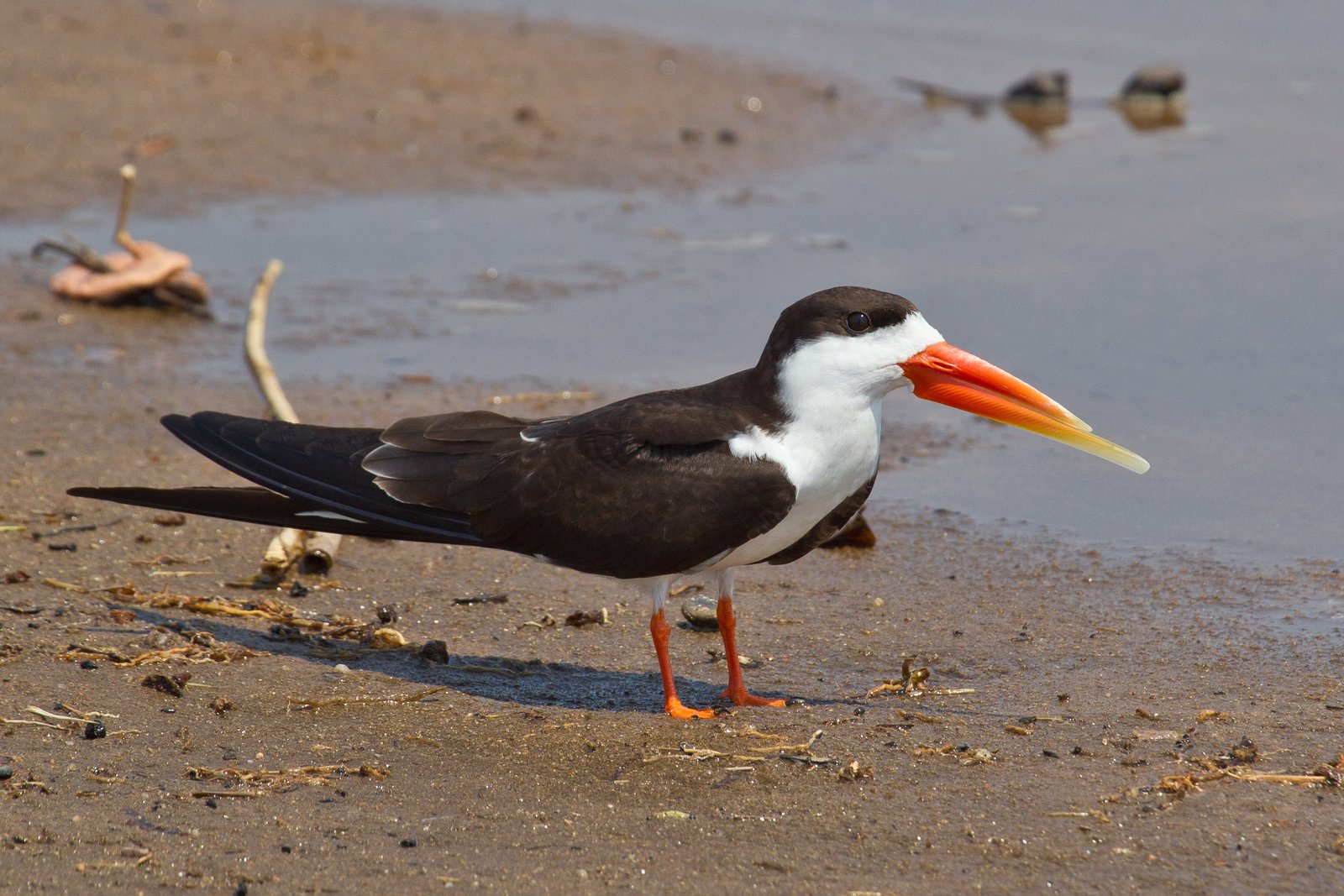
The African Skimmer is a tern-like bird with a unique bill: the lower mandible is a third longer than the upper and slices through the water surface as it feeds. With its black-and-white plumage and orange-red bill it is an emblem of the great rivers of the Okavango, the Chobe and the Zambezi.
Voice
A sharp, barking kip or kek, rapidly repeated at colonies and when disturbed into a high chatter, kek-kek-kek-kek.
Recording: Phil Gregory — CC BY-NC-SA 4.0 · converted to mono · xeno-canto
Identification
About 38 cm, with long, narrow wings extending well beyond the short, slightly forked tail. The upperparts, crown and hindneck are blackish brown, the forehead, face and underparts pure white; the wing has a narrow white trailing edge. The bill is long, laterally flattened like a blade, orange-red with a yellow tip, and the lower mandible clearly projects beyond the upper. The short legs are red. The eye has a vertical, cat-like pupil. Sexes alike, the male slightly larger. Juveniles are browner with pale fringes to the upperpart feathers and a duller, blackish bill with a shorter lower mandible.
Confusion species
Unmistakable in the region; the only other skimmer, the Black Skimmer (Rynchops niger), is an exceptional vagrant that is larger, purer black above and has a red bill with a black outer half. At distance, roosting groups can suggest terns, but the black-and-white pattern and the thick red bill are always diagnostic.
Habitat
Broad, slow rivers, lakes and lagoons with open water and exposed sandbars and sandy islands, on which the birds roost and breed in loose colonies. It feeds low over calm water with the lower mandible slicing the surface, mostly at dusk, at night and in the early morning, on small fish near the surface.
Where the bird is most at home, classified by the vegetation units of southern Africa.

Range and movements
Breeds along the Okavango and the Chobe in Botswana and the Caprivi Strip of Namibia, along the Zambezi and its tributaries in Zambia, Zimbabwe and Mozambique, along the Luangwa and on the shores of Lake Malawi and the Shire in Malawi, and along the major rivers of Angola. It formerly bred farther south, into KwaZulu-Natal, where it is now only a scarce vagrant. Elsewhere in sub-Saharan Africa from Senegal and the Nile to Kenya and Tanzania.
- Resident
- dark = core range, pale = thinly spread
How and when to look
A boat trip on the Chobe at Kasane or in the Okavango Panhandle from August to October is almost certain to produce skimmers, roosting on sandbars or skimming the water at sunset. Keep your distance from breeding colonies: the eggs lie exposed on the sand and overheat quickly when parents are flushed.
Conservation status
Not threatened according to the IUCN data followed here, but the species is declining across much of Africa. Breeding colonies are threatened by rising water below dams, disturbance by boats and tourists, and trampling of sandbars by livestock and people. In southern Africa the population numbers at most a few thousand birds, concentrated on a small number of rivers.
Scientific name
Rynchops flavirostris | Vieillot, 1816
Vieillot described the species in 1816 as Rhyncops flavirostris; because it was later moved to another genus, the author and year stand in brackets. The genus Rynchops was introduced in 1758 by Linnaeus. Rynchops comes from the Greek rhunkhos, 'bill', and ōps, 'face' — a 'bill-face', for the striking bill with its much longer lower mandible. flavirostris comes from the Latin flavus, 'yellow', and rostrum, 'bill' — for the orange-yellow bill. The specimen the first description was based on came from Senegal.