All species › Falcons › Falcons › Amur Falcon
Amur Falcon | Falco amurensis
Amoerroodpootvalk | Cernícalo del Amur
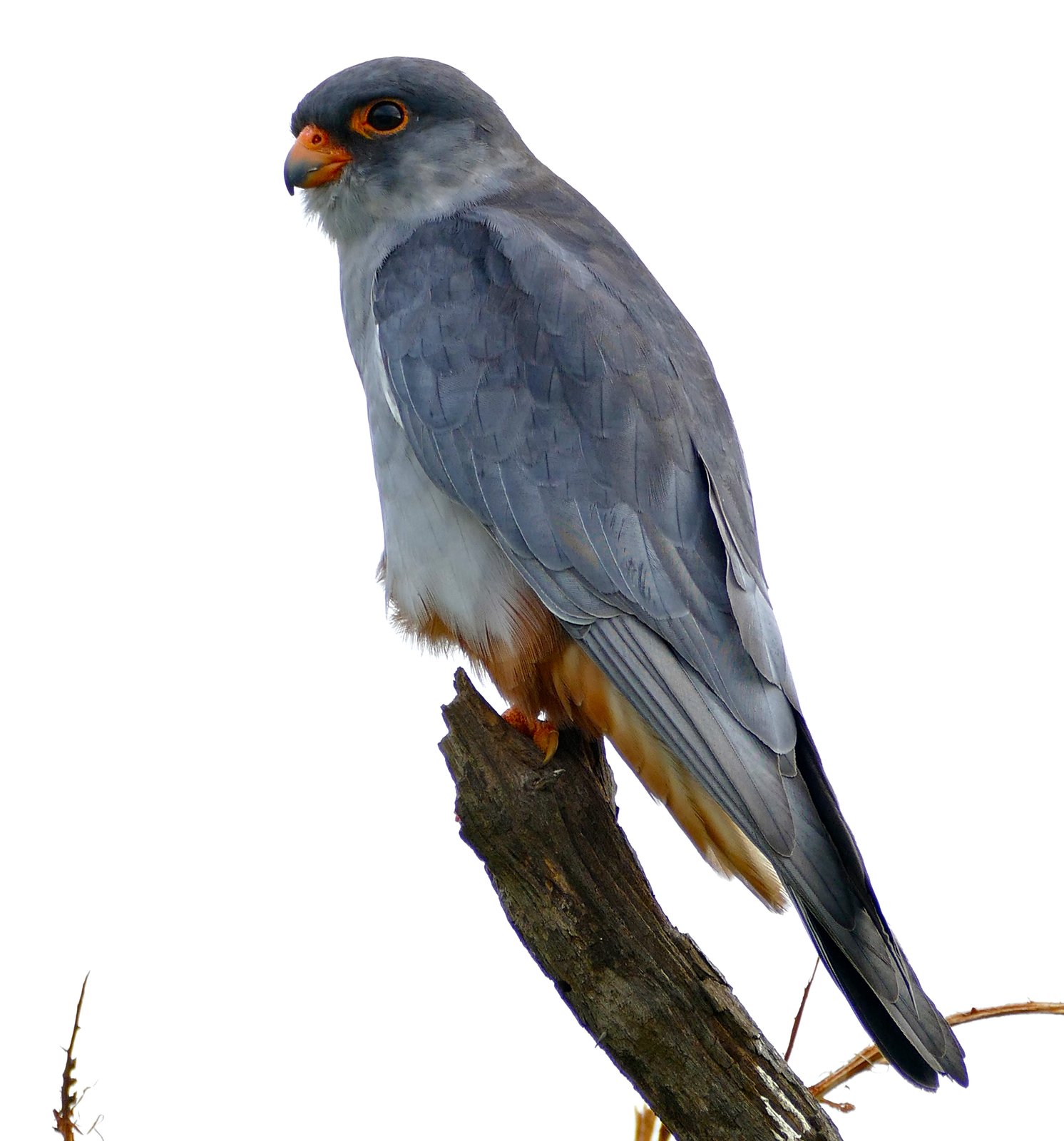
The Amur Falcon makes one of the longest migrations of any raptor: from eastern Asia via India and across the Indian Ocean to southern Africa. In the austral summer it is the commonest small falcon of the eastern highveld, where tens of thousands roost communally in the trees of rural towns.
Click a thumbnail to switch the photo above.
Voice
At the roost a deafening chorus of high kew-kew-kew calls, especially when birds come in at dusk and before they leave at sunrise.
Recording: Martin Billard — CC BY-NC-SA 4.0 · converted to mono · xeno-canto
Identification
About 28 cm, slender and long-winged. The male is dark slate-grey with rufous undertail and trousers, orange-red cere, eye-ring and legs, and white underwing coverts that contrast strongly in flight with the blackish flight feathers. The female has a grey crown, a short dark moustache, grey upperparts barred dark and white underparts marked with black drops and arrowheads, with pale buff trousers. The juvenile resembles the female but is browner, with pale fringes above and streaking below.
Confusion species
Red-Footed Falcon (Falco vespertinus) is best told by the all-grey underwing of the male and the orange-buff crown and underparts of the female. Eurasian Hobby (Falco subbuteo) has a longer moustache, streaked rather than spotted underparts and no red legs. Lesser Kestrel (Falco naumanni), which often shares the roosts, has a rufous back and a longer tail and hovers more.
Habitat
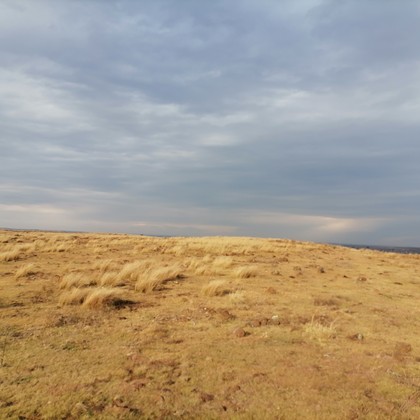
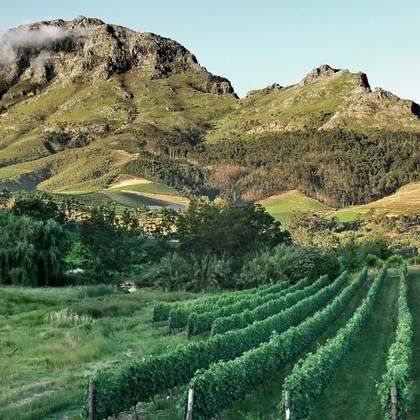
Open grassland, farmland and wooded savanna, by day often on telephone wires along roads. It hunts from a perch or by hovering for grasshoppers, beetles and flying termites, sometimes in large flocks over an emergence. It roosts in tall trees, often eucalypts, in towns and on farms.
Where the bird is most at home, classified by the vegetation units of southern Africa.

Range and movements
Widespread in the east and centre of the region: the South African highveld (Free State, Gauteng, Mpumalanga, KwaZulu-Natal, Eastern Cape), Lesotho, Eswatini, Zimbabwe, Zambia, Malawi, eastern Botswana and inland Mozambique; scarcer in northern Namibia and in Angola. Breeds in south-eastern Siberia, north-eastern China and Korea.
- Summer visitor (c. Oct–Mar)
- dark = core range, pale = thinly spread
How and when to look
Visit a known roost (for example in Newcastle, Harrismith or Bethlehem) in the last hour before sunset, when the flocks arrive. Look among the Amur Falcons for Red-Footed Falcons and Lesser Kestrels. Birds start leaving from late March.
Conservation status
Not threatened, with a very large world population. On migration tens of thousands were trapped each year in Nagaland (north-eastern India) until around 2012; local conservation programmes have largely stopped this. In southern Africa the felling of roost trees and insecticides are potential threats.
Scientific name
Falco amurensis | Radde, 1863
Radde described the species in 1863 and placed it straight away in the genus where it still stands. The genus Falco was introduced in 1758 by Linnaeus. Falco is the Latin word for 'falcon', possibly related to falx, 'sickle', for the curved shape of the claws or wings. amurensis refers to the Amur, the river on the Russia–China border where the species breeds and the type was collected. The specimen the first description was based on came from Zeya River, Amur region, Russia.