All species › Falcons › Falcons › Grey Kestrel
Grey Kestrel | Falco ardosiaceus
Grijze torenvalk | Cernícalo Pizarroso
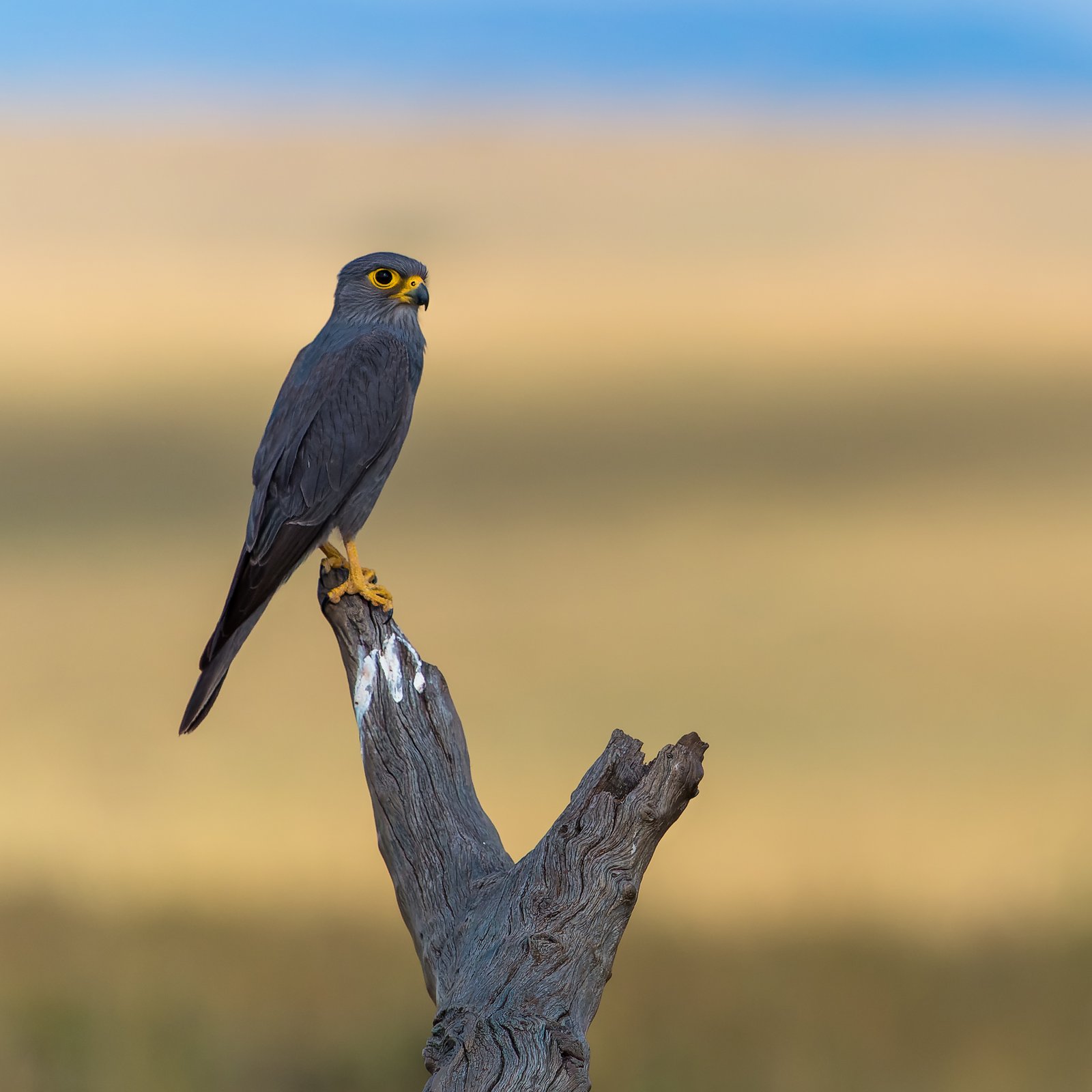
The Grey Kestrel is a stocky, all slate-grey falcon of the savannas of tropical Africa. In southern Africa it reaches the southern edge of its range only in Angola, north-western Zambia and the far north of Namibia, and it is a sought-after species for birders.
Voice
Mostly silent; at the nest a high, rattling kee-kee-kee and a harsh twittering.
Recording: Bram Piot — CC BY-NC-SA 4.0 · converted to mono · xeno-canto
Identification
About 30 cm, compact with a large, flat head and a short, square tail; when perched the wingtips fall short of the tail tip. The plumage is uniform slate-grey with fine dark shaft streaks and darker primaries; the underwing is lightly barred. The cere, a broad bare eye-ring and the legs are yellow. The juvenile is tinged browner, with a greenish eye-ring and cere.
Confusion species
Dickinson’s Kestrel (Falco dickinsoni) has a pale grey head and rump that contrast with the dark back, and a clearly barred black-and-white tail. Sooty Falcon (Falco concolor) is slimmer and much longer-winged, the wingtips reaching beyond the tail. The male Amur Falcon has a rufous vent and red legs. The heavy build and yellow eye-ring are distinctive.
Habitat
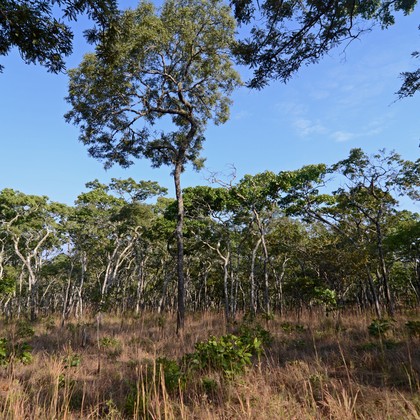
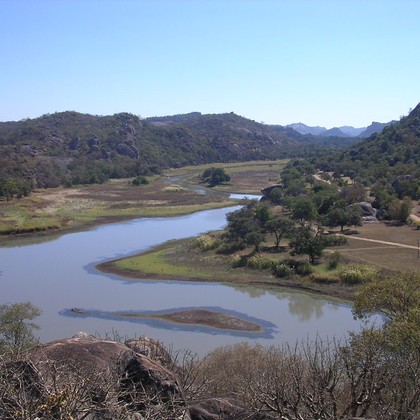
Open wooded savanna, miombo with clearings, forest edges, oil palms and cultivation with scattered trees, often near water. It hunts from a perch for insects, lizards, small rodents and birds, and rarely hovers. It nests in tree holes, in palms or in old Hamerkop nests.
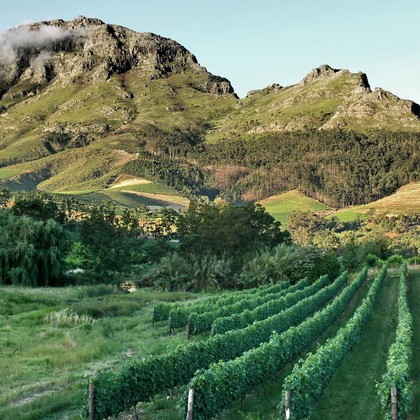
Where the bird is most at home, classified by the vegetation units of southern Africa.
Range and movements
In the region over most of Angola and locally in north-western Zambia; rare or a vagrant in northern Namibia (Kunene). Elsewhere from Senegal east to Ethiopia and south to Tanzania and the Democratic Republic of the Congo.
- Resident
- Summer visitor (c. Oct–Mar)
- Winter visitor (c. Apr–Sep)
- Passage (Mar–Apr, Oct–Nov)
- dark = core range, pale = thinly spread
How and when to look
In Angola scan dead branches and palm fronds in open savanna and around villages; the bird sits still for long periods and stands out by its stocky silhouette. Look out for a Hamerkop nest nearby: Grey Kestrels readily use them for breeding.
Conservation status
Not threatened and widespread in tropical Africa. It benefits locally from the opening up of forest for agriculture. Poorly studied at the southern edge of its range; data from Angola and Zambia are scarce.
Scientific name
Falco ardosiaceus | Vieillot, 1823
Vieillot described the species in 1823 and placed it straight away in the genus where it still stands. The genus Falco was introduced in 1758 by Linnaeus. Falco is the Latin word for 'falcon', possibly related to falx, 'sickle', for the curved shape of the claws or wings. ardosiaceus is New Latin for 'slate-coloured', from the French ardoise, 'slate' — for the uniform slate-grey plumage. The specimen the first description was based on came from Senegal.