All species › Waders, gulls and terns › Gulls and terns › Antarctic Tern
Antarctic Tern | Sterna vittata
Antarctische stern | Charrán Antártico
The Antarctic Tern is the southern counterpart of the Arctic Tern, breeding on subantarctic islands and moving in the southern winter to the cold coasts of southern Africa. Strikingly, it wears its breeding plumage here at that time, just when the Common Terns are in non-breeding dress.
Voice
A high kreet-kreet and a dry cackling trrr, often heard at roosts.
Recording: Sander Lagerveld — CC BY-NC-SA 4.0 · converted to mono · xeno-canto
Identification
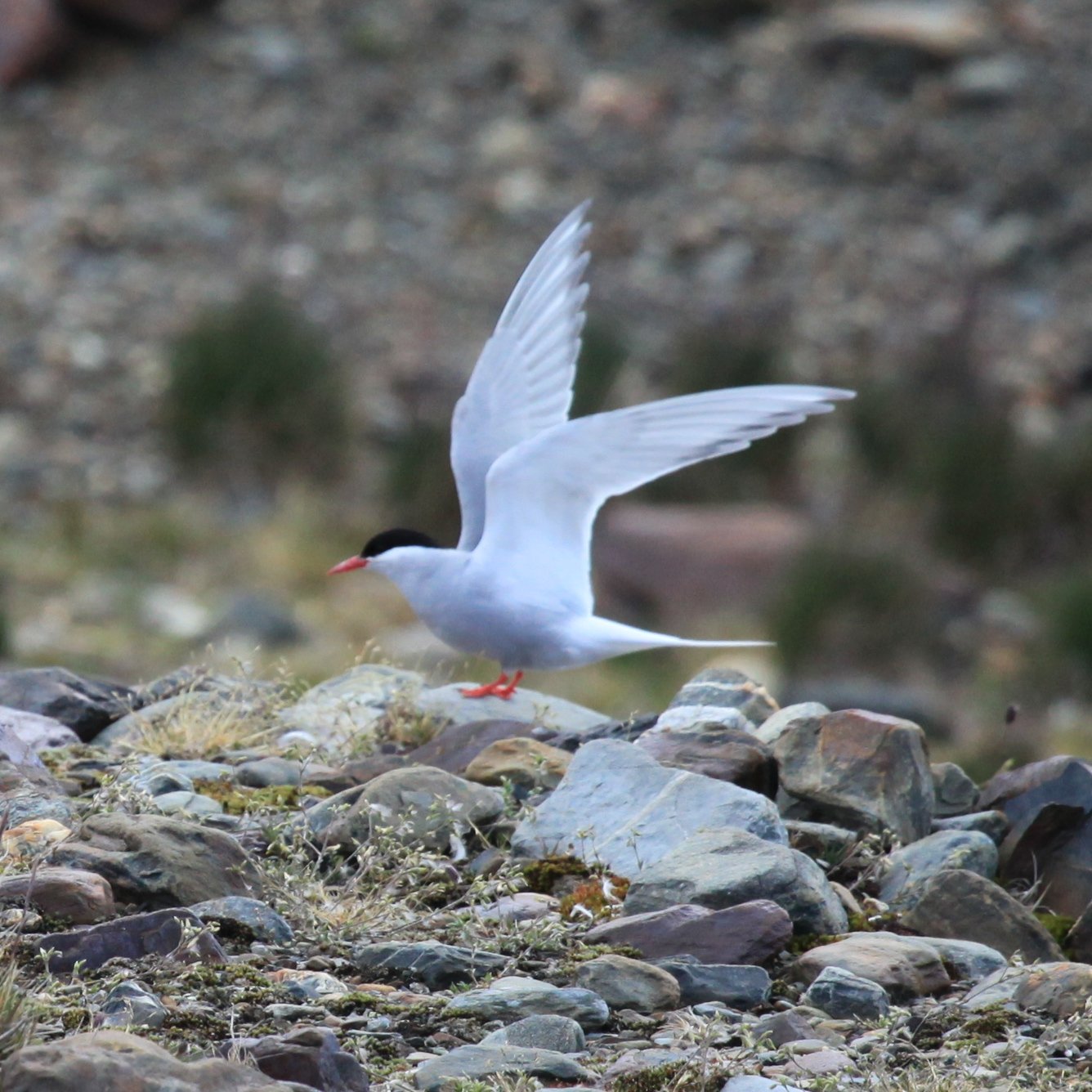
About 37 cm, more heavily built than Arctic Tern, with a thicker bill and slightly longer legs. In breeding plumage, as most birds are here in winter, the cap is wholly black, the bill and legs bright red and the underparts pale grey, with a clear white cheek stripe between cap and breast. Upperparts grey, rump and tail white, with long tail streamers. Moulting birds and juveniles have a white forehead and white underparts; juveniles are heavily scaled brown on the mantle and coverts, more strongly than young Arctic or Common Terns.
Confusion species
Arctic Tern (Sterna paradisaea) and Common Tern (Sterna hirundo) are almost always in non-breeding plumage here in the southern winter, with a white forehead, dark bill and white underparts. Kerguelen Tern (Sterna virgata), a rare vagrant, is darker grey, with a grey tail, shorter streamers and a shorter bill. Whiskered Tern (Chlidonias hybrida) also has grey underparts and a white cheek stripe, but is much smaller, with a short tail, and lives on fresh water.
Habitat
Rocky coasts, kelp beds and the surf zone, where it dips low over the water and makes shallow dives rather than plunging from a height. It roosts on rocks, coastal cliffs and sandy beaches, often with Common Terns and Greater Crested Terns.
Where the bird is most at home, classified by the vegetation units of southern Africa.


Range and movements
Mainly on the coast of the Western Cape, from the Olifants River to the Cape Peninsula and along the south coast to the Eastern Cape; also in southern Namibia around Lüderitz. Rare further north along the Namibian coast. The birds reaching the region come mainly from Tristan da Cunha and Gough; the species breeds on subantarctic islands throughout the Southern Ocean, including the Prince Edward Islands, and outside the breeding season ranges to the coasts of southern Africa, South America and New Zealand.
- Resident
- Summer visitor (c. Oct–Mar)
- Winter visitor (c. Apr–Sep)
- dark = core range, pale = thinly spread
How and when to look
From June to September at the roosts around the Cape Peninsula, such as Kommetjie, Betty's Bay and the rocks at Cape Point, and on the islands of Saldanha Bay. Look among flocks of Common Terns for a bird with a red bill, black cap and grey belly: that is almost certainly an Antarctic Tern.
Conservation status
Not threatened. On some breeding islands numbers have fallen sharply due to introduced rats, mice and cats; eradicating these predators, as on Gough, is therefore of great importance. No specific threats in southern Africa.
Scientific name
Sterna vittata | Gmelin, 1789
Gmelin described the species in 1789 and placed it straight away in the genus where it still stands. The genus Sterna was introduced in 1758 by Linnaeus. Sterna goes back to Old English stearn, which appears in the poem The Seafarer; the Frisians used a related word for terns. vittata is Latin for 'banded, bound with a ribbon', from vitta, 'headband' — probably for the black cap. The specimen the first description was based on came from Christmas Harbour, Kerguelen.