All species › Birds of prey › Hawks, eagles and kites › Ayres's Hawk-Eagle
Ayres's Hawk-Eagle | Hieraaetus ayresii
Ayres' havikarend | Águila-azor de Ayres
Ayres's Hawk-Eagle is a small, compact eagle that behaves like a hawk: it dives on birds in a steep stoop from a great height, even into the tree canopy. It is a scarce and unobtrusive species of forest and well-wooded savanna, which sometimes surprisingly hunts pigeons in the suburbs.
Voice
Mostly silent. In display flight a high hu-heep-heep-heep or a series of whistled klee-klee-klee calls.
Recording: Bram Piot — CC BY-NC-SA 4.0 · shortened to the first 60 s, mono · xeno-canto
Identification
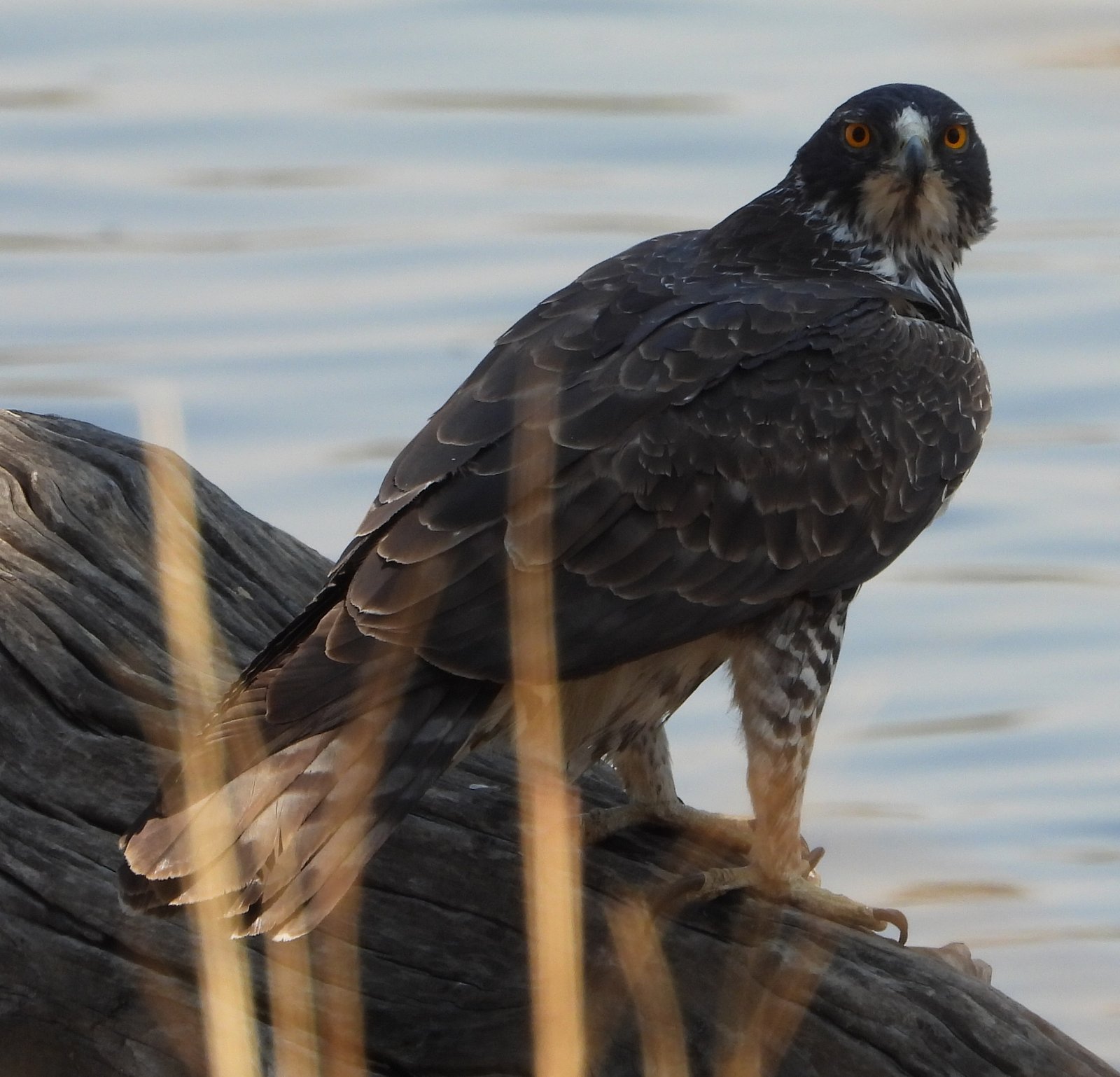
46–57 cm, wingspan 106–137 cm. Dark slate-grey to blackish brown above, white below with heavy black drops and blotches on the breast, belly and trousers. The head is dark, hood-like, often with a white forehead and a white eyebrow; some birds have a small crest. In flight the underwing coverts are heavily blotched black and the flight feathers and tail are densely and finely barred, with a narrow dark terminal band. On the leading edge of the wing, at its base, a small white patch shows from the front as a ‘landing light’. The wings are fairly short and broad, pinched in at the base. Juveniles are rufous to ochre below, more finely streaked, with a paler, rufous head.
Confusion species
African Hawk-Eagle Aquila spilogaster is larger, whiter below with narrow streaks rather than drops, has unmarked white primary bases on the underwing and a broad black terminal tail band. The pale morph of Booted Eagle Hieraaetus pennatus has unmarked pale underparts and a plain, unbarred tail. Cassin's Hawk-Eagle Aquila africana, only in the far north of Angola, is white below with black blotches confined to the flanks and a black underwing.
Habitat
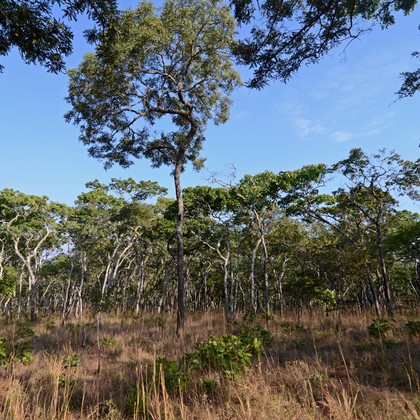
Miombo, riverine forest and the edges of lowland and coastal forest, also tall woodland and well-wooded suburban gardens and parks. It hunts almost exclusively birds, such as pigeons, francolins and turacos, often after a steep stoop from a great height or in a fast chase through the canopy.
Where the bird is most at home, classified by the vegetation units of southern Africa.


Range and movements
Mainly in the north and east of the region: Zimbabwe, Zambia, Malawi, Mozambique and Angola, and scarce in northern and north-eastern Botswana and the Caprivi Strip. In South Africa a scarce, mainly non-breeding summer visitor to Limpopo, Mpumalanga, Gauteng and KwaZulu-Natal, with a small number of breeding records. Beyond the region in forest and savanna areas of Africa south of the Sahara, from Sierra Leone to Ethiopia and Kenya.
- Resident
- dark = core range, pale = thinly spread
How and when to look
Look for this species high in the sky above a forest edge or well-wooded suburbs, often on warm mornings, where it soars in tight circles before stooping. In Harare and in the northern suburbs of Johannesburg and Pretoria birds have been seen hunting pigeons. A perched bird is inconspicuous and likes to sit hidden in a dense tree crown.
Conservation status
Not threatened, but everywhere scarce and little studied. Its distribution follows wooded country, so clearance of miombo and riverine forest affects it locally. Its habit of hunting pigeons in the suburbs occasionally leads to conflict with pigeon fanciers.
Scientific name
Hieraaetus ayresii | (Gurney, 1862)
Gurney described the species in 1862 as Spizaëtus ayresii; because it was later moved to another genus, the author and year stand in brackets. The genus Hieraaetus was introduced in 1844 by Kaup. Hieraaetus is Greek, from hierax 'hawk' and aetos 'eagle'. ayresii honours Thomas Ayres (1828–1913), an English collector and ornithologist who worked for many years in Natal and the Transvaal. The specimen the first description was based on came from Natal, South Africa.