All species › Birds of prey › Hawks, eagles and kites › Wahlberg's Eagle
Wahlberg's Eagle | Hieraaetus wahlbergi
Wahlbergs arend | Águila de Wahlberg
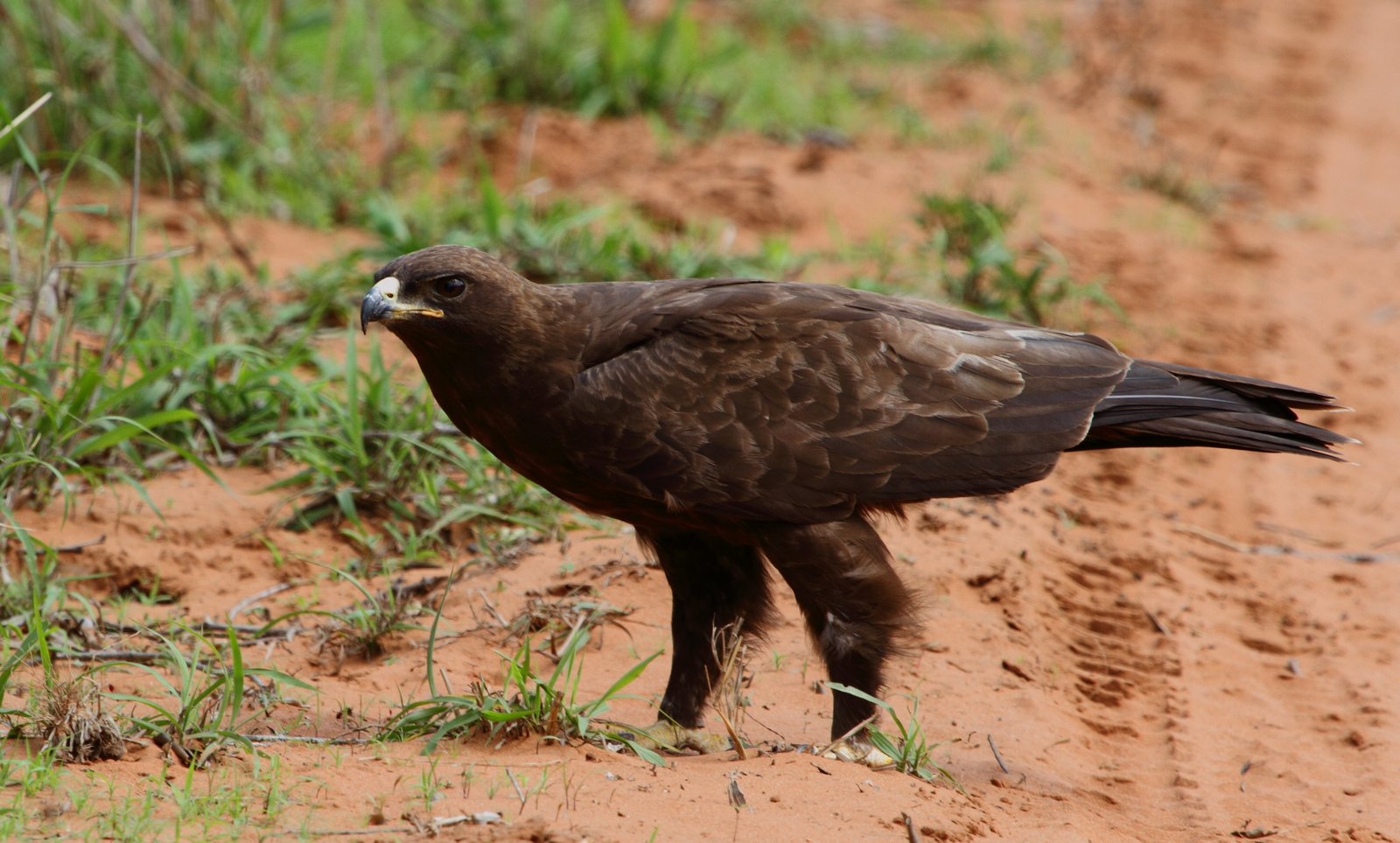
Wahlberg's Eagle is the commonest small eagle of the savannas of southern Africa and a true migrant: it arrives at the end of the dry season to breed and leaves after the rains for the Sahel and East Africa. Its plumage comes in dark, pale and intermediate forms.
Voice
A drawn-out, high and plaintive whistle, kleeee-ee or peeeeeoo, often in flight over the nest wood and usually the first sign that the species has arrived in September. At the nest also a series of short kyip-kyip calls.
Recording: David C. Moyer — CC BY-NC-SA 4.0 · shortened to the first 60 s, mono · xeno-canto
Identification
53–61 cm, wingspan 130–146 cm. A slender eagle with a small pointed crest on the back of the head, feathered legs and a relatively small head. Most birds are uniform dark brown; a minority are creamy white to pale brown on the head and underwing, with dark flight feathers, and there are intermediates. In flight the long, narrow, parallel-edged wings and the long, narrow, square-ended tail are characteristic; the bird soars on flat wings and has a cross-shaped silhouette. The tail is usually held closed. The sexes are alike, the female larger; juveniles resemble adults.
Confusion species
Tawny Eagle Aquila rapax is larger and heavier, with a shorter, rounded tail and no crest. Lesser Spotted Eagle Clanga pomarina has broader wings with obvious ‘fingers’ and a shorter tail. Black Kite Milvus migrans has a forked tail and angled wings. Booted Eagle Hieraaetus pennatus has white ‘landing lights’ on the leading edge of the wing, a pale band across the upperwing and a shorter tail. Long-Crested Eagle Lophaetus occipitalis has a long floppy crest and white windows in the primaries.
Habitat
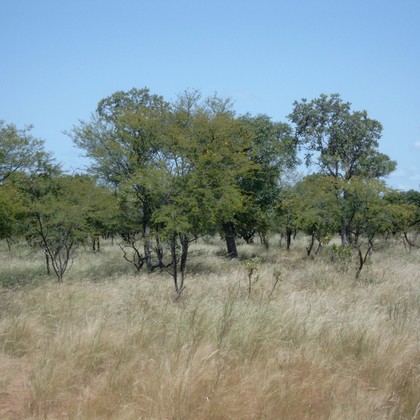
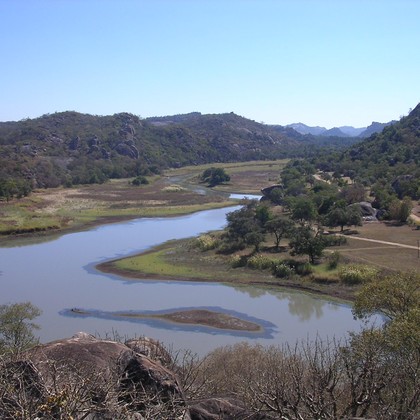
Well-wooded savanna and woodland: acacia savanna, mopane, mixed broadleaf woodland and miombo, often along rivers. It hunts from a perch or from a glide on lizards, small mammals, birds up to francolin size and large insects. It nests in the crown of a tall tree, often a riverine tree, and reuses the nest year after year.
Where the bird is most at home, classified by the vegetation units of southern Africa.

Range and movements
In the breeding season widespread in the savanna belt: northern and eastern South Africa (Limpopo, Mpumalanga, North West, KwaZulu-Natal), Eswatini, Botswana, northern and central Namibia, Zimbabwe, Mozambique, Zambia, Malawi and Angola; absent from the Karoo, the fynbos and Lesotho. Outside the breeding season the population moves north as far as the Sahel and East Africa; a population also breeds in East Africa and the Sahel.
- Resident
- Summer visitor (c. Oct–Mar)
- Winter visitor (c. Apr–Sep)
- Passage (Mar–Apr, Oct–Nov)
- dark = core range, pale = thinly spread
How and when to look
From mid-September the birds are conspicuous over the savanna, in display flight with tumbling dives and plaintive whistles. With a soaring medium-sized brown eagle, look first at the shape: long, parallel-edged wings and a long, narrow, square-ended tail point to Wahlberg's Eagle, whatever the colour. Nests are often in tall trees along dry riverbeds, as in the Kruger National Park.
Conservation status
Not threatened. In southern Africa fairly common in protected savanna areas; outside them sensitive to the felling of large trees, poisoned carcasses and electrocution. Little is yet known about the migration routes and wintering areas.
Scientific name
Hieraaetus wahlbergi | (Sundevall, 1850)
Sundevall described the species in 1850 as Aquila Wahlbergi; because it was later moved to another genus, the author and year stand in brackets. The genus Hieraaetus was introduced in 1844 by Kaup. Hieraaetus is Greek, from hierax 'hawk' and aetos 'eagle'. wahlbergi honours the Swedish naturalist Johan August Wahlberg (1810–1856), who collected in southern Africa and was killed there by an elephant. The specimen the first description was based on came from Mohapvani, Botswana.