All species › Birds of prey › Hawks, eagles and kites › Bearded Vulture
Bearded Vulture | Gypaetus barbatus
Lammergier | Quebrantahuesos
The Bearded Vulture is a huge, long-winged vulture with a long wedge-shaped tail and a black beard below the bill, which lives on bones: it drops large bones onto rocks to smash them and reach the marrow. In southern Africa it is confined to the high mountains of Lesotho and the Drakensberg.

Voice
Usually silent. At the nest and in display a high whistling squeal and a high feeeeu.
Recording: Thomas SIGNEAU — CC BY-SA 4.0 · converted to mono · xeno-canto
Identification
100–115 cm, wingspan 250–280 cm. Adults have slate-grey upperparts with white shaft streaks, a creamy white head with a black mask ending in a bristly black beard, and an orange to rusty neck and underparts. The colour comes from bathing in iron-rich water and mud. The eye is yellow with a bright red eye-ring. In flight it shows long, narrow, pointed wings and a long, wedge-shaped tail, a silhouette more like a giant falcon than a vulture. Juveniles are dark greyish brown with a blackish head and neck and take five to seven years to reach adult plumage.
Confusion species
Cape Vulture Gyps coprotheres is paler, with broad wings, a short tail and a bare, elongated neck. Verreaux's Eagle Aquila verreauxii is jet black with a white V on the back and white windows in the primaries, and has a shorter tail. Young Bearded Vultures can suggest a dark eagle, but the long wedge-tailed silhouette and narrow wings are unique.
Habitat
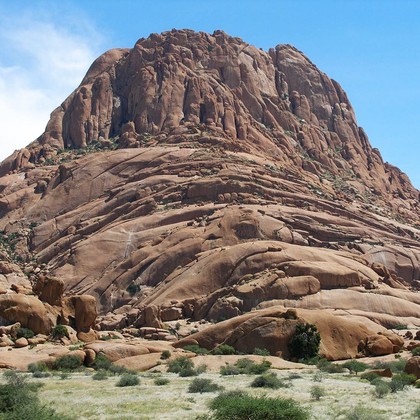
High mountains with deep gorges, sheer basalt cliffs and high-altitude grassland, mainly above 2000 m. It quarters low along slopes for carcasses of livestock and game and eats mainly bones; it breeds in a pothole or on a ledge in a sheer cliff. It visits protected feeding sites stocked with bones.
Where the bird is most at home, classified by the vegetation units of southern Africa.

Range and movements
In the region only in the Drakensberg-Maloti massif: Lesotho, western KwaZulu-Natal, the north-eastern Eastern Cape and the eastern edge of the Free State. It formerly occurred in other South African mountains, as far as the Western Cape, but vanished there long ago. Beyond the region it occurs in the highlands of Ethiopia and East Africa, north-west Africa, the mountains of southern Europe, the Middle East and Central Asia to the Himalaya and Mongolia.
- Resident
- Summer visitor (c. Oct–Mar)
- dark = core range, pale = thinly spread
How and when to look
The best chance is a bone-stocked feeding site in the Drakensberg, such as at Giant's Castle, or a drive over Sani Pass and the high roads of Lesotho. Scan the rims of gorges: the bird glides low and fast along the slope, seldom flapping. In clear weather the orange underparts of adults stand out against the blue.
Conservation status
Near Threatened globally, but critically threatened in southern Africa: the isolated population numbers about a hundred breeding pairs and is declining. Poisoning, including baits set for jackals, collisions with power lines, poaching for the traditional use of vulture parts and disturbance at nests are the main threats. Supplementary feeding and a captive-breeding programme are under way.
Scientific name
Gypaetus barbatus | (Linnaeus, 1758)
Linnaeus described the species in 1758 as Vultur barbatus; because it was later moved to another genus, the author and year stand in brackets. The genus Gypaetus was introduced in 1784 by Storr. Gypaetus comes from Greek gupaietos, a corrupt form of hupaietos, 'eagle' or 'vulture'. barbatus is Latin for 'bearded', from barba 'beard', after the black bristles below the bill. The specimen the first description was based on came from Santa Cruz, near Oran, Algeria.