All species › Birds of prey › Hawks, eagles and kites › Black-Winged Kite
Black-Winged Kite | Elanus caeruleus
Grijze wouw | Elanio Común
The Black-Winged Kite is a small, pale grey raptor with black shoulders and bright red eyes that hovers like a kestrel over open country and perches on wires and poles along the road. It is one of the most frequently seen raptors in southern Africa.

Voice
Not very vocal. A thin, whistled wheep or peeeu and a rasping, hoarse kree-ah when disturbed or when squabbling over prey. Soft piping from both adults around the nest.
Recording: Tony Rinaud — CC BY-NC-SA 4.0 · shortened to the first 60 s, mono · xeno-canto
Identification
30–33 cm, wingspan 75–87 cm. Pale grey above, white below and on the head, with a large black patch on the shoulder (lesser and median wing coverts) and a short black line in front of and above the eye. The eyes are deep red, the bill black with a yellow cere, the legs yellow. The tail is short, white and slightly forked. In flight the underwing is white with black primaries, which with the black shoulder patches gives a sharp contrast; it glides with raised wings. When perched it often wags its tail up and down. Juveniles have a brownish-grey back with pale fringes, a rufous-washed breast and orange-brown eyes.
Confusion species
Male Pallid Harrier Circus macrourus and male Montagu's Harrier Circus pygargus are also pale grey, but much larger and slimmer, with long wings and a long tail, and they quarter low over the veld without hovering. Pale Chanting Goshawk Melierax canorus is much larger and has long red legs. The combination of black shoulder patches, red eyes and hovering makes the Black-Winged Kite unmistakable.
Habitat
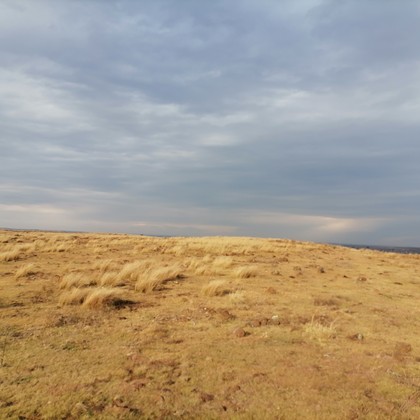
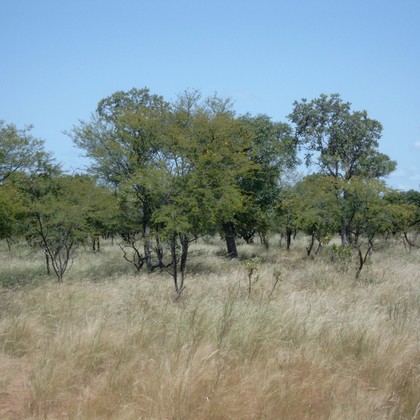
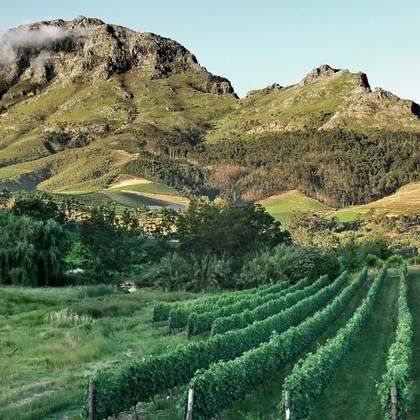
Open grassland, cropland, pasture, fallow land and open savanna with scattered trees or poles; road verges with power lines are favourite hunting perches. It hunts mainly mice and rats, located while hovering or from a lookout. It nests in a small stick cup in a tree crown, often in an isolated exotic tree.
Where the bird is most at home, classified by the vegetation units of southern Africa.
Range and movements
Across almost the whole region: every province of South Africa, Lesotho, Eswatini, Namibia, Botswana, Zimbabwe, Mozambique, Zambia, Malawi and Angola. Commonest in the grain fields of the Highveld and Free State and in the farmland of the Western Cape; scarce in closed forest and the barren Namib. Beyond the region it occurs over almost all of sub-Saharan Africa, in north-west Africa and southern Iberia, and from the Indian subcontinent to South-East Asia and New Guinea.
- Resident
- Summer visitor (c. Oct–Mar)
- Winter visitor (c. Apr–Sep)
- Passage (Mar–Apr, Oct–Nov)
- dark = core range, pale = thinly spread
How and when to look
Drive a farm road through cropland and scan power lines and telephone poles: the small white bird with black shoulders stands out from afar. When hovering it alternates rapid wingbeats with hanging still, legs dangling. After a wet season with many rodents, dozens of birds can gather in one area and roost communally in a stand of trees.
Conservation status
Not threatened and probably increased in the region through clearing of woodland and the spread of agriculture. Poisoning by rodenticides and road collisions are the main known causes of death.
Scientific name
Elanus caeruleus | (Desfontaines, 1789)
Desfontaines described the species in 1789 as Falco caeruleus; because it was later moved to another genus, the author and year stand in brackets. The genus Elanus was introduced in 1809 by De Savigny. Elanus comes from Greek elanos, the name of a kite. caeruleus is Latin for 'blue', for the blue-grey plumage. The specimen the first description was based on came from Algiers.