All species › Passerines › Swallows and martins › Black-and-Rufous Swallow
Black-and-Rufous Swallow | Hirundo nigrorufa
Benguelazwaluw | Golondrina Rojinegra
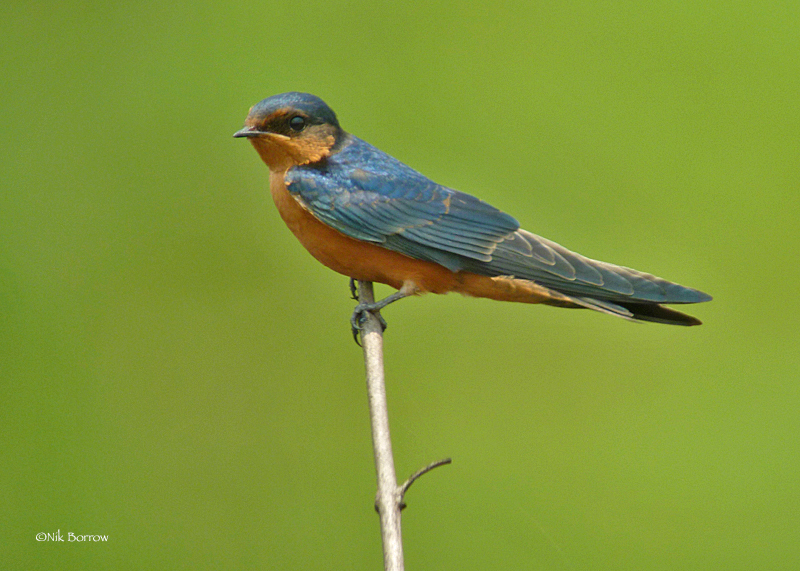
The Black-and-Rufous Swallow is a striking bicoloured swallow, glossy blue-black above and deep rufous below. It is confined to the grassy flats (dambos) of the miombo belt in central Angola, north-western Zambia and the adjacent south of DR Congo.
Voice
A soft, short chip and a fine, chattering twitter in flight; poorly known and not loud.
Recording: Dries Van de Loock — CC BY-NC-SA 4.0 · converted to mono · xeno-canto
Identification
15 cm, with a moderately forked tail and short, narrow streamers. The upperparts, including crown, cheeks and rump, are glossy dark steel-blue. The entire underside, from throat to undertail coverts, is uniform deep rufous to chestnut, without a breast band. The underwing coverts are rufous. The sexes are almost alike; the female has shorter streamers, juveniles are duller and paler orange-brown below. The flight is low and light, often just above the grass.
Confusion species
Red-Breasted Swallow Cecropis semirufa is larger, with a rufous rump, rufous cheeks and much longer streamers, and flies more slowly with more gliding. Angola Swallow Hirundo angolensis has a rufous throat with an incomplete black breast band and a dingy grey belly. Barn Swallow Hirundo rustica has a dark breast band and a white to buff belly, although some birds are warmly tinged. Mosque Swallow Cecropis senegalensis is much larger, with a rufous rump and a white throat.
Habitat
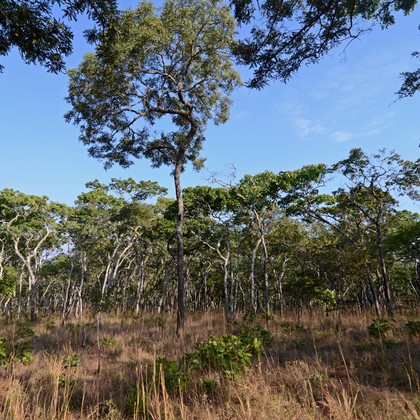
Open grassy dambos, floodplains and vleis in the miombo belt, mostly on the plateau and often near running water. It breeds in culverts under roads, in pipes, under small bridges and in holes or old pits, where it builds an open mud bowl against the ceiling. It hunts small insects low over the grass, often singly or in pairs.
Where the bird is most at home, classified by the vegetation units of southern Africa.

Range and movements
Within the region on the central plateau of Angola (mainly Bié, Huambo, Moxico and the Lunda provinces) and in north-western Zambia (Mwinilunga and surroundings, and the western dambos); beyond the region only in southern DR Congo (Katanga). Largely resident, with minor seasonal movements.
- Resident
- dark = core range, pale = thinly spread
How and when to look
Easiest to find in the dambos around Mwinilunga in north-western Zambia or on the Angolan plateau; check culverts and small bridges over dambo streams. A swallow skimming low over a dambo that is entirely rufous below without a rufous rump is almost certainly this species.
Conservation status
Not threatened. The range is small but largely thinly populated; local pressure comes from burning and ploughing of dambos and from culverts being blocked during road maintenance.
Scientific name
Hirundo nigrorufa | Bocage, 1877
Bocage described the species in 1877 and placed it straight away in the genus where it still stands. The genus Hirundo was introduced in 1758 by Linnaeus. Hirundo is the ordinary Latin word for 'swallow'. nigrorufa comes from the Latin niger, 'black', and rufus, 'red' — for the dark blue upperparts and rufous underparts. The specimen the first description was based on came from Caconda, Angola.