All species › Passerines › Chats and flycatchers › Brown-Chested Alethe
Brown-Chested Alethe | Chamaetylas poliocephala
Bruinborstalethe | Alete Pechipardo
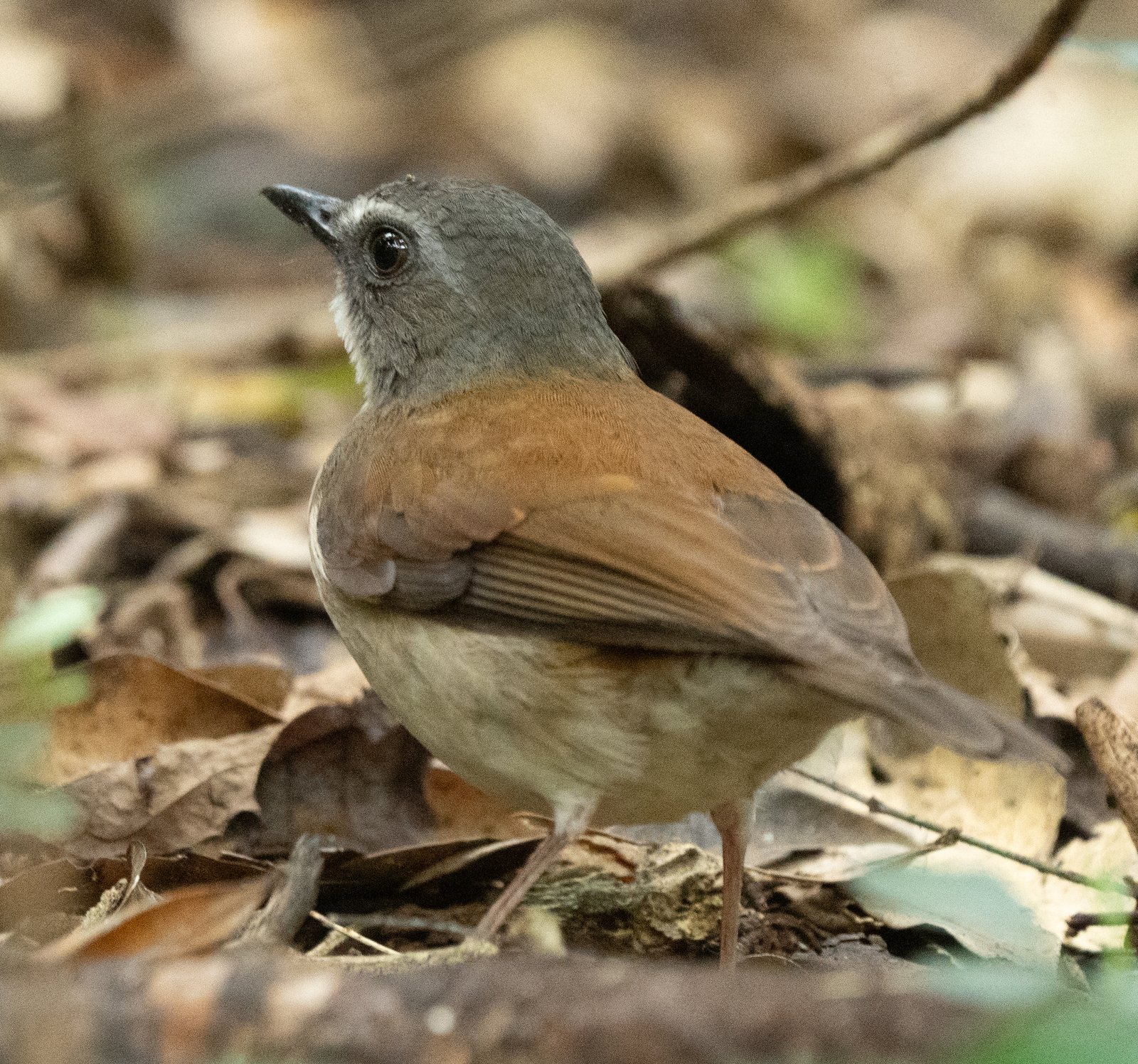
The Brown-Chested Alethe is a thrush-like forest-floor bird of the African rainforest that within the region occurs only in the escarpment forests of western Angola. It lives in the gloom of the undergrowth and is seen mainly at swarms of driver ants, where it catches insects fleeing ahead of the ants.
Voice
The song is a series of clear, rather plaintive whistles of varying pitch, such as hwee-hoo-hwee, mainly at dawn. At ant swarms a soft, nasal kweet and a dry, rattling alarm, chrrr, are often heard.
Recording: Budongo Conservation Field Station — CC BY-NC-SA 4.0 · converted to mono · xeno-canto
Identification
16–18 cm, a robust, fairly short-tailed alethe with long, pale legs. Crown and cheeks are dark slate-grey, with a long, narrow white supercilium above a dark eye-stripe. The upperparts are warm rufous-brown, the tail slightly darker chestnut. The throat is white and bordered by a broad, brownish-grey to rufous-tinged breast band; the belly is white with brownish-grey flanks. The sexes are alike; juveniles are dark, with ochre spots on the head and upperparts. It perches upright on low branches and lianas, flicks its tail and droops its wings.
Confusion species
There are no other alethes in the Angolan escarpment forest. Gabela Akalat Sheppardia gabela and Bocage's Akalat Sheppardia bocagei are much smaller, with an orange or ochre throat and breast and no white supercilium. Olive Thrush Turdus olivaceus and African Thrush Turdus pelios are larger, with a yellow or orange bill and streaked throat, and live more in open woodland and gardens. The combination of grey head, white supercilium, white throat and brown breast band is distinctive.
Habitat
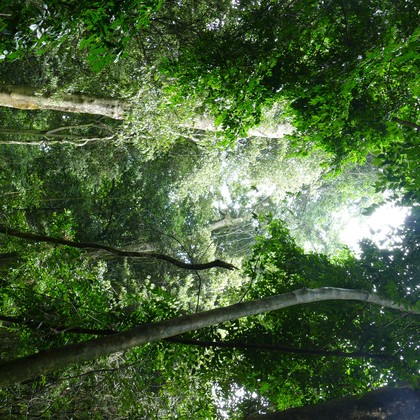
The understorey and floor of moist evergreen forest with a dense shrub layer; in Angola mainly semi-humid escarpment forest and old shade-coffee plantations between about 700 and 1,400 m. It feeds on insects, spiders and other invertebrates, largely caught at the edges of driver-ant swarms. The nest is a cup of leaves and moss low in a stump, among lianas or in a tree hollow.
Where the bird is most at home, classified by the vegetation units of southern Africa.

Range and movements
Within the region only in western Angola, mainly in the escarpment forests of Cuanza Sul around Gabela, Kumbira and Seles, with a few records further north into Malanje. Not known from the other countries of the region. Beyond the region from Sierra Leone through West and Central Africa to Uganda, western Kenya and the mountains of Tanzania.
- Resident
- dark = core range, pale = thinly spread
How and when to look
Visit the forests around Kumbira and Gabela and walk the trails slowly, especially in the early morning. Finding a swarm of driver ants gives the best chance: stand at some distance and wait until the alethe, often together with other ant-followers, appears low on a branch.
Conservation status
Not threatened as a species, as its range in the African rainforest is large. The isolated Angolan population, however, lives in a small and severely threatened forest area where shade-coffee plantations are being cleared for cultivation and charcoal, and is therefore vulnerable.
Scientific name
Chamaetylas poliocephala | (Bonaparte, 1850)
Bonaparte described the species in 1850 as Trichophorus (Criniger) poliocephalus; because it was later moved to another genus, the author and year stand in brackets. The genus Chamaetylas was introduced in 1860 by Heine. Chamaetylas comes from the Greek khamai, 'on the ground', and tulas, 'thrush', for these plump, upright, long-legged birds of the forest floor and low undergrowth (Keith et al., 1992). poliocephala comes from the Greek polios, 'grey', and kephalē, 'head' — for the grey crown. The specimen the first description was based on came from Bioko (Fernando Po), Equatorial Guinea.