All species › Passerines › Chats and flycatchers › Swynnerton's Robin
Swynnerton's Robin | Swynnertonia swynnertoni
Swynnertons sterrenpaapje | Ruiseñor de Swynnerton
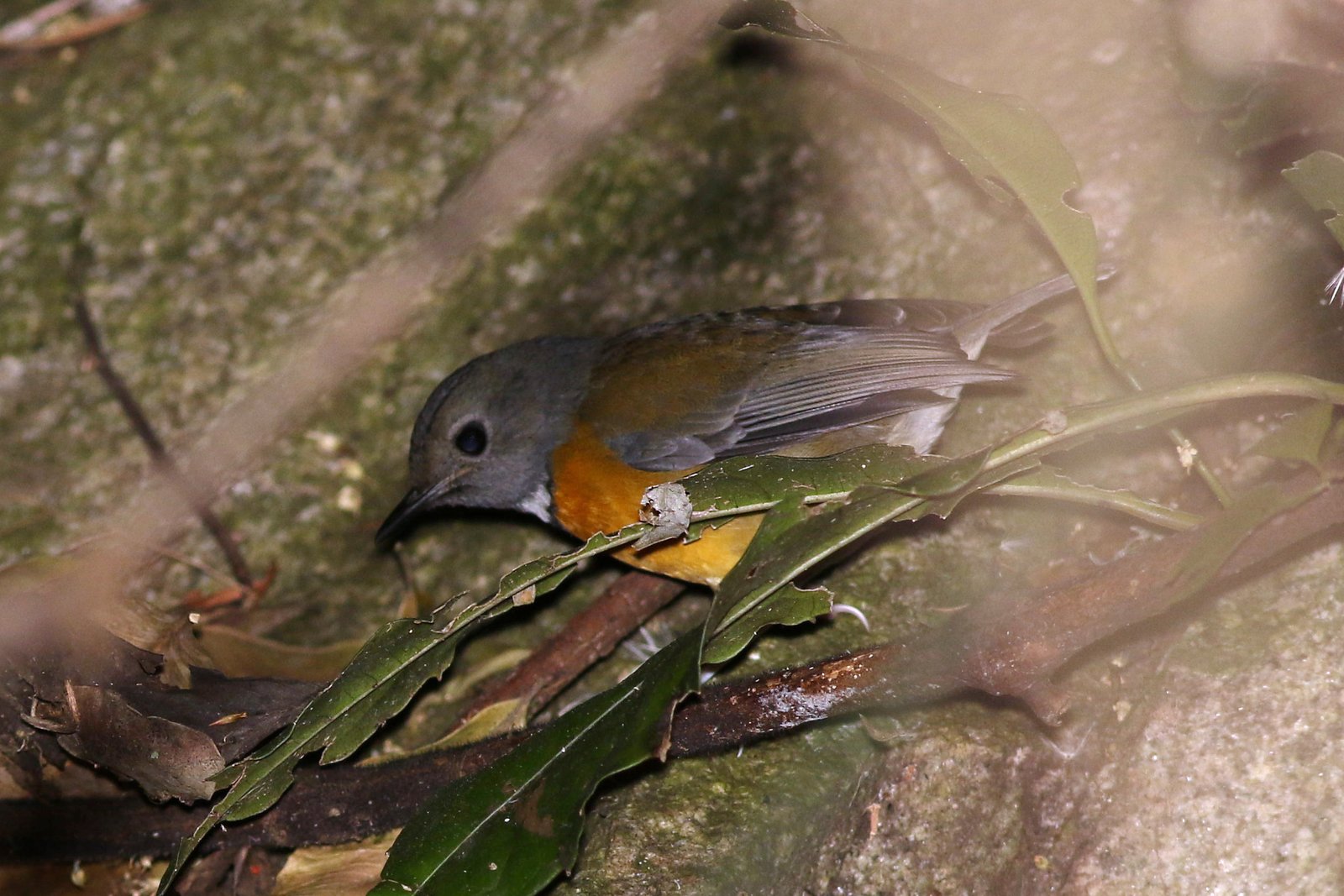
Swynnerton's Robin is a small, shy forest-floor bird of the montane forests on the border of Zimbabwe and Mozambique, with a few isolated populations in Tanzania. The male is striking with its orange throat and breast and white crescent, but the bird usually keeps to the gloom of the undergrowth.
Voice
The song is a soft, whistled three-note phrase, zit-zitt-slurr, with a falling last note, often repeated from a low branch. The alarm is a quiet, dry chattering and a grating chrrr.
Recording: Louis A. Hansen — CC BY-NC-SA 4.0 · shortened to the first 60 s, mono · xeno-canto
Identification
13–14 cm, a compact, short-tailed robin with long legs. The male has a slate-grey head, olive-green back and wings and a dark grey tail without yellow. Throat and breast are warm orange, with a conspicuous white crescent across the upper breast bordered below by a narrow black line; the belly is dirty white with grey flanks. The female is duller, with an olive wash over the crown and face. Juveniles are spotted buffy yellow on the head and upperparts, with a faint greyish-brown breast band. It perches low, bobs its tail and droops its wings.
Confusion species
White-Starred Robin Pogonocichla stellata is larger and has wholly yellow underparts with no white crescent, and yellow tail sides that flash as it flies off; both species live in the same forests, the White-Starred Robin often somewhat higher. East Coast Akalat Sheppardia gunningi has an orange throat and breast but no white crescent or black line, and a blue-grey wing edge; it lives in lowland forest in Mozambique and Malawi. Red-Capped Robin-Chat Cossypha natalensis is larger, rusty orange below and has a blue-grey wing and back.
Habitat
The understorey and floor of moist, shady montane and mid-altitude forest with a dense shrub layer and abundant leaf litter, mainly between 850 and 1,850 m. It forages on or just above the ground for ants, beetles and other invertebrates and sometimes follows columns of driver ants. The nest is a cup of moss and leaves in a hollow stump or among roots, low above the ground.
Where the bird is most at home, classified by the vegetation units of southern Africa.

Range and movements
Within the region only in the eastern highlands of Zimbabwe, with Chirinda Forest and the Bvumba as the main sites, and in Mozambique on Gorongosa and Mabu and in forests along the border with Zimbabwe. Beyond the region only in Tanzania, in the Udzungwa and East Usambara Mountains, where a separate subspecies lives. Records from South Africa do not refer to wild birds.
- Resident
- Summer visitor (c. Oct–Mar)
- Winter visitor (c. Apr–Sep)
- Passage (Mar–Apr, Oct–Nov)
- dark = core range, pale = thinly spread
How and when to look
Chirinda Forest near Mount Selinda and the forests of the Bvumba, such as at Seldomseen, are the classic sites. Walk slowly and quietly along the forest paths in the early morning and listen for the soft three-note whistle. Stop at an ant column or an opening in the undergrowth, where the bird often comes to sit briefly on a low twig.
Conservation status
Near Threatened. The species has a highly fragmented range in a few small forest blocks, and logging, burning and the spread of cultivation on the mountain slopes are reducing its habitat. In Zimbabwe most of the population lives in protected forests; the discovery of a population on Mabu in Mozambique enlarged the known range.
Scientific name
Swynnertonia swynnertoni | (Shelley, 1906)
Shelley described the species in 1906 as Erythracus swynnertoni; because it was later moved to another genus, the author and year stand in brackets. The genus Swynnertonia was introduced in 1922 by Roberts. Swynnertonia honours the British naturalist Charles Swynnerton (1877–1938), who collected birds in Zimbabwe and Tanzania and studied the tsetse fly. swynnertoni honours the British naturalist Charles Swynnerton (1877–1938), who discovered the species in Chirinda Forest. The specimen the first description was based on came from Chirinda Forest, Zimbabwe.