All species › Passerines › White-eyes › Cape White-Eye
Cape White-Eye | Zosterops virens
Kaapse brilvogel | Anteojitos del Cabo
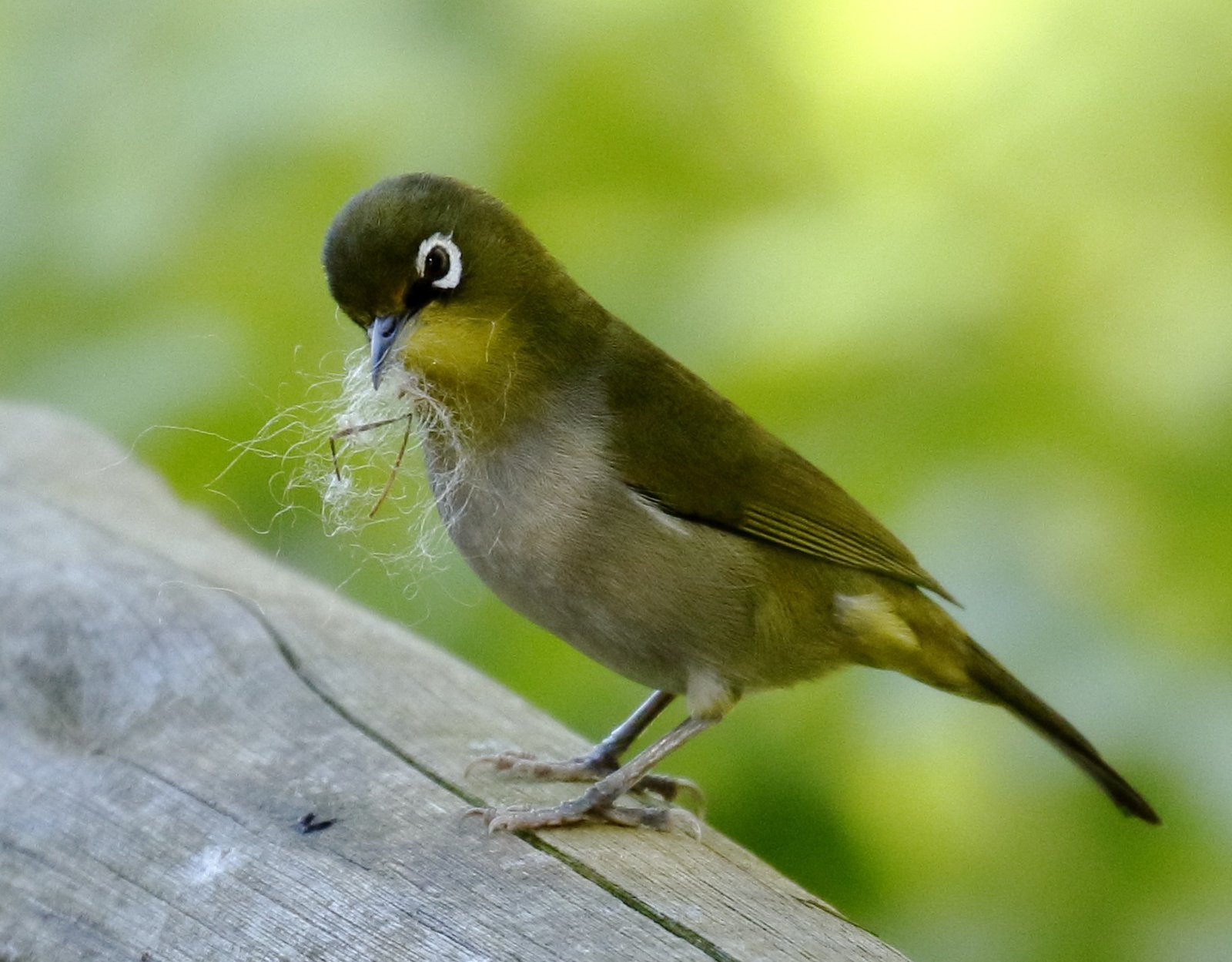
The Cape White-Eye is one of the commonest and most familiar birds of the south and east of the region: a small green bird with a white eye-ring that moves in parties through gardens, fynbos and forest. The western race has a grey belly, the eastern one a greenish-yellow one; both belong to the same species.
Voice
The contact call is a soft, plaintive tsiu or tee-uu, repeated constantly by a party; when alarmed a fast twittering. The song is a fast, varied, rippling series of high, sweet whistles and chirps, mainly in the early morning and often half hidden in the foliage.
Recording: Walter Wallner — CC BY-NC-SA 4.0 · converted to mono · xeno-canto
Identification
11–12 cm. The upperparts are olive-green, the throat and undertail coverts bright yellow. In the western and southern race the belly is grey with grey flanks; in the eastern race, from the Eastern Cape to Limpopo, the belly and flanks are greenish yellow, so that the whole underside looks yellowish. Around the eye is a broad white ring, broken in front of the eye by a narrow black line. The bill is thin and black, the legs grey. The sexes are alike; juveniles are duller, with a narrower eye-ring. It lives in parties of five to twenty, sometimes more outside the breeding season, which keep in constant contact with soft calls.
Confusion species
Orange River White-Eye Zosterops pallidus is paler sandy olive-green above and has a white belly with apricot flanks; intermediates occur in the contact zone in the interior. Southern Yellow White-Eye Zosterops anderssoni in the north-east is smaller, paler yellow-green above and bright lemon-yellow from throat to undertail. Bar-Throated Apalis Apalis thoracica has a black breast band, a long tail and a pale iris, and no white eye-ring.
Habitat
Almost any vegetation with trees and bushes: Afromontane and coastal forest, forest edges, fynbos, riverine forest, plantations, parks and gardens right into city centres. It forages in trees and bushes for small insects, nectar and soft fruit, and readily comes to fruit and sugar water in gardens.
Where the bird is most at home, classified by the vegetation units of southern Africa.


Range and movements
In South Africa in the Western Cape, the Eastern Cape, KwaZulu-Natal, the eastern Free State, Gauteng, Mpumalanga and the Limpopo highlands; also in Lesotho, Eswatini, southern Mozambique and south-eastern Botswana. It does not occur outside the region.
- Resident
- Winter visitor (c. Apr–Sep)
- dark = core range, pale = thinly spread
How and when to look
All year and almost everywhere in the south and east; a birdbath or half an orange in the garden soon attracts them. In north-eastern South Africa check the colour of the belly and flanks to rule out Southern Yellow White-Eye, and in the interior look for the apricot flanks of Orange River White-Eye.
Conservation status
Not threatened. Very common, and it has increased through the planting of trees and gardens in formerly treeless areas such as the Highveld.
Scientific name
Zosterops virens | Sundevall, 1850
Sundevall described the species in 1850 and placed it straight away in the genus where it still stands. The genus Zosterops was introduced in 1827 by Vigors & Horsfield. Zosterops comes from the Greek zōstēr, 'belt, girdle', and ōps, 'eye' — for the white eye-ring shown by most white-eyes. virens is Latin for 'green, verdant' — for this white-eye's green upperparts. The specimen the first description was based on came from Durban, KwaZulu-Natal, South Africa.