All species › Waders, gulls and terns › Gulls and terns › Caspian Tern
Caspian Tern | Hydroprogne caspia
Reuzenstern | Pagaza Piquirroja
The Caspian Tern is the largest tern in the world, as big as a medium-sized gull, with a massive red bill that stands out from afar. In the region it is a scarce resident of coastal lagoons, estuaries and large inland waters, with a small population that depends on only a handful of breeding sites.
Voice
A deep, hoarse, loud kraa-ah or kree-ach, heron-like and carrying far, often given in flight. Juveniles beg for months after fledging with a high, whistled wee-ee.
Recording: Julien Bottinelli — CC BY-NC-SA 4.0 · converted to mono · xeno-canto
Identification
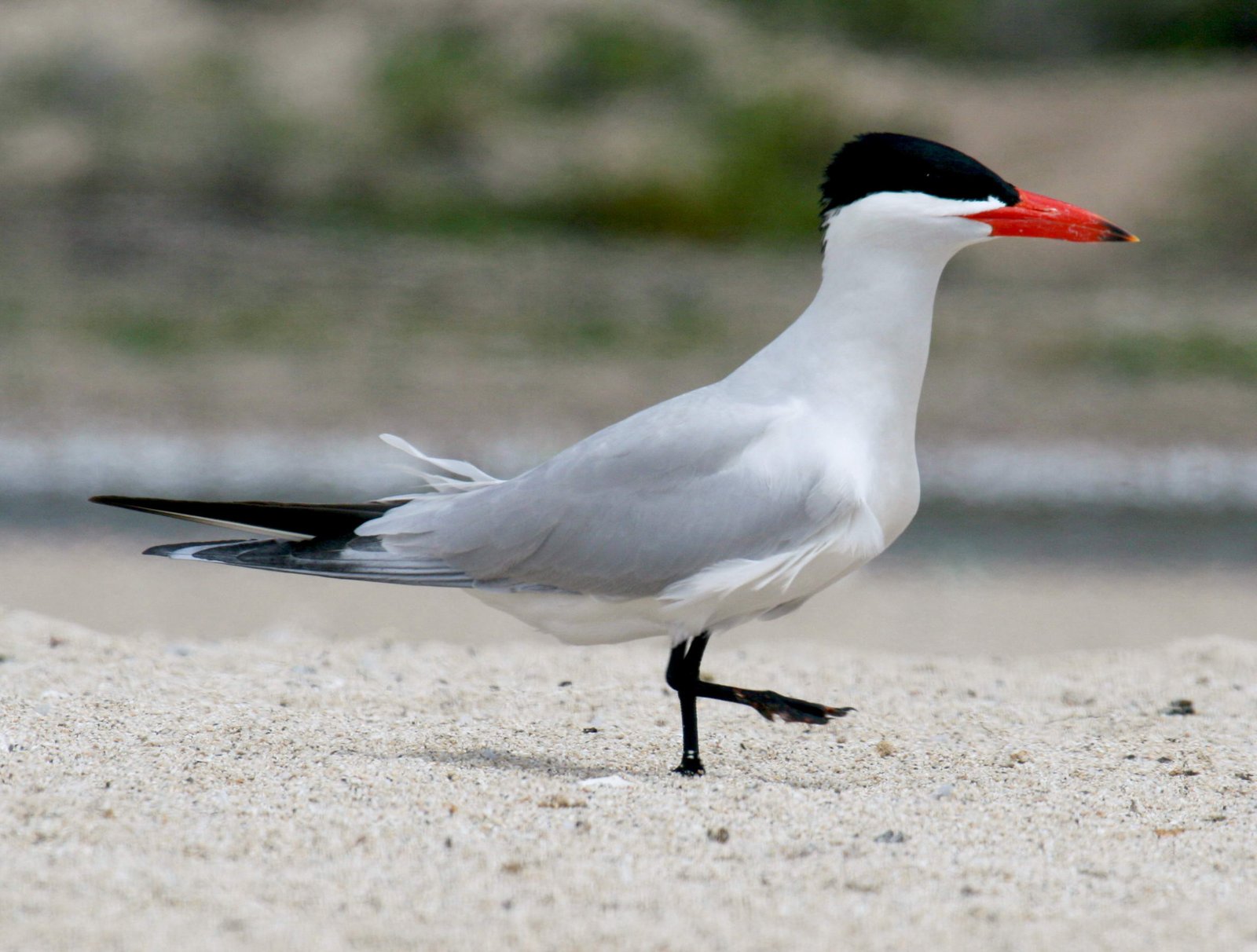
About 52 cm, heavily built with broad wings and a short, shallowly forked tail. The bill is thick and deep red, with a dark band just behind the paler tip. In breeding plumage the crown is entirely black and slightly crested; outside the breeding season the crown is finely streaked white and the forehead speckled, but never as white as in the crested terns. The upperparts are pale grey, the rump, tail and underparts white. In flight the underside of the outer primaries is strikingly dark, a good feature at distance. The legs are black. Juveniles have an orange-red bill and brown-scaled upperparts. The flight is powerful and gull-like, with slow wingbeats.
Confusion species
Greater Crested Tern Thalasseus bergii is smaller and slimmer, with a yellow bill, a darker grey back and a shaggy crest with a white forehead. Royal Tern Thalasseus maximus, a vagrant, has a slimmer orange bill, a whiter forehead outside the breeding season and pale undersides to the primaries with only a dark trailing edge. Kelp Gull Larus dominicanus has a dark back and a yellow bill with a red spot.
Habitat
Estuaries, coastal lagoons, sheltered bays and salt pans, and inland large dams, lakes and flooded pans. It fishes by hovering a few metres up and plunging heavily into the water, mainly for medium-sized fish. It breeds on sandbanks, islets and bare shores, in loose colonies or as single pairs.
Where the bird is most at home, classified by the vegetation units of southern Africa.


Range and movements
Scattered along the coast of Namibia, including Walvis Bay and Swakopmund, around South Africa to KwaZulu-Natal, where Lake St Lucia is an important breeding site, and on along the coasts of Mozambique and Angola. Inland on large waters such as Kalkfontein Dam in the Free State, Lake Kariba in Zimbabwe and Zambia, the Makgadikgadi Pans and the Okavango in Botswana, and Etosha in wet years. Beyond the region it is almost cosmopolitan, breeding in North America, Europe, Asia, Australia, West Africa and Madagascar.
- Resident
- Summer visitor (c. Oct–Mar)
- Winter visitor (c. Apr–Sep)
- Passage (Mar–Apr, Oct–Nov)
- dark = core range, pale = thinly spread
How and when to look
Most reliable in coastal estuaries and lagoons such as Lake St Lucia, the Berg River mouth and Walvis Bay lagoon, usually resting among gulls and crested terns on sandbanks. The raucous call often gives the bird away before it comes into view. Keep well back from breeding sites: colonies are easily deserted when disturbed.
Conservation status
Not globally threatened, with a large population. The southern African population is small, however, with at most a few hundred breeding pairs, and the species is listed as Vulnerable in South Africa. The main threats are disturbance at breeding sites, fluctuating water levels on dams, predation and entanglement in fishing line.
Scientific name
Hydroprogne caspia | (Pallas, 1770)
Pallas described the species in 1770 as Sterna caspia; because it was later moved to another genus, the author and year stand in brackets. The genus Hydroprogne was introduced in 1829 by Kaup. Hydroprogne joins Greek hudro- 'water' to Latin progne 'swallow'. caspia is Latin and refers, like the English name, to the Caspian Sea. The specimen the first description was based on came from Caspian Sea.