All species › Waders, gulls and terns › Sandpipers and snipes › Common Redshank
Common Redshank | Tringa totanus
Tureluur | Archibebe Común
In Europe the Common Redshank is one of the best-known waders, but in southern Africa it is a scarce visitor. Most birds winter in East Africa and around the Red Sea; in the region there are at most a few dozen each year, mainly on mudflats and in estuaries on the coast.
Voice
Noisy and wary: a clear, falling tyoo-hu-hu or tyoo-hu on take-off, and a hard, persistent tchip-tchip-tchip of alarm that warns other waders.
Recording: Vandousselaere Patrick — CC BY-NC-SA 4.0 · converted to mono · xeno-canto
Identification
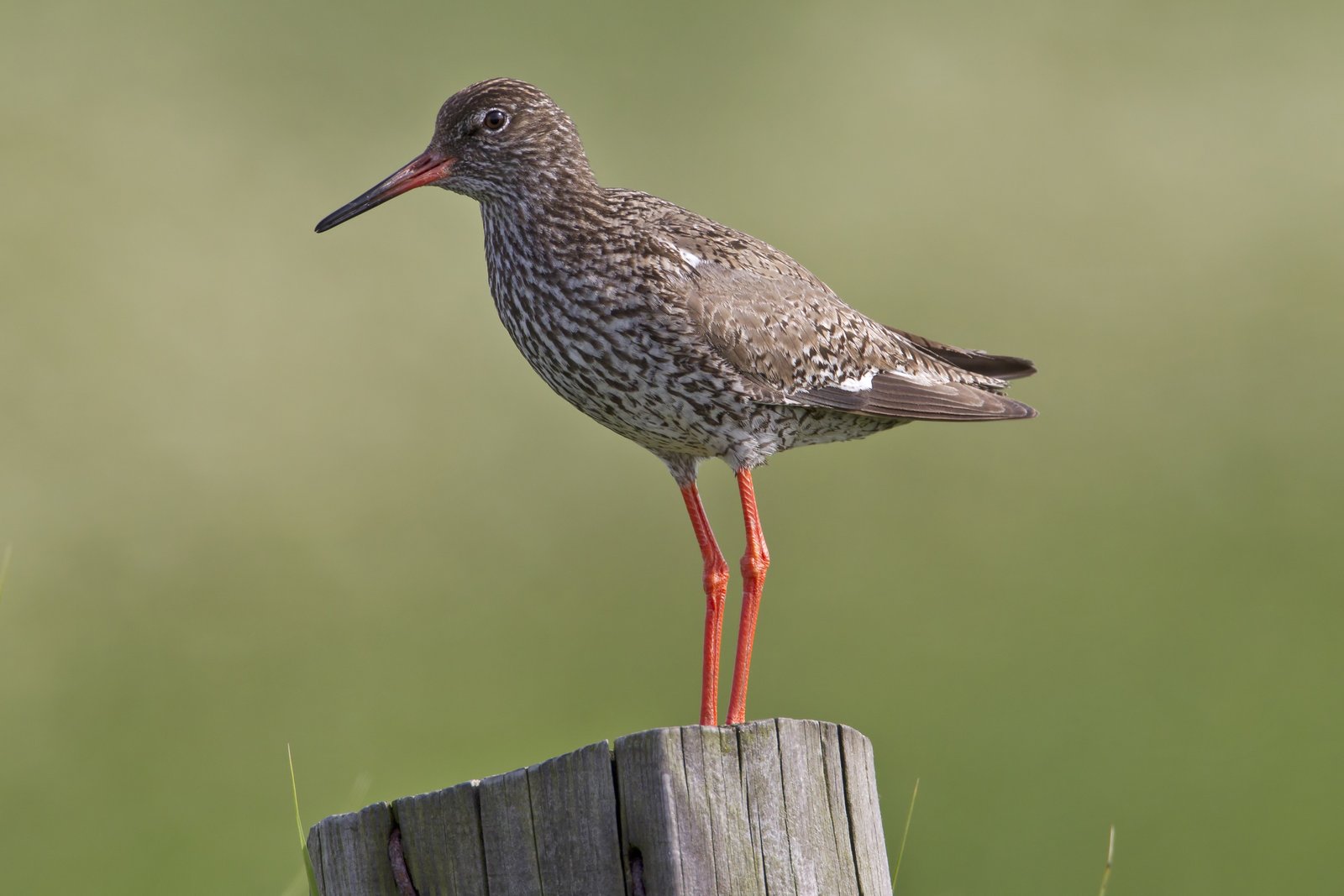
27–29 cm. A medium-sized, grey-brown sandpiper with bright orange-red legs and a straight, medium-long bill with a red base and dark tip. In non-breeding plumage plain grey-brown above, with a pale, faintly streaked breast and a white belly; a white eye-ring and a short pale line in front of the eye. In flight unmistakable: a broad white trailing edge to the wing, across the secondaries and inner primaries, and a white wedge up the back. In breeding plumage browner and more densely spotted. Juveniles have yellowish-orange legs and pale spotting on the upperparts.
Confusion species
Ruff Calidris pugnax often has orange legs too, but a shorter, slightly decurved bill, scaly plumage, no white trailing edge to the wing and oval white patches on either side of the rump. Common Greenshank Tringa nebularia is larger and paler, with greenish-grey legs and an upturned bill. Terek Sandpiper Xenus cinereus has a long upturned bill and shorter orange-yellow legs.
Habitat
Tidal mudflats, estuaries, lagoons, mangroves and salt works on the coast; occasionally on fresh and saline pans and sewage ponds inland. It forages walking over the mud, picking crustaceans, worms and molluscs.
Where the bird is most at home, classified by the vegetation units of southern Africa.

Range and movements
Scarce and scattered along the coast of Mozambique, KwaZulu-Natal and the Eastern Cape, with a few regular sites on the west coast such as Langebaan Lagoon and Walvis Bay; exceptional inland in South Africa, Botswana, Zimbabwe and Zambia. Beyond the region it breeds from Iceland and western Europe to eastern Asia and winters around the Mediterranean, in Africa south to Tanzania, and in southern and South-East Asia.
- Summer visitor (c. Oct–Mar)
- dark = core range, pale = thinly spread
How and when to look
Look for it on a rising tide among Common Greenshanks and Bar-Tailed Godwits in the estuaries of Mozambique and Zululand or at Langebaan Lagoon. The alarm call often announces it before it is seen; a flushed bird with a white trailing edge to the wing is a Common Redshank.
Conservation status
Not threatened; the world population is large, although breeding numbers in western Europe have fallen with the loss of wet meadows. In the region the species has always been scarce.
Scientific name
Tringa totanus | (Linnaeus, 1758)
Linnaeus described the species in 1758 as Scolopax Totanus; because it was later moved to another genus, the author and year stand in brackets. The genus Tringa was introduced in 1758 by Linnaeus. Tringa is the Neo-Latin name Aldrovandi gave to the green sandpiper, after Ancient Greek trungas, a thrush-sized, white-rumped, tail-bobbing wading bird mentioned by Aristotle. totanus comes from totano, an Italian folk name for this bird. The specimen the first description was based on came from Sweden.