All species › Waders, gulls and terns › Sandpipers and snipes › Wood Sandpiper
Wood Sandpiper | Tringa glareola
Bosruiter | Andarríos Bastardo
The Wood Sandpiper is the most numerous Palearctic freshwater wader in southern Africa. From September to April it is present at almost every muddy pan, vlei or flooded meadow, alone or in loose groups, and gives itself away on take-off with its high triple call.
Voice
On take-off a quick, high, clear chiff-chiff-chiff or giff-giff-giff, three or four even notes; highly characteristic and often the first sign of the species. When alarmed a hard chip.
Recording: Stanislas Wroza — CC BY-NC-SA 4.0 · converted to mono · xeno-canto
Identification
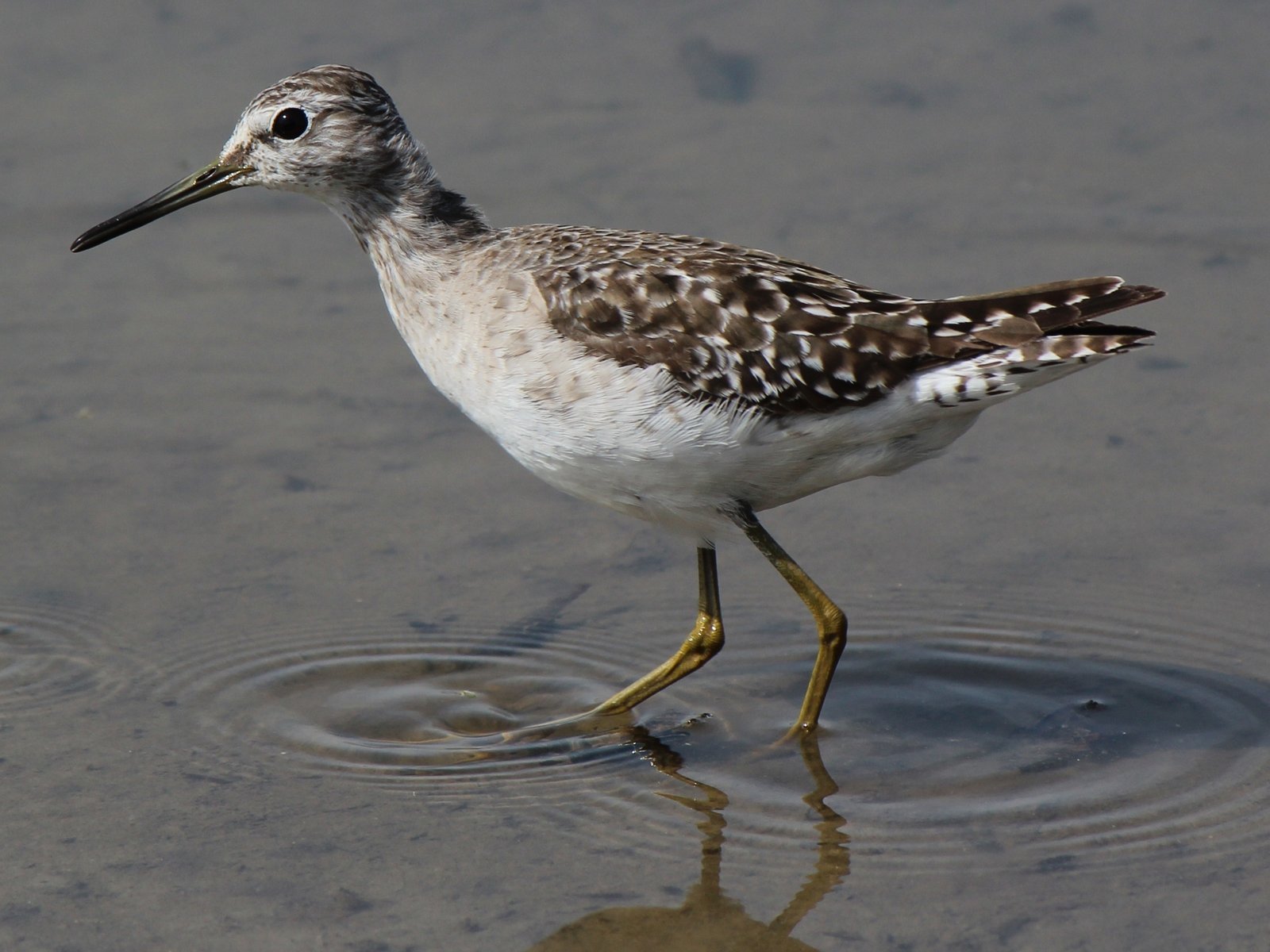
19–21 cm. A slender, medium-sized sandpiper with grey-brown upperparts densely spotted white and pale buff, a pale, finely streaked breast and a white belly. The long white supercilium extends well behind the eye and contrasts with a dark eye-stripe. The bill is straight, dark and medium-long; the legs are yellowish-green to dull yellow and project clearly beyond the tail in flight. In flight it shows a plain dark upperwing without a wing bar, a pale underwing, a small white rump and a finely barred tail. Juveniles are warmer brown with buff spotting.
Confusion species
Green Sandpiper Tringa ochropus is darker and more contrasting, with a short supercilium, greenish-grey legs, a blackish underwing and a larger, brighter white rump. Marsh Sandpiper Tringa stagnatilis is paler grey, with a needle-fine bill, longer legs and a white wedge up the back. Common Sandpiper Actitis hypoleucos has shorter, greyish-green legs, a white wing bar and a dark rump, and bobs constantly.
Habitat
Shallow fresh waters with muddy margins and low vegetation: vleis, marshes, pans, farm dams, flooded grassland, rice fields and sewage ponds. It largely avoids bare coasts and salt water. It walks calmly along the edge and among short vegetation, picking insects and larvae from the surface.
Where the bird is most at home, classified by the vegetation units of southern Africa.

Range and movements
Throughout the region, from the coast to the highveld: common to very common in Zambia, Malawi, Zimbabwe, Botswana (especially the Okavango Delta), Mozambique, Eswatini and the northern and eastern half of South Africa; also in Angola and northern Namibia, and scarcer in Lesotho and the arid Karoo and Namib. Beyond the region it breeds in boreal bogs from Scandinavia to eastern Siberia and winters in sub-Saharan Africa, southern Asia and Australia.
- Resident
- Summer visitor (c. Oct–Mar)
- Winter visitor (c. Apr–Sep)
- Passage (Mar–Apr, Oct–Nov)
- dark = core range, pale = thinly spread
How and when to look
In the rainy season walk along a vlei or flooded meadow and listen for the triple call of flushed birds. On the ground the species stands out by its dense white spotting and long supercilium; when in doubt, always compare the underwing colour with that of Green Sandpiper.
Conservation status
Not threatened; globally one of the most numerous sandpipers. Locally sensitive to the loss of shallow freshwater marshes, but widespread and common in the region.
Scientific name
Tringa glareola | Linnaeus, 1758
Linnaeus described the species in 1758 and placed it straight away in the genus where it still stands. He introduced the genus Tringa in that same work. Tringa is the Neo-Latin name Aldrovandi gave to the green sandpiper, after Ancient Greek trungas, a thrush-sized, white-rumped, tail-bobbing wading bird mentioned by Aristotle. glareola is Latin, a diminutive of glarea 'gravel', after the gravelly shores the bird frequents. The specimen the first description was based on came from Sweden.