All species › Waders, gulls and terns › Sandpipers and snipes › Green Sandpiper
Green Sandpiper | Tringa ochropus
Witgat | Andarríos Grande
The Green Sandpiper is a dark, solitary sandpiper that flushes with a ringing alarm call and a dazzling white rump. It winters mainly in Africa north of the region; in southern Africa it is a scarce visitor to small, sheltered waters, most frequent in Zambia, Malawi and Zimbabwe.
Voice
On take-off a clear, jubilant tlooo-eet-weet-weet, three-syllabled and rising, often repeated; one of the best features. When alarmed also a sharp twit-twit.
Recording: Stanislas Wroza — CC BY-NC-SA 4.0 · converted to mono · xeno-canto
Identification
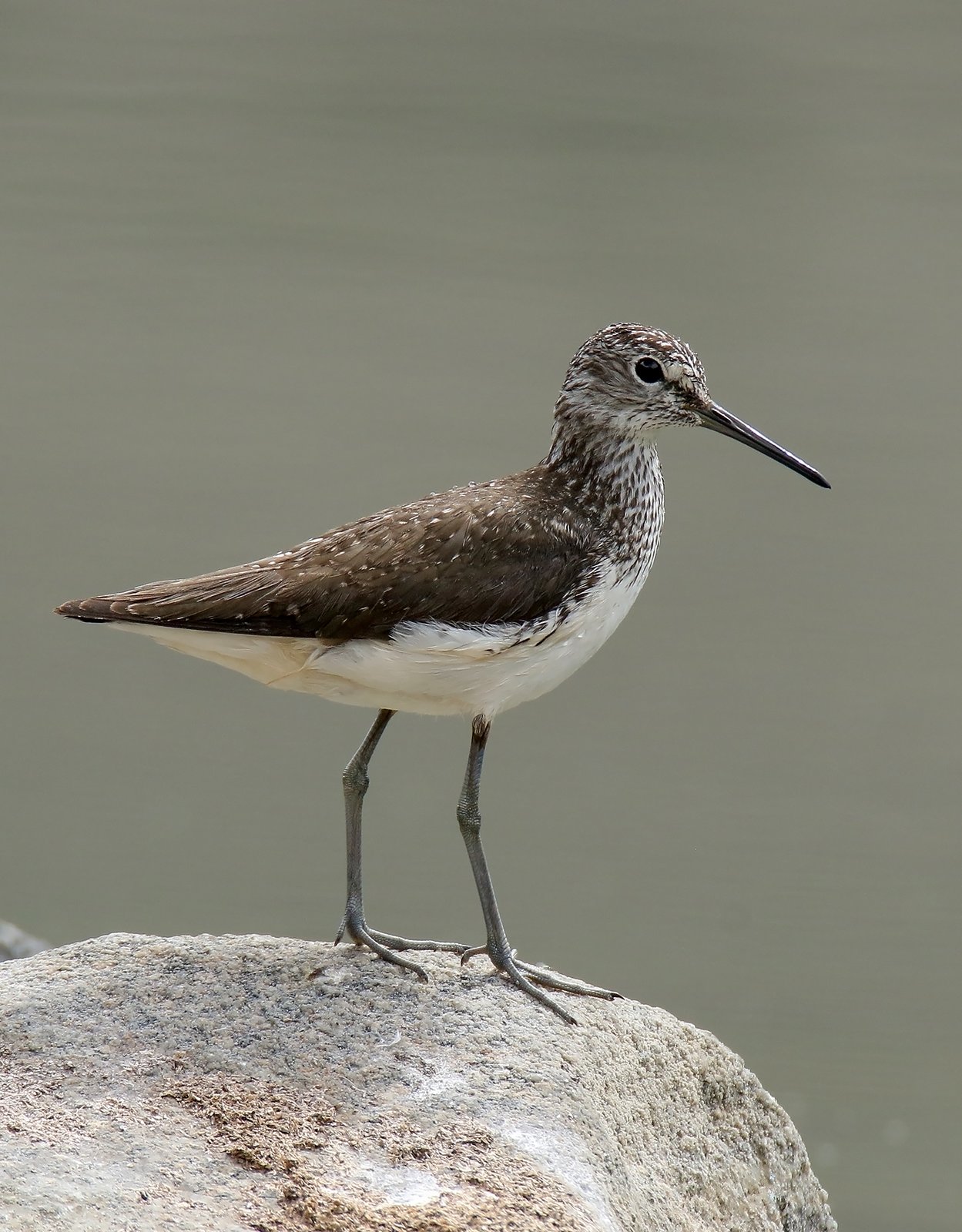
21–24 cm. Very dark olive-brown above with fine, faint pale speckling, white below with a dark, streaked breast sharply demarcated from the white belly. A short white supercilium in front of the eye and a white eye-ring. The bill is straight, dark and medium-long, the legs greenish grey. In flight it looks black and white: dark upperwing and underwing, a bright white rump and a white tail with a few broad black bars. It bobs its rear end, less markedly than Common Sandpiper.
Confusion species
Wood Sandpiper Tringa glareola is slimmer and paler brown with distinct white spotting, a long white supercilium extending behind the eye, yellowish-green legs and a pale underwing. Common Sandpiper Actitis hypoleucos is browner, with a white wedge in front of the wing, a white wing bar and a dark rump, and flies low over the water on flickering wingbeats.
Habitat
Small, sheltered fresh waters with muddy margins: streams, drinking pools, ditches, flooded furrows, forest pools and sewage ponds, often among trees or bushes. It avoids large open waters and the coast. It feeds alone or in pairs along the water's edge.
Where the bird is most at home, classified by the vegetation units of southern Africa.

Range and movements
Scarce but regular in Zambia, Malawi, northern Mozambique, Zimbabwe, northern Botswana and Angola; rare farther south in Limpopo, Mpumalanga and KwaZulu-Natal, and a vagrant in Namibia and the Cape. Beyond the region it breeds in the boreal forests from Scandinavia to Siberia and winters from Europe and southern Asia to sub-Saharan Africa, chiefly in East and West Africa.
- Summer visitor (c. Oct–Mar)
- Passage (Mar–Apr, Oct–Nov)
- dark = core range, pale = thinly spread
How and when to look
Walk slowly along sheltered pools and streams in the north of the region; the bird usually flushes unexpectedly close, calling and flashing its white rump, then zigzags away high. With any dark sandpiper always check the underwing: almost black in Green Sandpiper, pale in Wood Sandpiper.
Conservation status
Not threatened; the world population is large and stable. In the region the species is naturally scarce, which makes trends hard to follow.
Scientific name
Tringa ochropus | Linnaeus, 1758
Linnaeus described the species in 1758 and placed it straight away in the genus where it still stands. He introduced the genus Tringa in that same work. Tringa is the Neo-Latin name Aldrovandi gave to the green sandpiper, after Ancient Greek trungas, a thrush-sized, white-rumped, tail-bobbing wading bird mentioned by Aristotle. ochropus is Greek, from ōkhros 'ochre' and pous 'foot', hence 'ochre-foot'. The specimen the first description was based on came from Sweden.