All species › Passerines › Larks › Karoo Long-Billed Lark
Karoo Long-Billed Lark | Certhilauda subcoronata
Karoolangsnavelleeuwerik | Alondra Piquilarga
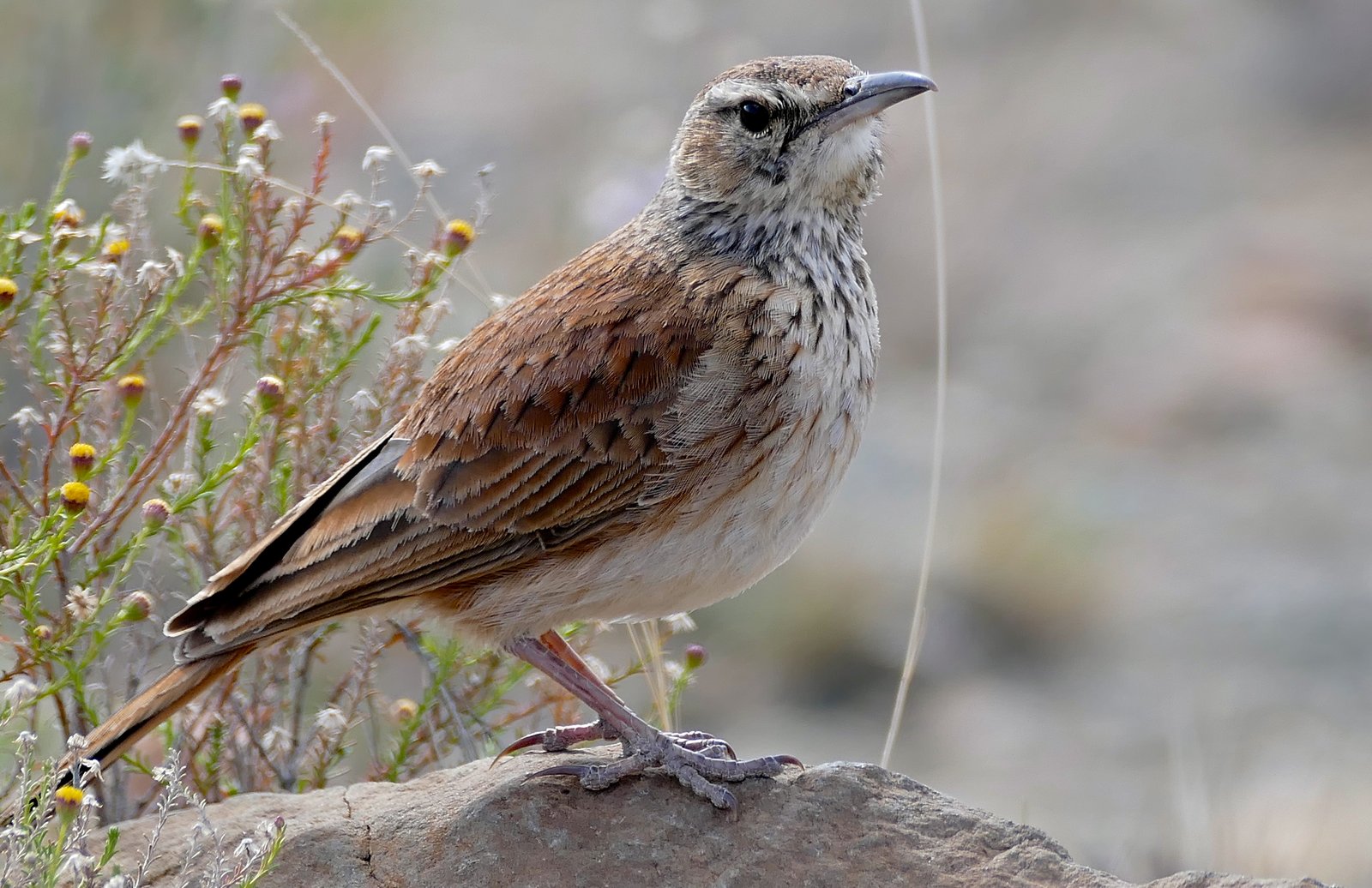
The Karoo Long-Billed Lark is a large, long-tailed lark with a long, decurved bill, keeping watch from a stone or shrub on rocky Karoo slopes. Its display flight, ending in a long descending whistle, is one of the characteristic sounds of the Karoo. It is one of five closely related long-billed larks whose ranges largely exclude one another.
Voice
In display the male climbs steeply, sometimes after a run-up from a boulder, then drops with closed wings while giving a long, descending whistle, seeeeeeooo, sometimes in two parts. It also sings from a rock or shrub. The call is a short tcheep.
Recording: Lynette Rudman — CC BY-NC-SA 4.0 · shortened to the first 60 s, mono · xeno-canto
Identification
18–22 cm; the male is clearly larger and longer-billed than the female. The bill is long and decurved. The head shows a pale supercilium, a dark eye-stripe and a dark malar stripe beside the white throat. Upperparts are dark-streaked on a ground colour that varies by region, from dark rufous-brown in Namaqualand and the western Karoo to paler grey-brown and buff in the east and in Namibia. The breast is buff with bold dark streaking, the belly paler. The tail is long and dark with pale outer edges. In flight the long bill and tail and the broad wings stand out.
Confusion species
Cape Long-Billed Lark Certhilauda curvirostris of the west coast is larger, greyer and more heavily streaked, living on sandy coastal plains and farmland; Eastern Long-Billed Lark Certhilauda semitorquata of the eastern highveld has a shorter bill and unstreaked rufous underparts. Agulhas Long-Billed Lark Certhilauda brevirostris (Overberg) and Benguela Long-Billed Lark Certhilauda benguelensis (north-western Namibia and Angola) replace it in adjoining areas. The long-billed larks are best separated by range and habitat. Spike-Heeled Lark Chersomanes albofasciata is much smaller, with a very short, white-tipped tail.
Habitat
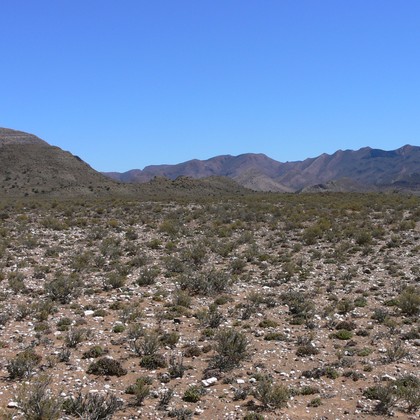
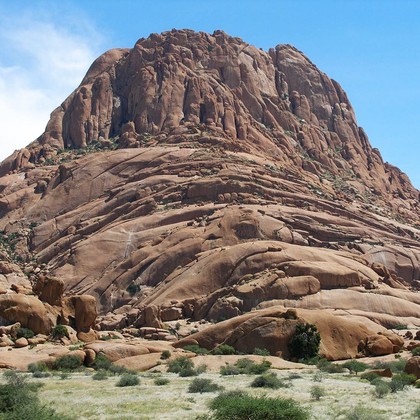
Rocky and stony slopes and plains with low Karoo scrub in the Nama and Succulent Karoo, also on gravel plains and in dry grassland on the Karoo margins. It feeds on the ground, digging with its long bill for larvae, termites and other insects, and also eats seeds.
Where the bird is most at home, classified by the vegetation units of southern Africa.

Range and movements
Endemic to southern Africa: in South Africa in the Karoo of the Northern, Western and Eastern Cape, in Namaqualand and Bushmanland and in the south-western Free State; in Namibia from the south to the centre of the country, north to about the Khomas Highland. In north-western Namibia and Angola it is replaced by Benguela Long-Billed Lark, on the west coast by Cape Long-Billed Lark.
- Resident
- Summer visitor (c. Oct–Mar)
- Winter visitor (c. Apr–Sep)
- Passage (Mar–Apr, Oct–Nov)
- dark = core range, pale = thinly spread
How and when to look
Year-round; best early in the morning on rocky slopes in, for example, Karoo National Park, Tankwa Karoo National Park or around Springbok. Listen for the long descending whistle of the display flight, then find the bird on a boulder. Let locality guide identification: within its range a long-billed lark is hard to place as anything else.
Conservation status
Not threatened; fairly common in suitable Karoo terrain. No large-scale threats are known, although heavy overgrazing can degrade the scrub locally.
Scientific name
Certhilauda subcoronata | Smith, 1843
Smith described the species in 1843 and placed it straight away in the genus where it still stands. The genus Certhilauda was introduced in 1827 by Swainson. Certhilauda combines Certhia, 'treecreeper', with Alauda, 'lark' — a lark with a long, decurved bill like a treecreeper's. subcoronata is Latin for 'slightly crowned', from sub, 'somewhat', and coronatus, 'crowned' — for the slightly darker crown. The specimen the first description was based on came from Arid districts of the Cape Colony (unspecified).