All species › Passerines › Chats and flycatchers › Mountain Chat
Mountain Chat | Myrmecocichla monticola
Bergtapuit | Zorzal Hormiguero Montano
The Mountain Chat is the bold black-and-white or grey chat of rocky slopes, koppies and farmyards in the west and interior of southern Africa. It allows close approach, perches on boulders, walls and roofs, and in flight is striking for its white rump and white tail sides. Males occur in strikingly different plumage forms.

Click a thumbnail to switch the photo above.
Voice
A powerful, clear song of whistled and chattering phrases, chee-choo-chiwee-choo, often mixed with imitations of other birds, delivered from a rock pinnacle or roof, also at dusk. The call is a dry chak and a whistled fee-oo.
Recording: Faansie Peacock — CC BY-NC-SA 4.0 · converted to mono · xeno-canto
Identification
A large chat of 17 to 20 cm. The male is variable: most are black with a white or pale grey crown, a white shoulder patch, white rump and undertail coverts, and white outer tail feathers with black central feathers; there are also grey males with a black face and black wings, and intermediates. The crown ranges from pure white to dark grey. The female is plain dark greyish-brown, without a shoulder patch but with the same white rump and tail sides. Juveniles resemble the female. Bill and legs are black. It perches upright, raises the tail slowly and often fans it briefly.
Confusion species
Female Southern Anteater-Chat (Myrmecocichla formicivora) is also dark brown, but lacks the white rump and tail sides and shows white primary windows only in flight. Mocking Cliff Chat (Thamnolaea cinnamomeiventris) has a rufous belly and rump. Boulder Chat (Pinarornis plumosus) of Zimbabwe and Botswana is larger, brownish-black, with white spots on the wing and tail tips but no white rump. Karoo Chat (Emarginata schlegelii) is much paler grey with a white rump and tail sides; confusion arises only with females at long range, and the female Mountain Chat is always much darker.
Habitat
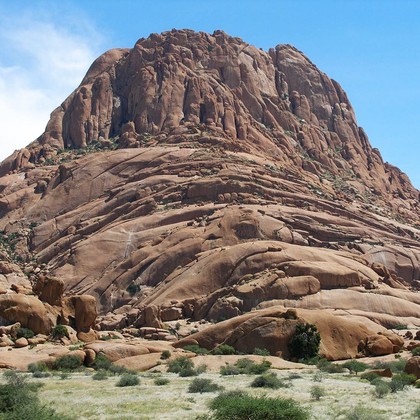
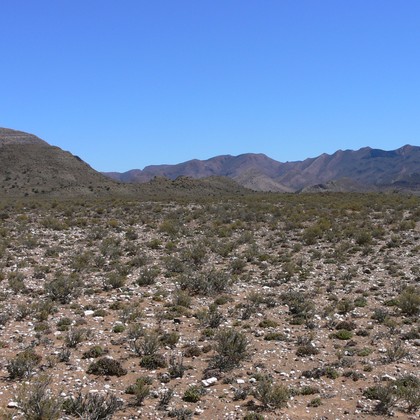
Rocky slopes, koppies, gorges and ravines in dry country, from the Karoo and the Namaqualand mountains to the edges of the Highveld, and high into the mountains. It is well used to human settlement and readily perches on farmyards, sheds and kraal walls. Forages on the ground for insects and sometimes takes small fruit. Nests in a rock crevice, under a stone or in a building.
Where the bird is most at home, classified by the vegetation units of southern Africa.
Range and movements
Endemic to southern Africa. Widespread in the western half of South Africa, from the Western and Northern Cape through the Karoo to the Eastern Cape, the Free State, the Highveld and the rocky ridges of Gauteng and North West, and also in Lesotho and in western and central Namibia, north to south-western Angola. Largely absent from the eastern lowlands and from Botswana. It occurs nowhere outside this region.
- Resident
- Winter visitor (c. Apr–Sep)
- Passage (Mar–Apr, Oct–Nov)
- dark = core range, pale = thinly spread
How and when to look
Stop at any farm or rest area in the Karoo or Namaqualand and check walls and roofs: the bird often comes to you. Where several males are present, note crown colour and the grey or black forms. The song is best heard early in the morning in spring, from August to November.
Conservation status
Not threatened. The species is common and numbers are stable; its tolerance of farmyards and buildings has even helped it locally. No significant threats are known.
Scientific name
Myrmecocichla monticola | (Vieillot, 1818)
Vieillot described the species in 1818 as Oenanthe monticola; because it was later moved to another genus, the author and year stand in brackets. The genus Myrmecocichla was introduced in 1851 by Cabanis. Myrmecocichla comes from the Greek myrmex, 'ant', and kichle, 'thrush' — an 'ant-thrush', for foraging on ants and termites. monticola is Latin for 'mountain-dweller', from mons, 'mountain', and -cola, 'dweller' — for its rocky, mountainous habitat. The specimen the first description was based on came from Namaqualand, southern Africa.