All species › Passerines › Chats and flycatchers › Congo Moor Chat
Congo Moor Chat | Myrmecocichla tholloni
Congomiertapuit | Zorzal Hormiguero del Congo
The Congo Moor Chat is a little-known brown chat of the sandy grasslands of the Congo Basin, which reaches the region only in northern Angola. It perches upright on tussocks, low bushes and termite mounds, and in flight shows a white rump and white in the wing.

Voice
Poorly documented. Reports mention a short, clear song of whistled and chattering notes, given from a raised perch or in a brief song flight, and a dry chak call.
Recording: Rob Gordijn — CC BY-NC-SA 4.0 · converted to mono · xeno-canto
Identification
About 18 cm, a fairly large, upright chat. The plumage is mainly grey-brown to earth-brown, slightly paler and greyer below, with darker brown wings and a blackish tail. The rump and uppertail coverts are bright white and the primaries have white bases, so that a white rump and a pale wing patch show in flight. The face is slightly paler than the crown. The sexes are alike or nearly so; juveniles are faintly spotted. It flicks its tail and jerks its wings, often from a raised perch in open country.
Confusion species
Sooty Chat (Myrmecocichla nigra) shares the same grassland: the male is glossy black with a white shoulder patch, the female dark chocolate-brown without a white rump. Female African Stonechat (Saxicola torquatus) is much smaller, streaked above and has an orange-brown breast. Northern Wheatear (Oenanthe oenanthe) and Capped Wheatear (Oenanthe pileata) also have a white rump, but show a black-and-white tail pattern and a pale supercilium.
Habitat
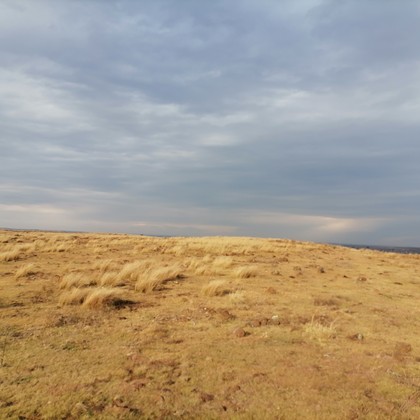
Open, dry sandy grassland with scattered bushes and termite mounds, and seasonally wet or flooded grassland on the plateaus. It forages on the ground for insects. Little is known of its breeding biology; as in related species the nest is probably placed in a cavity in the ground or in a termite mound.
Where the bird is most at home, classified by the vegetation units of southern Africa.

Range and movements
Within the region known only from Angola, from the grasslands of the north and north-east; there are few recent records and its exact distribution is poorly known. Beyond the region in the grasslands of Gabon, Congo-Brazzaville, south-western Democratic Republic of the Congo and south-western Central African Republic.
How and when to look
A species for the seasoned Angola traveller: search open sandy grassland in the north of the country for a brown chat with a white rump on a tussock or termite mound. Every well-documented record with a photograph is valuable, as its distribution in Angola is still poorly known.
Conservation status
Not threatened according to the 2018 assessment. Its habitat is extensive and of little interest for intensive agriculture, although expanding cultivation and overly frequent fires may have local effects. Within the region its status is unclear for lack of data.
Scientific name
Myrmecocichla tholloni | (Oustalet, J-FÉ, 1886)
Oustalet, J-FÉ described the species in 1886 as Saxicola Tholloni; because it was later moved to another genus, the author and year stand in brackets. The genus Myrmecocichla was introduced in 1851 by Cabanis. Myrmecocichla comes from the Greek myrmex, 'ant', and kichle, 'thrush' — an 'ant-thrush', for foraging on ants and termites. tholloni honours the French naturalist and artist François-Romain Thollon (1855–1896), who collected in French Congo. The specimen the first description was based on came from Leketi on the Alima River, Republic of the Congo.