All species › Passerines › Chats and flycatchers › Southern Anteater-Chat
Southern Anteater-Chat | Myrmecocichla formicivora
Kaapse miertapuit | Zorzal Hormiguero Meridional
The Southern Anteater-Chat is the dark, upright chat of open grassland and karoo, almost always perched on a termite mound, fence post or stone. Only when it flies do the white patches in the primaries show. It breeds in tunnels it digs itself in sandy banks, and in disused aardvark burrows.

Voice
A clear, short piping pee-pee-pee and a harsh tzerr in alarm. The song is a hurried mix of whistles, chattering notes and mimicry, often given in a short song flight over the territory. Take-off is accompanied by a dry rattle of the wings.
Recording: Tony Archer — CC BY-NC-SA 4.0 · shortened to the first 60 s, mono · xeno-canto
Identification
A stocky chat of 17 to 18 cm. The male is sooty black with a white shoulder patch and conspicuous white primary bases that flash like two windows in flight. The female is duller brownish-black, with the same wing windows but no shoulder patch. Bill and legs are black. Flight is low and undulating, and the wings produce a rattling sound on take-off. When perched it bobs its tail and flicks its wings.
Confusion species
Sooty Chat (Myrmecocichla nigra) of Angola, Zambia and Malawi lacks the white primary windows; the glossy black male shows only a white shoulder patch and the female is plain brown. Arnot's Chat has a white crown. Southern Black Flycatcher (Melaenornis pammelaina) is slimmer, glossy black and never shows white in the wing, and it sallies from a perch after flying insects.
Habitat
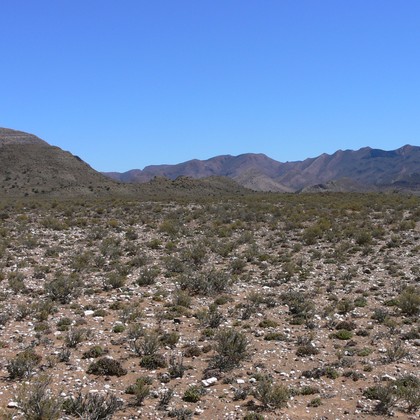
Open grassland, karoo scrub plains, short-grazed pasture and field margins with termite mounds, sandy gully walls and erosion donga banks. Forages on the ground for ants, termites and beetles. Nests in a self-dug tunnel half a metre to over a metre deep in a steep sandy bank or in an aardvark burrow.
Where the bird is most at home, classified by the vegetation units of southern Africa.

Range and movements
Endemic to southern Africa. The core lies in the interior of South Africa: the Highveld, Free State, Northern Cape and Karoo, and on into Lesotho, Eswatini, eastern and central Botswana, central Namibia and the extreme south-west of Zimbabwe. The species occurs nowhere outside this region.
- Resident
- Winter visitor (c. Apr–Sep)
- Passage (Mar–Apr, Oct–Nov)
- dark = core range, pale = thinly spread
How and when to look
Drive slowly along grassland roads and watch for dark birds on fence posts and termite mounds. The white wing windows show only in flight, so wait until the bird moves from post to post. In the breeding season from September to December the nest tunnels in road cuttings and erosion gullies are easy to locate by the birds flying in and out.
Conservation status
Not threatened. The species is numerous and numbers are stable; grazing and an open landscape work in its favour. It disappears locally where grassland is converted to intensive cropping or dense plantation, and levelling of banks and gullies removes its nest sites.
Scientific name
Myrmecocichla formicivora | (Wilkes, 1817)
Wilkes described the species in 1817 as Motacilla formicivora; because it was later moved to another genus, the author and year stand in brackets. The genus Myrmecocichla was introduced in 1851 by Cabanis. Myrmecocichla comes from the Greek myrmex, 'ant', and kichle, 'thrush' — an 'ant-thrush', for foraging on ants and termites. formicivora comes from the Latin formica, 'ant', and vorare, 'to devour' — 'ant-eating', for the main diet. The specimen the first description was based on came from the Sundays River, Eastern Cape.