All species › Passerines › Chats and flycatchers › Sooty Chat
Sooty Chat | Myrmecocichla nigra
Zwarte miertapuit | Zorzal Hormiguero Negro
The Sooty Chat is the glossy black chat of short grassland, dambos and burnt plains in the north of the region. It perches upright on termite mounds, posts and bush tops, and the male shows a bright white shoulder patch in flight.

Click a thumbnail to switch the photo above.
Voice
A short, clear song of whistled and chirping notes, often in a brief song flight or from a termite mound. The call is a soft fweet and a sharp chik; when disturbed a rattling chrrr.
Recording: James Bradley — CC BY-NC-SA 4.0 · shortened to the first 60 s, mono · xeno-canto
Identification
17–18 cm, a stocky, upright chat. The male is wholly glossy blue-black with a white patch on the lesser wing coverts, sometimes almost hidden when perched but conspicuous in flight; there is no white in the primaries. The female is plain dark chocolate-brown without the shoulder patch, with slightly paler fringes to the wing feathers. Bill and legs are black. Juveniles resemble the female. It perches prominently on raised points, flicks its tail and jerks its wings, and flies low and undulating to the next perch.
Confusion species
Southern Anteater-Chat (Myrmecocichla formicivora), further south and in drier terrain, is sooty brown with bright white primary windows in both sexes. Arnot's Chat (Myrmecocichla arnotti) of miombo and mopane has white in the wing and a white crown in the male or white throat in the female, and perches in trees. Congo Moor Chat (Myrmecocichla tholloni) is brown with a white rump. Southern Black Flycatcher (Melaenornis pammelaina) is slimmer, has no white and perches in trees.
Habitat
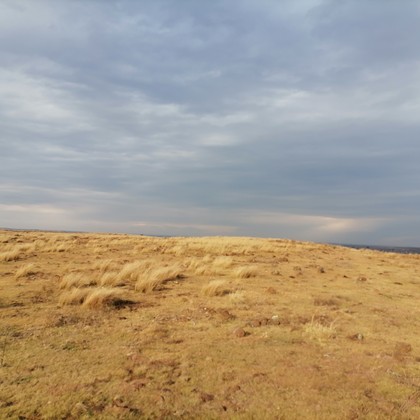
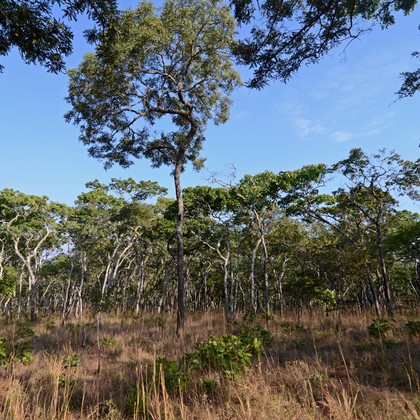
Open short grassland, dambos and floodplain edges, freshly burnt plains, pasture and farmland with termite mounds, often at the transition to miombo. It forages on the ground for ants, termites and other insects. The nest is placed in a self-dug or existing cavity in a termite mound, a bank or an erosion gully.
Where the bird is most at home, classified by the vegetation units of southern Africa.

Range and movements
In the region only in the north: much of Angola, especially the north, the central plateau and the east, widespread in Zambia (mainly in the north and west) and scarce in northern Malawi. Beyond the region from Nigeria and Cameroon east to South Sudan, Uganda, western Kenya and Tanzania.
- Resident
- dark = core range, pale = thinly spread
How and when to look
In Zambia look for it along roads through dambos and open grassland, such as in the Kasanka and Bangweulu area and on the Liuwa plains, and in Angola on the plateau around Huambo and Malanje. After a grass fire birds gather in numbers to feed on the blackened plains. The male is most obvious as it takes off and shows the white shoulder patch.
Conservation status
Not threatened. The species is locally common and benefits from open, grazed and regularly burnt grassland. Conversion of dambos to intensive cropping can cost habitat locally.
Scientific name
Myrmecocichla nigra | (Vieillot, 1818)
Vieillot described the species in 1818 as Oenanthe nigra; because it was later moved to another genus, the author and year stand in brackets. The genus Myrmecocichla was introduced in 1851 by Cabanis. Myrmecocichla comes from the Greek myrmex, 'ant', and kichle, 'thrush' — an 'ant-thrush', for foraging on ants and termites. nigra is Latin for 'black' — for the male's almost entirely black plumage. The specimen the first description was based on came from Malembo, Cabinda (Angola).